
Modi’s Three-Nation Tour: A Blueprint for India’s Global South Leadership
Prime Minister Narendra Modi’s three-nation tour to Jordan, Ethiopia, and Oman was a strategic move to solidify India’s leadership in the Global South by advancing concrete economic partnerships, such as a key trade deal with Oman, and strengthening diplomatic coalitions, notably with Ethiopia as a gateway to Africa and a fellow BRICS member. The visits also underscored India’s delicate diplomatic balancing act, as it reaffirmed support for Palestinian statehood in Amman while maintaining its crucial strategic partnership with Israel, a maneuver aimed at preserving credibility across divided regions.
However, the tour highlighted unresolved challenges, including the imperiled India-Middle East-Europe Economic Corridor due to regional tensions and the impending test of reconciling these positions during Israeli Prime Minister Netanyahu’s expected visit, ultimately framing the mission as an effort to translate India’s vision for a multipolar global order into substantive, albeit complex, alliances.
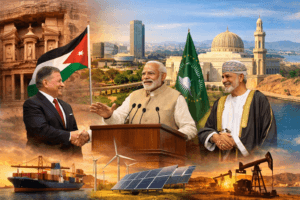
Modi’s Three-Nation Tour: A Blueprint for India’s Global South Leadership
In mid-December 2025, Indian Prime Minister Narendra Modi’s tour of Jordan, Ethiopia, and Oman was more than a set of diplomatic meetings; it was a strategic mission to cement India’s role as a principal architect of a new global order. The carefully chosen destinations—spanning West Asia and Africa—represent the core of the “Global South,” a constituency India actively seeks to lead. This series of engagements reveals a sophisticated, multi-pronged foreign policy: forging concrete economic partnerships, assuming the mantle of a developmental guide for emerging economies, and performing a delicate diplomatic ballet on the world’s most contentious stages. The tour underscores India’s ambition to move beyond symbolic leadership and build the substantive alliances necessary to reshape international politics and economics.
The Strategic Stops: A Snapshot of Outcomes
The following table summarizes the core diplomatic and economic achievements from each leg of Prime Minister Modi’s three-nation tour.
| Country | Key Diplomatic & Economic Outcomes | Strategic Significance |
| Jordan | – Visit marked 75 years of diplomatic relations. – Five MoUs signed in renewable energy, water management, and digital infrastructure. – Trade target set to increase bilateral trade to $5 billion in five years. – Proposed linking Jordan’s payment system with India’s Unified Payments Interface (UPI). | – Critical partner in West Asian stability and the Gaza peace process. – A key node for the proposed India-Middle East-Europe Economic Corridor (IMEC). |
| Ethiopia | – PM Modi’s first visit to the country. – Launch of a “strategic partnership” focused on trade, knowledge, and technology exchange. – PM addressed a Joint Session of the Ethiopian Parliament. | – Gateway to Africa: Ethiopia hosts the African Union (AU) headquarters. – A fellow BRICS member, vital for coordinating agendas as India prepares for the 2026 BRICS presidency. |
| Oman | – Visit marked 70 years of diplomatic relations. – Comprehensive Economic Partnership Agreement (CEPA) finalized, with trade already at $10.5 billion. – Oman is India’s third-largest export destination in the Gulf. | – Anchor for maritime security and energy ties in the Arabian Sea. – Expected to smooth the path for a broader India-Gulf Cooperation Council (GCC) free trade agreement. |
Beyond Bilateralism: The Pillars of a Grand Strategy
- The Economic Engine: From Transactions to Transformative Partnerships
Gone are the days of loose cooperation. India’s engagement is now laser-focused on creating structured, institutionalized economic interdependence. The Comprehensive Economic Partnership Agreement (CEPA) with Oman is a prime example. It aims to significantly deepen a trade relationship where key Indian exports include minerals, chemicals, and machinery, while imports are dominated by petroleum and urea. This agreement is not an isolated deal but a potential template and catalyst for a broader free trade pact with the entire Gulf Cooperation Council, a region of immense strategic and economic importance.
Similarly, with Jordan, the ambition is quantified: a clear goal to boost bilateral trade to $5 billion. The collaboration extends beyond simple exchange to joint ventures in strategic sectors. The Jordan India Fertiliser Company (JIFCO), a major source of phosphoric acid for Indian agriculture, exemplifies this deeper integration. By proposing to integrate India’s UPI digital payment system with Jordan’s financial infrastructure, New Delhi is exporting its most successful digital governance innovations, creating lasting technological linkages.
- Leading the Global South: The BRICS and Africa Corridor
The choice of Ethiopia was profoundly symbolic. Addis Ababa is not just a national capital; it is the diplomatic capital of Africa, housing the African Union (AU) headquarters. By addressing the Ethiopian Parliament and launching a strategic partnership there, India was speaking directly to the entire continent, positioning itself as a reliable partner in “South-South cooperation.”
This move is inextricably linked to India’s upcoming presidency of BRICS in 2026. Ethiopia, a new member of the expanded BRICS grouping, becomes a crucial ally in shaping the bloc’s agenda. India’s vision for BRICS, as previewed in recent conferences, emphasizes multilateral reform, equitable economic development, and serving as a counterweight to traditional Western-dominated institutions. Strengthening ties with Ethiopia, and by extension Africa, provides India with greater heft and legitimacy as it prepares to steer this influential coalition. This alignment is further evidenced by events like the planned BRICS+ Universities Summit in New Delhi in March 2026, which aims to build “knowledge corridors” among member nations.
- The Diplomatic Tightrope: Navigating the Israel-Palestine Divide
Perhaps the most delicate aspect of the tour was India’s navigation of the Israel-Palestine conflict, a task that requires balancing deeply held principles with hard-nosed strategic interests. In Jordan, a key player in the Gaza peace process, Modi reaffirmed India’s traditional support for a “sovereign and independent Palestinian state”. This message was aimed at reassuring Arab partners and the wider Global South of India’s principled stance.
However, this rhetoric exists alongside a robust and growing strategic partnership with Israel, encompassing defense, technology, and counter-terrorism. The complexity was on full display: while Modi was in Jordan, India’s External Affairs Minister was concurrently meeting Israeli leadership. This calculated simultaneity is the essence of India’s balancing act. It allows New Delhi to maintain credibility with Arab nations—which is vital for energy security, the IMEC corridor, and its UNSC ambitions—without sacrificing a relationship with Israel that provides critical military technology and aligns with certain domestic political narratives.
This balancing act is not new but is under unprecedented strain. Critics argue that India’s traditional “neutrality” has tilted, with its condemnations of violence becoming increasingly generic and rarely naming Israel explicitly, even as it continues defense trade. The ultimate test of this strategy will come when Israeli Prime Minister Benjamin Netanyahu visits India, forcing a clarification of how New Delhi reconciles its words in Amman with its actions in Tel Aviv.
The Road Ahead: Challenges and the Unfinished Agenda
Prime Minister Modi’s tour successfully laid the groundwork for India’s envisioned global role, but significant challenges remain.
- The Corridor at a Crossroads: The India-Middle East-Europe Economic Corridor (IMEC), a flagship initiative announced in 2023, was conspicuously absent from the Jordanian joint statements. The ongoing Gaza war and regional tensions have “imperilled” this ambitious project, which is meant to traverse through Jordan. Its future depends on a stable regional order that currently seems elusive.
- The Consistency Test: The upcoming visit of Israeli PM Netanyahu will pressure India to demonstrate the consistency of its foreign policy. Can it advocate forcefully for Palestinian statehood to a key Israeli ally without damaging a vital strategic partnership? The outcome will reveal much about the limits and possibilities of India’s “multi-alignment” doctrine.
- From Summitry to Substance: The announcement of a long-delayed Africa-India summit is a positive step. However, its success will depend on moving beyond grand declarations to deliver tangible, mutually beneficial projects in trade, climate resilience, and digital infrastructure that meet Africa’s own developmental aspirations.
In conclusion, Modi‘s three-nation tour was a masterclass in layered diplomacy. It wove together immediate economic gains, long-term coalition-building for a multipolar world, and a precarious but necessary balancing of regional rivalries. India is no longer just a vocal advocate for the Global South but is actively constructing the bilateral and multilateral frameworks to lead it. The tour proved that Indian diplomacy is thinking beyond the optics of bonhomie, working to translate a shared vision of the global order into a web of tangible partnerships. The enduring challenge will be to maintain this complex equilibrium as the world’s geopolitical fault lines continue to shift and shake.
You must be logged in to post a comment.