
Medvedev Ends Alcaraz’s Perfect Start to Set Up Blockbuster Indian Wells Final Against Sinner
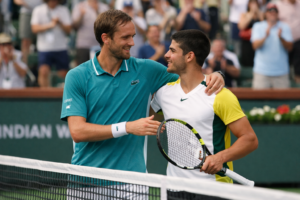
Medvedev Ends Alcaraz’s Perfect Start to Set Up Blockbuster Indian Wells Final Against Sinner
In a electrifying semifinal clash that had the tennis world on edge, the Russian veteran produced a masterclass to dethrone the world number one, while Jannik Sinner dispatched Alexander Zverev with chilling efficiency to book his place in Sunday’s title match.
INDIAN WELLS, Calif. — The confetti hadn’t even settled from Carlos Alcaraz’s Australian Open triumph in January when whispers began circulating through the tennis landscape: Could anyone stop this man in 2026? The Spaniard had arrived in the California desert with a pristine 16-0 record, collecting titles in Melbourne and Rotterdam while looking every bit the unstoppable force the sport had anticipated when he first burst onto the scene as a teenager.
Standing in his path to a 17th consecutive victory was Daniil Medvedev, a man who has made a career out of solving puzzles that leave others baffled.
What transpired inside Stadium 1 on Saturday evening wasn’t merely an upset. It was a declaration—from both Medvedev and the tennis gods who remind us that coronation ceremonies often require a few more rehearsals before the crown sits comfortably.
“It’s an amazing feeling to beat someone like Carlos—the number one in the world,” Medvedev said afterward, his voice carrying the quiet satisfaction of a craftsman who had just completed his most intricate work. “In a way, when you play him or Jannik or Novak it doesn’t matter the ranking. It’s just a great feeling to play them, and to beat them, of course, is even better.”
The final scoreline—6-3, 7-6 (7-3)—barely hints at the chess match that unfolded under the desert sunset. This was Medvedev at his computational best, the human supercomputer who arrived in Indian Wells with his own quiet momentum after claiming the Dubai Tennis Championship title last month, extending his winning streak to nine matches.
The Opening Gambit
From the opening game, something felt different. Medvedev, typically content to engage in extended rallies from several meters behind the baseline, crept forward. His returns, often criticized for their defensive nature, found unprecedented depth. Alcaraz, accustomed to dictating terms from the first ball, found himself pinned against the back fence, reaching for balls that seemed to have private conversations with the lines.
The first set lasted 35 minutes. It felt like an eternity for Alcaraz, who managed just three games—the fewest he’s dropped in any completed set this year. Medvedev converted both break-point opportunities he generated, a statistical anomaly against a returner of Alcaraz’s caliber.
“I just have to give credit to Daniil,” Alcaraz admitted in his post-match press conference, the disappointment evident but the respect genuine. “I think he just played an amazing match. Since the start of the match until the end of the match, he was playing unreal, I got to say. I have never seen, to be honest, playing Daniil like this.”
The compliment carries weight coming from a player who has studied Medvedev’s game since his junior days. What Alcaraz witnessed was something beyond the typical Medvedev experience—a version of the Russian who had apparently decided that his conventional toolkit, impressive as it is, required expansion.
Tactical Masterclass
The numbers tell a fascinating story. Medvedev won 78% of his first-serve points, a figure consistent with his career norms. But it was the second-serve statistics that raised eyebrows—56% win rate against a player widely considered the best returner in men’s tennis. More tellingly, Medvedev committed just 12 unforced errors in the entire match, a figure that borders on the supernatural against an opponent who forces opponents into uncomfortable positions with nearly every shot.
“When you play someone like Carlos, you have to accept that some points will look ugly,” Medvedev explained. “The key is making sure you’re the one controlling when those ugly points happen. I wanted to take time away from him, not give him the same ball twice in a row, make him hit from positions he doesn’t practice as much.”
The strategy manifested most clearly in Medvedev’s approach to Alcaraz’s forehand wing. Rather than feeding the Spaniard’s strength and engaging in extended rallies—a tactic that has doomed countless opponents—Medvedev consistently targeted Alcaraz’s backhand with heavy, deep balls, then shifted direction abruptly to the open court. The pattern forced Alcaraz into recovery mode, neutralizing his ability to step into the court and generate the devastating angles that have become his signature.
The Second-Set Crucible
If the first set announced Medvedev’s intentions, the second set tested his resolve. Alcaraz, as champions do, recalibrated. His shot selection sharpened, his footwork quickened, and suddenly the rallies lengthened. The stadium, heavily tilted toward the charismatic Spaniard, found its voice.
For 12 games, neither player blinked. Service holds became statements of intent. Alcaraz saved break points in the fifth and seventh games with the kind of shotmaking that reminds everyone why he sits atop the rankings. Medvedev responded in kind, erasing two set points on his own serve at 4-5 with the calm of a banker reviewing routine paperwork.
The tiebreak became a microcosm of the entire match. Alcaraz, seeking to impose his will, struck first with a forehand winner. Medvedev, undeterred, responded with four straight points—two of them coming on daring forays to the net, a tactic he historically avoids like a dietary restriction. When Alcaraz netted a routine backhand at 3-5, the upset was essentially complete.
“I believed I could win even when I was down in the second set,” Medvedev reflected. “That’s the difference now compared to maybe a few years ago. I’ve been in these situations enough times to know that the match isn’t over until the last point.”
Sinner’s Statement
Earlier in the day, Jannik Sinner delivered his own masterpiece, dismantling Alexander Zverev 6-2, 6-4 in a performance that screamed “statement” louder than any post-match interview could.
The world number two has endured what by his stratospheric standards qualifies as a frustrating start to 2026. No finals prior to Indian Wells. A quarterfinal exit in Australia that felt, in the moment, like a crisis. Questions whispered in the corridors of tennis journalism about whether his meteoric rise had plateaued.
Against Zverev, Sinner answered every question with emphatic returns.
“It was a great performance—very solid from the back of the court,” Sinner said, his understatement almost comical given the statistics. “I tried to go for shots and that felt like one of the keys.”
The numbers were staggering. In the first set, Sinner dropped just four points on his serve—four—while breaking Zverev twice. He won six of eight second-serve return points, a figure that essentially renders an opponent’s second delivery irrelevant. The entire set required just 35 minutes, matching Medvedev’s first-set time against Alcaraz but achieving an even more comprehensive dismantling.
Zverev, to his credit, fought in the second set, saving three break points in the opening service game. But Sinner’s pressure proved relentless. The decisive break came at 3-3, after which Sinner served out the match with the cold efficiency of a banker closing a routine transaction.
The Historical Context
Sunday’s final carries weight beyond the rankings points and winner’s check. For Medvedev, it represents a third opportunity to capture the Indian Wells title after finishing runner-up on two previous occasions. The 30-year-old Russian has constructed a Hall of Fame-worthy career—a US Open title, multiple Masters 1000 crowns, weeks at world number one—but the California desert has remained stubbornly resistant to his charms.
For Sinner, the stakes are arguably higher. The 24-year-old Italian is chasing history—specifically, the chance to become just the third man in tennis history to capture all six ATP Masters 1000 hard-court titles. The list reads like a who’s who of tennis royalty: Roger Federer and Novak Djokovic stand as the only players to have accomplished the feat.
“It would mean a lot,” Sinner acknowledged when asked about the potential achievement. “But honestly, I’m not thinking about that right now. I’m thinking about how to beat Daniil Medvedev in a final, which is one of the hardest tasks in our sport.”
The head-to-head record between the two finalists adds another layer of intrigue. Medvedev holds a 7-5 advantage in their previous meetings, but Sinner has won four of their last five encounters, including a memorable five-set victory in last year’s Wimbledon quarterfinals that announced his arrival on grass as a legitimate threat.
The Evolution of Two Champions
What makes this final particularly compelling is the parallel evolution both players have undergone. Medvedev, long considered a hard-court specialist with stylistic limitations on other surfaces, has expanded his game in ways that confound traditional analysis. His victory over Alcaraz featured 17 net approaches—more than double his tournament average—and a willingness to vary spin and pace that suggests a player still adding chapters to his tennis education.
“I’m 30, but I feel like I’m still learning,” Medvedev admitted. “The game changes. The players change. If you stay the same, you get left behind. I don’t want to get left behind.”
Sinner’s evolution has been more subtle but equally significant. The Italian has transformed from a pure ball-striker whose primary weapon was pace into a more nuanced tactician capable of winning points multiple ways. Against Zverev, he mixed drop shots with heavy topspin, varied his serve locations, and demonstrated a comfort at the net that would have seemed foreign just 18 months ago.
“I thought the match would be more physical but when both serve well it’s difficult to get into a rhythm with short points,” Sinner noted, explaining his tactical approach. “From my side I was very precise and it was a solid performance.”
The Mental Game
As Sunday approaches, the psychological dynamics merit examination. Medvedev arrives having slain the tournament’s biggest threat, but that emotional high can cut both ways. Players who produce career-best performances to upset top opponents sometimes struggle to replicate that level 24 hours later—a phenomenon tennis insiders call the “semifinal letdown.”
Sinner, conversely, benefited from a relatively straightforward semifinal that required just 83 minutes of court time. The extra rest could prove significant in a final that will inevitably feature extended rallies and physical demands.
“Both guys are playing at an incredibly high level,” observed ESPN analyst Brad Gilbert during the broadcast. “Medvedev just beat the best player in the world playing maybe his best match of the last two years. Sinner just dismantled a top-five player without breaking a sweat. Something has to give.”
The Bigger Picture
Beyond Sunday’s result, this tournament has reinforced several themes shaping men’s tennis in 2026. The “Big Three” era—Federer, Nadal, Djokovic—has officially transitioned to something new, though Djokovic remains competitive at 38. Alcaraz and Sinner represent the present and future, but veterans like Medvedev, Zverev, and others refuse to cede ground.
The depth on display at Indian Wells—with Jack Draper’s title defense ending in the quarterfinals, with unseeded players pushing favorites to three sets, with the quality of tennis arguably reaching new heights—suggests a golden era for the men’s game.
“I’ve been saying this for a while—men’s tennis is in incredible hands,” Medvedev offered. “You have Carlos and Jannik at the top, but then you have so many guys who can beat anyone on any given day. It makes every tournament exciting. It makes every match matter.”
The Final Act
Sunday’s championship will unfold under the desert sun, with the San Jacinto Mountains providing their timeless backdrop. Medvedev will chase his first Indian Wells title and his 22nd career trophy. Sinner will pursue history and his 22nd career title—a statistical symmetry that feels almost too perfect.
The contrast in styles promises fascinating viewing. Medvedev’s defensive genius against Sinner’s offensive precision. The Russian’s unpredictability against the Italian’s consistency. Experience against prime. Puzzle-solving against puzzle-creation.
“I’m expecting a war,” Medvedev concluded. “Jannik doesn’t give you anything. Every point feels like you’ve earned it through labor. But that’s what finals should be. If you want easy matches, stay home.”
Sinner, ever the diplomat, offered his own perspective: “Daniil is one of the smartest players I’ve ever faced. He figures you out. He adapts. The key for me is to keep evolving during the match, to not let him solve me. Easier said than done, obviously.”
When the first ball is struck Sunday afternoon, two players with everything to prove and history to chase will begin their latest chapter. For Medvedev, it’s validation that his expanded game can deliver titles beyond his comfort zone. For Sinner, it’s confirmation that his adjusted approach can succeed when it matters most.
For tennis fans, it’s another reminder that this era, defined by transition and emergence, might just be the most compelling yet.
You must be logged in to post a comment.