
Market Radar: Decoding the ₹590 Crore Bank Fraud, Trump’s Tariff Twist, and Key Stocks to Watch
Indian markets are poised for a gap-up opening, but Monday’s trading session will be defined by sharp contrasts as investors digest a major banking scandal and renewed global trade tensions. The spotlight is on IDFC First Bank, which revealed a ₹590 crore fraud by employees at a Chandigarh branch, leading to its immediate de-empanelment by the Haryana government alongside AU Small Finance Bank, creating severe reputational and operational headwinds. Simultaneously, export-oriented sectors like textiles, shrimp, and auto components face pressure from Donald Trump’s sudden tariff hike on global imports to 15%, eroding competitiveness. Amidst this turbulence, positive corporate actions offer some relief, including UPL’s plan to consolidate its crop protection business into a pure-play entity, SBI’s aggressive green lending targets, and RailTel securing a massive ₹1,136 crore government contract, setting the stage for a session where stock-specific narratives will outweigh the broader positive index cues.
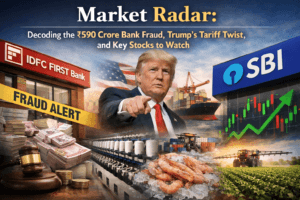
Market Radar: Decoding the ₹590 Crore Bank Fraud, Trump’s Tariff Twist, and Key Stocks to Watch
As the sun rises on Monday, February 23, 2026, the Indian stock market is poised for a gap-up opening, with GIFT NIFTY futures hinting at a 163-point gain for the NIFTY50. While the broader sentiment appears buoyant, the devil, as always, is in the details. Today’s market action will be a fascinating tug-of-war between positive corporate actions and severe fundamental headwinds. From a massive bank fraud to shifting global trade dynamics, here is your deep-dive guide to navigating the sessions ahead.
The Macro Crosscurrent: Trump’s Tariff Tightrope
Before diving into individual stocks, investors must grapple with the latest salvo from the White House. Over the weekend, former President Donald Trump announced an immediate increase in baseline global tariffs on U.S. imports from 10% to 15%. This move effectively tears up the “legally tested” framework and reintroduces a level of uncertainty that global supply chains despise.
For Indian exporters, this is a moment of recalibration. The earlier expectation of a stable 10% tariff under a potential India-U.S. trade deal has been replaced by a 15% wall. This isn’t just a five-percentage-point increase; it represents a significant erosion of competitiveness for Indian goods versus domestic U.S. products and other nations that might not face the same rates. The market’s initial gap-up might be tested as export-heavy sectors digest the long-term implications of this protectionist pivot.
- The Bombshell: IDFC First Bank’s ₹590 Crore Fraud
The Stock: IDFC First Bank The Context: The private sector lender dropped a bombshell late Sunday, revealing a fraudulent activity amounting to a staggering ₹590 crore at a single branch in Chandigarh.
What Happened? The bank discovered the discrepancy when a department of the Haryana government requested to close its account. Upon verification, the actual balance didn’t match the amount to be transferred. The bank has since suspended four officials and vowed to pursue “strict disciplinary, civil, and criminal action.”
The Human Insight: While the quantum of the fraud is alarming, the market will be dissecting two critical aspects. First, the nature of the fraud. Was it a complex, collusive scheme involving external parties, or a failure of internal controls over a period of time? The fact that it involved a government account adds a layer of reputational risk that is hard to quantify.
Second, and perhaps more immediately damaging, is the cascading effect. The Haryana government has swiftly de-empanelled both IDFC First Bank and AU Small Finance Bank from all government business “with immediate effect till further orders.” This is a severe punitive measure. For IDFC First, which has been aggressively building its retail and corporate franchise, losing government business—a source of low-cost, stable deposits and fee income—is a significant strategic setback.
Investor Takeaway: Today’s price action will reflect pure shock. However, savvy investors will listen for management commentary on the root cause, the robustness of their audit mechanisms, and their strategy to mend fences with the government. This is a test of the bank’s crisis management capabilities as much as its financial resilience.
- UPL’s Surgical Strike: A Pure-Play Crop Protection Giant
The Stock: UPL Ltd. The Context: In a move aimed at simplifying its labyrinthine structure, UPL announced a comprehensive scheme of arrangement to consolidate its crop protection businesses into a single, listed entity.
The Strategic Play: The plan is multi-step but the goal is simple: create a focused, pure-play global crop protection platform. Currently, the business is scattered across different entities. By merging UPL Sustainable Agri Solutions (UPL SAS) into UPL, and then demerging the India crop protection business into a new entity (UPL 2) which will also absorb the global business from UPL Cayman, the company is creating a streamlined structure.
Why This Matters: Conglomerates often trade at a discount to their sum-of-parts value due to complexity. By creating a single, dedicated agro-chemical entity, UPL is hoping to unlock shareholder value. It allows investors to directly bet on the company’s core competency without the baggage of unrelated verticals.
Investor Takeaway: This is a long-term positive. The process will take 12-18 months, but it signals that management is listening to the market’s desire for clarity. The new listed entity, UPL 2, will likely attract a different breed of investors focused purely on the agri-input space. For current shareholders, this could be a value-unlocking event, though the interim period may see some arbitrage activity.
- Sector in the Crosshairs: The Tariff Trio (Textiles, Shrimps, Auto Ancillaries)
The Stocks: Export-oriented companies in textiles, aquaculture, and auto components. The Context: Trump’s tariff hike to 15% is a direct headwind. While India has been negotiating a bilateral trade agreement, this unilateral move throws a wrench in the works.
The Ground Reality:
- Textiles: This is a volume-driven, low-margin business. A 5% increase in duties can wipe out profit margins entirely, making Indian apparel more expensive for U.S. buyers. Orders could shift to competitors like Vietnam or Bangladesh if they enjoy better tariff terms.
- Shrimp (Aquaculture): India is a major shrimp exporter to the U.S. The tariff increase acts as a tax on consumption. It could reduce demand or force Indian processors to absorb the cost, squeezing farmers and processors alike.
- Auto Ancillaries: While slightly more insulated due to the specialized nature of components and existing supply contracts, the tariff adds friction. It makes the “China Plus One” strategy slightly less lucrative for Indian suppliers if the cost of entry into the U.S. rises.
Investor Takeaway: This is not a blanket sell signal, but it demands stock-specific analysis. Companies with high pricing power, unique products, or manufacturing units inside the U.S. will be resilient. However, pure-play commodity exporters will face a tough quarter. Watch for management commentary on how they plan to share the tariff burden with U.S. importers.
- Banking on the Future: SBI’s Green Pivot and YES Bank’s Profitability Goal
The Stock: State Bank of India (SBI) The Context: SBI has set an ambitious target to grow its green advances to 7.5%-10% of its total loan book by 2030, up from a mere 1.56% in March 2025. The Insight: This isn’t just ESG lip service. The launch of ‘CHAKRA’—a Centre of Excellence for sunrise sectors like renewable energy, green hydrogen, and electric mobility—signals a concrete shift in lending strategy. Furthermore, SBI is actively engaging with Japanese lenders for acquisition finance tie-ups, a market just opened up by the RBI. With the capacity to fund up to ₹94,000 crore in this space, SBI is positioning itself as the banker of choice for India’s next wave of corporate consolidation and green transition.
The Stock: YES Bank The Context: CFO Niranjan Banodkar stated the bank expects to exit the fiscal year with a Return on Assets (RoA) of 1%, aiming to exceed that on an annual basis in FY27. The Insight: For a bank that was in a recovery mode, hitting a 1% RoA is a significant psychological milestone. It signals that the worst of the asset quality stress is behind them and that the core business is generating sustainable profits. This gives retail investors confidence that the turnaround story has tangible financial metrics to back it up.
- Corporate Actions and Contracts: The Movers and Shakers
- Vedanta: The stock will be active ahead of its February 25 board meeting, where it will consider issuing Non-Convertible Debentures. This is routine refinancing, but the street will watch the coupon rates for cues on the company’s borrowing costs.
- JSW Infrastructure: A dual announcement—the appointment of a new independent director and a massive plan to raise funds via equity issuance (up to 25 crore shares). The mode (QIP, FPO, Rights) will be crucial. A rights issue could spook existing shareholders, while a QIP might be seen as non-dilutive to retail.
- RailTel Corporation: In a consortium with Ashoka Buildcon, RailTel has bagged a massive contract worth approximately ₹1,136 crore over five years from the Inspector General of Registration for document scanning. At ₹24.75 per page, this is a high-volume, high-visibility government tech project, reinforcing RailTel’s reputation as a reliable partner for digital infrastructure.
- Allcargo Terminals: January volumes showed an 8% growth year-on-year. While this is positive, the month-on-month dip of 5% suggests some seasonality or operational hiccup. The market will look for confirmation that the growth trajectory remains intact.
- Axis Bank & CreditAccess Grameen: Axis Bank has officially denied any plans to bid for a stake in CreditAccess Grameen, squashing recent speculation. This clarity might lead to a correction in CreditAccess shares, which may have rallied on the buzz.
- WeWork India: Continuing its expansion spree, WeWork India has leased 1.69 lakh square feet in Bengaluru. This aggressive capacity addition signals strong confidence in the return-to-office trend and demand for managed flexible spaces in India’s IT capital.
Conclusion: A Day of Contrasts
Monday, February 23, is a microcosm of modern investing. We have the optimism of structural corporate simplification (UPL) and new contract wins (RailTel) clashing with the reality of systemic fraud (IDFC First) and geopolitical trade wars (Trump’s tariffs). For the prudent investor, the key is to look past the headline gap-up and analyze which of these stories has the legs to run and which is a value trap in the making. The smart money will be watching how the banking index reacts to the fraud news and how export-heavy pockets absorb the tariff shock.
You must be logged in to post a comment.