
Market Pulse: Strategic Moves by Maruti, RailTel Order Win, and Vi’s Legal Battle Define Trading Day
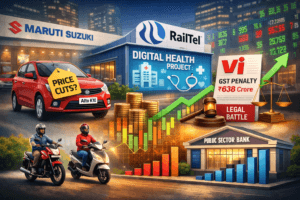
Market Pulse: Strategic Moves by Maruti, RailTel Order Win, and Vi’s Legal Battle Define Trading Day
As markets opened on January 2, 2026, a distinct narrative of strategic corporate decisions, major order wins, and regulatory challenges emerged. From the automotive sector’s pricing power to the telecom industry’s legal battles and a significant push in digital healthcare infrastructure, today’s market movers reveal deep insights into India’s evolving economic landscape and corporate resilience.
Maruti Suzuki’s Strategic Crossroads on Pricing
India’s passenger vehicle leader, Maruti Suzuki, finds itself at a strategic pricing juncture. The company has announced it will decide “very soon” whether to reverse its aggressive price cuts implemented in September 2025.
Last year, following the implementation of GST 2.0, which provided an 8.5% tax benefit on small cars, Maruti went beyond simply passing on this reduction. It implemented “strategic pricing” on entry-level models like the Alto K10, S-Presso, Celerio, and Wagon-R, slashing prices by up to ₹1.3 lakh to boost motorization. This move created a significant price advantage and resulted in robust demand, with the company still holding a booking backlog of over 1.5 months for its mini-segment vehicles.
Senior Executive Officer Partho Banerjee stated the company is contemplating whether to revert prices to the post-GST reduction level or continue its deeper strategic discounts for customers who have booked vehicles. This decision comes amid a sector-wide trend of price hikes. Rival Hyundai Motor India has already announced a 0.6% average increase across models, citing rising costs of metals and commodities. Other automakers, including Renault, Nissan, MG Motor, and luxury brands BMW and Mercedes-Benz, have also announced increases.
Maruti’s deliberation highlights a critical balance between market share defense in the competitive entry-level segment and protecting profitability. The outcome will signal the company’s confidence in sustaining demand momentum without aggressive discounts.
Hero MotoCorp & TVS Motor: Riding the Demand Wave
The two-wheeler sector kicked off the new year with explosive sales numbers, indicating a strong demand upcycle. Hero MotoCorp reported a stellar 40% year-on-year growth in total sales for December 2025, dispatching 456,479 units against 324,906 units in the same month last year. This performance comfortably beat market estimates.
Table: December 2025 Two-Wheeler Sales Performance
| Company | Total Sales (Units) | Year-on-Year Growth | Key Growth Drivers |
| Hero MotoCorp | 456,479 | 40% | Strong domestic demand (up 42.5%), 21% export growth. |
| TVS Motor Company | 481,389 | 50% | 48% growth in two-wheelers, 77% surge in EV sales, 110% jump in three-wheelers. |
Analysts attribute this surge to the GST rationalization in September 2025 and sustained post-festive demand. Brokerage Motilal Oswal has a ‘Buy’ rating on Hero MotoCorp with a target price of ₹6,827, suggesting a 16% potential upside from recent closes. The broader expectation is for a 5-7 quarter demand upcycle in the auto sector.
RailTel’s Mega Order and the Digital Health Push
In a significant development for the IT-infrastructure sector, RailTel Corporation of India secured a major order for a Hospital Management Information System (HMIS) from the Assam Health Infrastructure Development & Management Society.
Note: There is a discrepancy in reported order value. Sources cite figures of ₹567 crore and ₹56.71 crore. Investors should await official clarification from the company.
The project involves the procurement, implementation, and maintenance of a comprehensive HMIS and is scheduled for completion by January 31, 2032. This long-term project will provide RailTel with stable revenue visibility and marks a strategic expansion into large-scale e-health solutions.
This win builds on RailTel’s solid Q2 FY26 performance, where it reported a 12.8% growth in revenue and a 19.4% jump in EBITDA, with margins improving across both its telecom and project work services businesses. The order underscores the government’s push for digital health infrastructure and positions RailTel as a key player in this mission.
Vodafone Idea’s Ongoing Regulatory Challenges
Vodafone Idea (Vi) faces fresh financial pressure, receiving a Goods and Services Tax (GST) penalty order of approximately ₹638 crore from authorities in Ahmedabad. The order alleges short payment of tax and excess availment of input tax credit.
The telecom operator has stated it disagrees with the order and will pursue appropriate legal action. This development adds to the company’s well-documented financial stress. However, it comes alongside potential relief from the central government, which is reportedly set to freeze Vi’s massive Adjusted Gross Revenue (AGR) dues and approve a five-year moratorium on payments.
This proposed relief, aimed at preserving competition in the telecom sector, could be a pivotal factor in stabilizing Vi’s finances and enabling its crucial ₹25,000 crore fundraising plan. Investors are closely watching for formal government communication on this matter.
Banking on Growth: Public Sector Banks Show Strength
Several public sector banks reported robust quarterly business updates, signaling continued credit growth and deposit mobilization:
- Indian Bank reported a 13.4% jump in total business and a 14.5% surge in gross advances.
- Punjab & Sind Bank’s total business grew by 11.84%.
- South Indian Bank saw gross advances increase by 11.27% and deposits grow by 12.17%, with its low-cost CASA ratio also improving.
This collective performance points to a healthy credit environment and strengthening balance sheets in the public banking space.
Market Activity Spotlight
Beyond specific news, trading volumes often reveal where market attention is truly focused. On this trading day, several stocks were exceptionally active.
Table: Notable High-Volume Stocks on January 2, 2026
| Company | Possible Driver for Volume |
| Vodafone Idea | Fresh GST penalty order and pending government relief news. |
| Devyani International | Continued market reaction to its recent merger announcement plan. |
| NMDC | Strong December operational performance with iron ore production up ~15%. |
| Coal India | Market digestion of mixed December data (production up 4.6%, offtake down 5.2%). |
Key Takeaways for Investors
- Sectoral Rotation in Play: Strength is visible in automobiles (post-GST demand), select PSU banks (business growth), and infrastructure/IT (large government projects). Telecom remains a high-risk, event-driven story.
- Policy Impact is Tangible: The GST 2.0 rationalization is having a clear and positive effect on demand for entry-level vehicles, a trend highlighted by brokerages.
- Infrastructure Spending is a Concrete Theme: RailTel’s large HMIS order is a direct example of the government’s spending on digitizing public services, creating opportunities for related companies.
- Legal and Regulatory Overhangs Matter: Vodafone Idea’s case is a reminder that regulatory disputes can result in significant contingent liabilities, even as broader government support may be in the works.
The day’s developments paint a picture of a market where policy tailwinds, corporate strategy, and execution are driving narratives. Investors would do well to look beyond headlines, understanding the strategic decisions behind pricing, the long-term nature of large infrastructure orders, and the delicate balance between regulatory challenges and government support in stressed sectors.
You must be logged in to post a comment.