
Market Mayhem Decoded: Why the Sensei Surged 1,000 Points Despite the Shadow of War
The sharp 1,000-point surge in the Sensex amidst the Iran conflict was driven by a pragmatic market response to a confluence of factors: investors capitalized on “buying the dip” after the previous week’s brutal correction made blue-chip stocks attractive; diplomatic progress, highlighted by External Affairs Minister S. Jaishankar securing the safe passage of Indian LPG vessels through the Strait of Hormuz, alleviated immediate fears of an energy supply shock; and while oil prices remained above $100, the risk of them spiking to catastrophic levels was perceived as contained, signaling that the market was pricing in geopolitical stability through diplomacy rather than succumbing to panic.
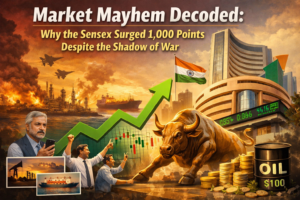
Market Mayhem Decoded: Why the Sensei Surged 1,000 Points Despite the Shadow of War
On a Monday that began with the world holding its breath over escalating conflict in the Middle East, the Indian stock market delivered a stunning counterpunch. The BSE Sensex vaulted over 1,200 points, and the Nifty50 climbed more than 340 points, painting a picture of defiant optimism on a canvas smudged with geopolitical risk.
At first glance, a “risk-off” event like a war typically sends investors scrambling for cover, pushing equity markets into the red. Yet, the bulls charged ahead. To the uninitiated, this seems like a paradox. To the seasoned market watcher, it’s a masterclass in the complex interplay of sentiment, valuation, and geopolitics.
This wasn’t just a random bounce. It was a calculated move driven by a confluence of factors that, for a moment, outweighed the fear of conflict. Let’s dissect the anatomy of this rally and understand what it tells us about the current state of the market.
The Primary Catalyst: The Allure of a Discounted Market
The single most powerful force behind Monday’s surge is a timeless Wall Street adage: “Be fearful when others are greedy, and greedy when others are fearful.”
The previous week was a bloodbath. The Nifty and Sensex suffered their most brutal weekly decline in years, with investors losing trillions in wealth as panic selling gripped the bazaars. The Nifty tumbled over 5%, its worst fall since mid-2022, while the Sensex saw its steepest weekly drop since the pandemic-induced crash of 2020.
This sharp correction created a compelling narrative for value hunters. Many fundamentally strong stocks—the ones investors had been eyeing but deemed too expensive—were suddenly trading at a discount. This phenomenon, known as “buying the dip,” is a cornerstone of market psychology.
When prices fall rapidly, the market’s perception of risk shifts. The fear of losing more money is slowly replaced by the fear of missing out on a bargain. Large institutional investors (DIIs) and retail traders alike saw the sell-off as overdone and began accumulating quality stocks.
The gains weren’t limited to a few sectors. The rally was broad-based, with banking heavyweights like HDFC Bank, ICICI Bank, and SBI leading the charge alongside auto majors like Mahindra & Mahindra and Larsen & Toubro. This indicates that the buying pressure wasn’t speculative in a niche area but a more general return of confidence. Investors weren’t just buying; they were buying the belief that the market’s long-term uptrend remained intact, and last week’s fall was merely a pothole, not a dead end.
The Geopolitical Safety Valve: Diplomacy Over Missiles
While the internal dynamics of the market set the stage for a rebound, the script was written by developments far from the trading floor. The market’s ability to sustain its gains, despite the ongoing Iran conflict, hinges critically on a specific geopolitical factor: the safety of shipping lanes, particularly the Strait of Hormuz.
For India, the Strait of Hormuz is not just a strategic chokepoint; it’s an economic lifeline. A significant portion of India’s crude oil and natural gas imports pass through this narrow waterway. Any disruption here can send inflation soaring and corporate margins crashing.
This is where the diplomatic efforts of India’s External Affairs Minister, Dr. S. Jaishankar, provided the crucial balm for jittery nerves. In an interview with the Financial Times, Jaishankar revealed that direct talks with Iran were yielding tangible results.
The most significant outcome was the safe passage of two Indian-flagged LPG carriers, the Shivalik and the Nanda Devi, through the Strait of Hormuz. These vessels, carrying nearly 93,000 metric tonnes of LPG destined for the Indian ports of Mundra and Kandla, became powerful symbols of diplomatic success.
For the market, this was a signal louder than any geopolitical rhetoric. It signaled that:
- Communication Channels are Open: India has the diplomatic heft to engage directly with key players in the conflict.
- Energy Security is a Priority: The government is actively working to ensure that the nation’s core energy needs are not held hostage by the conflict.
- A Repeat of the 1970s Oil Shock is Unlikely: The fear of a complete and prolonged blockade, which would send oil prices spiraling to unmanageable levels, receded.
Jaishankar’s nuanced statement that “diplomacy may be more effective than military pressure” resonated deeply with a market that craves stability over uncertainty. His clarification that this wasn’t a quid pro quo or a “blanket arrangement” but a product of a longstanding bilateral relationship further reassured investors that this was a sustainable, principle-based approach rather than a temporary fix.
Oil Prices: The Elephant in the Room (Still Under $110?)
The shadow of the Iran conflict looms largest over global crude oil prices. Historically, any major conflict in the oil-rich Middle East triggers a spike in crude, which is disastrous for a net importer like India. India imports over 85% of its crude oil needs, and every dollar increase in oil prices widens the current account deficit (CAD), weakens the rupee, and fuels inflation.
So, why did the market rally when oil prices are hovering above $100 a barrel?
The answer lies in the market’s forward-looking nature. While $100+ oil is undoubtedly painful, the market had already priced in the risk of it going much higher. In the days following the escalation, fears of $120 or even $150 oil were rampant. The fact that prices stabilized just above the $100 mark, rather than rocketing into the stratosphere, was, in a perverse way, a relief.
Furthermore, the successful diplomatic intervention regarding the LPG vessels suggested that the worst-case scenario for oil supply—a complete closure of the Strait of Hormuz—was being actively averted. The market interpreted this as a cap on the upside risk for oil prices. As long as the oil taps aren’t turned off completely, the Indian economy can, with some difficulty, adapt to $100 oil.
Deeper Dive: The Technical Rebound and Sectoral Rotation
Beyond the headlines, the market’s technical structure was ripe for a rebound. After a fall of over 5%, the Nifty had touched crucial support levels. Traders often look for these technical bounces. The buying in heavyweights like Reliance, HDFC Bank, and the IT pack wasn’t just about value; it was about these stocks being the “kings” that could pull the indices out of the red.
There’s also an element of sectoral rotation. Money that had fled the markets entirely last week began to find its way back, but not necessarily into the same sectors. The strength in banking and financials suggests a belief that domestic credit growth remains robust. The gains in auto (like M&M) point to confidence in rural demand and consumption recovery. This rotation shows that the money is not just looking for a safe haven but is being deployed with a thesis on which parts of the economy will outperform.
The Human Element: Sentiment and the “Animal Spirits”
Finally, we cannot ignore the human element. Markets are, at their core, a reflection of collective human emotion. Last week was dominated by fear. This week began with a cautious whisper of hope, amplified by the news of the ships’ safe passage.
Dr. Jaishankar’s comments acted as a powerful antidote to the “doom and gloom” narrative. He projected a sense of control and strategic clarity. In a crisis, markets despise uncertainty above all else. By signaling that India had a line of communication and was getting results, the government provided a dose of certainty.
This reignited the “animal spirits”—the psychological factors that drive investors to take action. The rally became a self-fulfilling prophecy: as prices started to climb, more investors jumped in, fearing they would miss the rebound, which pushed prices even higher.
Conclusion: A Rally Built on Pragmatism, Not Euphoria
The 1,000-point rally on the Sensex is not a sign that the market is ignoring the Iran war. Quite the opposite—it is a sophisticated read of the war’s immediate implications for India. The market rebounded because:
- Prices got cheap: The sharp fall last week made valuations attractive again.
- Diplomacy delivered: India’s direct engagement with Iran yielded the safe passage of critical energy shipments, easing supply-side fears.
- The oil scenario, while bad, wasn’t getting worse: The risk of oil spiraling to $150 was, for the moment, contained.
- Technical factors aligned: The indices hit support levels, triggering a wave of technical and algorithmic buying.
This is not the exuberance of a bull run, but the pragmatism of a market that is carefully weighing risks against reality. It is a reminder that in the world of finance, the headline is never the full story. The real story lies in the layers beneath—in the diplomatic cables, the technical charts, and the psychology of investors who decided that, for now, the opportunity outweighed the threat. The war is far from over, and the situation remains fluid, but for one Monday in March, the market chose to bet on reason over rockets.
Expert Insights: What the Analysts Are Saying
To add further depth, here are some synthesized perspectives from market experts that reflect the prevailing sentiment:
- On the “Buy the Dip” Strategy: “The correction was brutal but healthy. It washed out a lot of the excess froth. Investors are now sifting through the rubble and picking up high-quality blue-chip stocks that were oversold in the panic. The banking and IT sectors, in particular, offered a compelling risk-reward ratio at Friday’s closing prices.” – Vikram Mehta, Senior Fund Manager.
- On Geopolitical Risk: “The market has learned to differentiate between ‘risk’ and ‘uncertainty.’ The Iran situation is a known risk. The uncertainty was around how it would impact India’s energy security. Dr. Jaishankar’s statement effectively removed a layer of that uncertainty, at least in the short term. The market is now trading on the assumption that a wider supply shock will be avoided through back-channel diplomacy.” – Anjali Sharma, Chief Economist.
- On Oil and Inflation: “While $100 oil is a headache, it was largely factored into the market’s pessimistic scenario last week. The RBI will remain hawkish, but a full-blown oil crisis is what would have forced their hand into extreme measures. The market is now hoping that oil stabilizes around current levels, allowing the economy to absorb the shock over time rather than all at once.” – Rahul Jain, Head of Research.
Navigating the Rally: A Checklist for Investors
If you’re an investor looking at this rally and wondering what to do, consider this checklist before making a move:
- Don’t Chase the Rally Blindly: While the bounce is strong, geopolitical situations are fluid. Avoid making impulsive decisions based on a single day’s price action.
- Focus on Quality: Stick to companies with strong balance sheets, consistent cash flows, and proven management. These are the businesses that can weather economic storms better than highly leveraged or speculative ones.
- Monitor the Oil Price: Keep a close eye on crude oil prices. A sustained move above $110 or $115 could reverse the positive sentiment.
- Watch the Rupee: The Indian Rupee’s movement against the US dollar is another key indicator. A sharply weakening rupee increases import costs (especially oil) and can spook foreign investors.
- Stay Informed on Diplomacy: Follow credible news sources for updates on the India-Iran talks and the broader geopolitical landscape. The market’s direction will be heavily influenced by headlines from this front.
This rally is a powerful lesson in market dynamics. It underscores that the market is not just a voting machine on current events, but a weighing machine that constantly attempts to forecast the future, one trade at a time.
You must be logged in to post a comment.