
Living in the Shadow of the Temple: The Adivasi Fight for Power at India’s First Power Plant
For over six decades, the Adivasi communities displaced from their ancestral lands to make way for India’s pioneering Chandrapura Thermal Power Station have been left in a state of perpetual broken promise, trading their fertile villages for a precarious existence on marginal, undocumented land where they survive without basic amenities like water and electricity—resources they are forced to steal from the very plant built on their sacrifice—while the Damodar Valley Corporation profits from their land, reduces their culture to decorative tokenism, and offers only empty CSR gestures, creating a cruel paradox where the original givers of the land now cling to the hope of the plant’s expansion for survival, their lives a haunting testament to the gap between India’s developmental ambitions and the human cost buried beneath its foundations.
Living in the Shadow of the Temple: The Adivasi Fight for Power at India’s First Power Plant
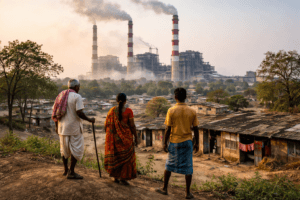
The red-and-white chimney of the Chandrapura Thermal Power Station (CTPS) dominates the skyline of Bokaro district in Jharkhand like a colossal, blinking sentinel. For the thousands of families who draw power from the grid it feeds, its nightly red flashes are a symbol of progress and development. But for Jagdish Hansda, a man in his late seventies, it is a constant, looming monument to a promise broken.
“Back then, there used to be nothing here except us Adivasis, our fields, jungles and wildlife,” Hansda says, gesturing towards the plant from a tea stall in the town below. His voice is calm, but his eyes carry the weight of a history written not in government reports, but in the scattered lives of his community.
Hansda’s ancestral village, Jhinjirguttu, was a lush green pocket of life in what was then Bihar. In the late 1950s, it was identified as the perfect site for one of independent India’s first major forays into energy independence: a thermal power station conceived by the Damodar Valley Corporation (DVC). Inspired by the Tennessee Valley Authority in the US, the DVC was hailed by Jawaharlal Nehru as a “temple of modern India,” a project that would generate power, control floods, and drag a newly independent nation into a prosperous future.
But for the original inhabitants of that land, the temple was built not with bricks and mortar alone, but with their displacement. Today, more than six decades later, Hansda and his neighbours live in a cramped, fly-ash-covered settlement that bears the same name as their lost home. They are surrounded by high-tension wires and the constant hum of machinery, yet they survive on electricity they are forced to steal. Their story is a stark testament to the gap between national ambition and local reality, and a powerful human lesson in what the word “rehabilitation” truly costs.
The Great Uprooting: A Village Erased by Policy
To understand the present, one must sit with the memories of men like Jagdish Hansda. He was a young boy when the rumours started. “We would hear whispers, ‘Sarkar aa rahi hai’—the government is coming,” he recalls. The phrase, meant to evoke authority and order, instead instilled a deep, primal fear. For the Adivasi and Mulvasi (lower caste) communities who had lived off the forest and the field for generations, the government was an abstract, distant entity. Its arrival could only mean one thing: change.
When it came, the change was cataclysmic. The Land Acquisition Act of 1894, a colonial-era law, was invoked. The Act was designed to give the state immense power to take land for public purposes, with little regard for the consent of the people living on it. For the villagers of Jhinjirguttu and the surrounding 1,200 acres acquired for the plant, the process was bewildering.
As TN Bhalla noted in his 1969 study of the DVC, the corporation offered a choice: land-for-land or cash compensation. In practice, this choice was an illusion. “Our ancestors were poor and unlettered,” Hansda explains. “The DVC officials did not explain the consequences of what was going to happen.” The corporation, facing budgetary constraints, reportedly encouraged cash payments, which were faster and logistically simpler than finding and allocating alternative land. A 1966 company report claimed that none of the displaced families asked for land in return, framing their acceptance of cash as a voluntary preference.
The reality on the ground was far more chaotic. “They were just given cash, and that too a small sum which was not enough to go buy land elsewhere,” Hansda says. In many heartbreaking cases, the money never even reached the families. It was transferred from the company to the state treasury, where it remained, a phantom fortune just out of reach. “My own grandfather told us that the money was with the treasury,” Hansda remembers. “But my parents didn’t know how to get it and time just went by.” The promise of compensation evaporated into the bureaucratic ether, leaving families displaced, landless, and destitute.
The Scattered Aftermath: Landlessness and a Life on the Margins
The villagers didn’t just lose their homes; they lost their identity. The community of Jhinjirguttu was scattered like seeds in a storm. Some drifted to nearby towns, seeking daily wage labour. Others, like Hansda’s family, clustered together on unoccupied government land on the outskirts of the new plant, creating a new, informal settlement. They defiantly named it Jhinjirguttu again, a desperate attempt to tether their present to a past that was rapidly being buried under industrial waste.
Today, that settlement is a study in contrasts. On one side of a dividing line stand the DVC’s administrative quarters—mustard-yellow buildings, however dilapidated, that still receive water and electricity. On the other, on sloping, marginal land, lie the hamlets of Jharnadih and Jhinjirguttu. Here, houses are a mix of mud and concrete, built with the sweat of their occupants but without the security of a single document proving they have a right to be there.
This lack of documentation is a cage. When the government launched the Abua Awaas Yojana to help the poor build homes, the villagers applied, only to be told they needed a No Objection Certificate (NOC) from the DVC. “It is impossible to get NOCs from the DVC,” says Narayan Marandi, the local mukhiya (village head) who himself lives in the basti. Despite his official position, he lives with the same gnawing anxiety as his neighbours. “The fact that we can’t get NOCs is a reminder that even though our ancestors contributed land for the thermal plant, today the land that we live on does not belong to us,” explains Ramesh Soren, a resident of Jharnadih. “We can be displaced from it anytime.” The fear of a second displacement, decades after the first, is a haunting inheritance.
The Irony of Stolen Power
The most glaring injustice, however, is the theft of electricity. In a town built for power generation, the original givers of the land live in darkness.
Social worker Shashikant Hembrom puts it bluntly: “Even the electricity and water have to be stolen.” Years ago, the DVC installed electric poles in Jharnadih, only to disconnect the supply shortly after. The message was clear: the power flowing from the plant was for the grid, not for the people who lost their world for it.
Desperation has forced ingenuity. Residents now jury-rig connections from nearby power lines, running thin, dangerous wires into their homes. It is a precarious and illegal existence. A slight surge, a monsoon storm, or a vigilant patrol could plunge them back into total darkness—or worse, cause a fatal accident. This is not the rebellious act of those refusing to pay a bill; it is the survival tactic of those denied a connection in the first place. They live under the shadow of the “temple,” not as devotees, but as trespassers in its backyard.
The same neglect applies to water. While the staff quarters enjoy regular supply, the hamlets rely on a few public taps installed after years of protest, which release a slow drip for only a few hours a day. Women and children spend hours walking to distant hand pumps, carrying heavy jerry cans. The DVC’s 2021-22 Corporate Social Responsibility (CSR) report boasts of working with 52 surrounding villages, aiming to “uplift socio-economic conditions.” But for the residents, these are empty words. A water tank installed in Burudih stopped working years ago. Streetlights installed in Bhursabad have long since died. The company, they say, makes a “big show” of distributing school bags for publicity photos but refuses to invest in the sustainable, basic infrastructure that would actually change their lives.
A Long History of Broken Promises and Resistance
The community’s struggle is not passive. It is a long, weary history of petitions, protests, and legal battles.
In the Constituent Assembly debates of 1948, when the DVC Act was being shaped, tribal leader Jaipal Singh Munda issued a prescient warning. He argued that displaced Adivasis needed more than just “better houses.” He asked, “Are you going to give them their self-respect? Are you going to give them a modus vivendi whereby they will be able to contribute as men of honour?”
The decades that followed provided a clear answer. In the 1970s, under pressure, the DVC created a list of 701 displaced families entitled to jobs. By the mid-1990s, only 64 had been employed. In 1992, a group of 91 displaced persons, including 87 not on the official list, took the corporation to the Kolkata High Court and won. The Supreme Court upheld the order, forcing the DVC to offer employment.
Yet, even this victory was tempered. In a 2011 parliamentary reply, the government stated that of the original 701, only 193 had been given jobs. Another 458 were offered a paltry sum of Rs 3 lakh in lieu of a job—a one-time payment that could never replace the security of a steady income. “There are many more people who were displaced and never received compensation or jobs,” says Narayan Marandi. “But they were too poor to fight out their case in the courts.” The legal system, for all its pronouncements, remains an expensive and intimidating labyrinth for those without resources.
Development’s Face: Erasure and Tokenism
Beyond the material deprivation, there is a cultural erasure that cuts deep. The plant and its accompanying urbanization have wiped out the physical markers of Adivasi life: the sacred groves (sarnas) where they worshipped, the ponds where they bathed, the forest paths they walked. The ecological balance has been replaced by a blanket of fine fly ash that coats everything—the roads, the crops, the leaves of the few remaining trees.
In the village of Neer Pipradi, which clings to a sliver of land next to the plant, residents like Anup Murmu still try to farm. “We grow some paddy and vegetables,” he says, wiping the grey dust off a leafy plant. “It’s alright for us to eat but not good enough to sell in the market.” The land that once sustained them has been poisoned by the very project it was sacrificed for.
What makes the neglect even more bitter is the corporation’s selective use of their culture. “Inside the plant you will find several decorative paintings of Adivasis and Adivasi art,” says Shashikant Hembrom. “Adivasis are also called to dance for DVC events. But nobody makes an effort to improve the condition of Adivasis still living here who were displaced for the plant.” Their identity is welcome as a colorful backdrop for company functions, a symbol of tribal heritage to be showcased, but their lived reality as a displaced people is an inconvenient truth to be ignored.
The Paradox of Hope: Clinging to the Chimney’s Shadow
In a twist of tragic irony, when the DVC announced in February 2025 that it would build a new 1,600 MW supercritical plant in Chandrapura, the local Adivasi response was not one of protest, but of hope.
“There is a saying here—as long as the plant remains, the people will survive,” says Sanjay Murmu of Jharnadih. This is the bleak logic of dependency. For generations, the plant has been the only economic engine in the area. While formal, permanent jobs have largely gone to outsiders, the Adivasi community survives on its fringes. They run tea stalls, drive rickshaws, load coal, and clean up fly ash. Some, researchers note, collect coal that falls from railway wagons to sell on the black market. The plant took their land, turning farmers into precarious wage labourers. Now, they are paradoxically reliant on its continued existence for their meagre livelihoods.
This is the complex reality of “just transition” discussions happening at a policy level. In 2022, the Jharkhand government set up a task force to assess how to move communities away from a reliance on coal. Researchers from Delhi have conducted studies in the area. But these high-level conversations feel distant to the people in Jharnadih and Jhinjirguttu. They are not worried about a transition away from coal; they are still waiting for their first taste of the benefits it was supposed to bring.
For them, the new plant is not a threat to a post-coal future. It is a potential, however faint, for a few more days of work, a few more rickshaw rides, a few more rupees. They are not stakeholders in development; they are survivors clinging to its scraps.
Conclusion: The Unfinished Business of Independence
The story of the Adivasis of Chandrapura is not an isolated incident. It is the foundational story of industrial India, a story written on the backs of its most vulnerable citizens. The “temples of modern India” were built, but the people who were displaced to make way for their foundations were left outside the sanctum, their offerings of land and livelihood accepted without receipt.
Jagdish Hansda, sitting under the blinking red light of the chimney, embodies this unfinished business. His faint memories of a green village are a ghost that haunts the present. His demand, and that of his community, is simple but profound. It is not for charity, but for the honour Jaipal Singh Munda spoke of in 1948. It is for the jobs that were promised, the land that was never given, the water that never flowed, and the electricity that is stolen.
As India marches towards its goal of net-zero emissions and a greener future, it must first reckon with the sooty legacy of its coal-powered past. The true test of a nation’s progress is not the megawatts it generates, but whether it can turn on the lights in the homes of the people who were left in the dark to build its temples. For the Adivasis of Chandrapura, that light has yet to arrive. And they are tired of waiting.
You must be logged in to post a comment.