
Lights, Camera, Innovation: How Netflix’s Eyeline Studio and India’s AVGC Policy Are Rewriting the Global VFX Script
The launch of Netflix’s Eyeline Studios in Hyderabad marks a transformative moment for India’s AVGC sector, signaling a shift from the country’s traditional role as a back-end service provider to a front-line innovator in global visual storytelling. Leveraging Hyderabad’s unique convergence of technological infrastructure, a robust filmmaking legacy exemplified by Tollywood, and proactive government policy, the 32,000-square-foot virtual production hub will integrate Indian talent into the highest levels of creative decision-making for global blockbusters. Complemented by the upcoming Indian Institute of Creative Technologies (IICT) campus and the government’s broader “Orange Economy” initiative aiming to generate 2 million creative jobs, this development positions India—and Hyderabad specifically—as a central hub where ancient storytelling traditions merge with cutting-edge technology to co-create the next generation of cinematic experiences.
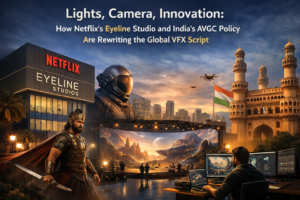
Lights, Camera, Innovation: How Netflix’s Eyeline Studio and India’s AVGC Policy Are Rewriting the Global VFX Script
Hyderabad is no stranger to ambition. Over the past two decades, the city has transformed from a pearl and diamond trading hub into the cynosure of India’s technology revolution—Cyberabad. But on March 12, 2026, the city added a new, vibrantly colored layer to its identity. With the inauguration of Eyeline Studios, Netflix’s global production and innovation hub, Hyderabad formally staked its claim as the nerve center of the global Animation, Visual Effects, Gaming, and Comics (AVGC) sector.
The event, attended by a constellation of political leaders, bureaucrats, and creative luminaries, was more than just a ribbon-cutting ceremony. It was a declaration of intent from India: that it is ready to move from being a back-end support service to a front-line innovator in the art of visual storytelling.
Beyond the Press Release: What Eyeline Studios Really Means
While the press release details the 32,000 square feet of real estate and the hybrid cloud infrastructure, the real story lies in the philosophy behind Eyeline Studios. Unlike traditional outsourcing units that handle rotoscoping or paintwork, Eyeline is designed as a center of excellence for virtual production—a technology that merges the physical and digital worlds in real-time.
Think of the photorealistic worlds in Stranger Things or the intricate CGI in The Gray Man. Traditionally, such effects are added months after filming, in post-production. Virtual production, powered by colossal LED walls and game-engine software, allows filmmakers to see fantastical landscapes—like an alien planet or a medieval castle—live on set, reacting to the actors’ movements. It saves time, money, and unlocks unprecedented creative freedom.
By housing this capability in Hyderabad, Netflix isn’t just opening an office; it is planting a flag. It is signaling that the next generation of global blockbusters will be conceived, visualized, and executed with significant Indian intellectual and technological firepower.
Why Hyderabad? The Perfect Storm of Talent and Policy
The choice of Hyderabad was not accidental. As Telangana’s IT Minister D. Sridhar Babu noted, the state has been aggressively courting the creative economy. But the seeds were sown long before the current administration.
Hyderabad possesses a unique trinity of assets:
- A Robust Tech Backbone: As home to the global campuses of Google, Amazon, and Microsoft, the city has the deepest pool of software engineering talent in the country. VFX is, at its core, software engineering applied to art.
- A Filmmaking Legacy: Tollywood (Telugu cinema) is one of India’s largest and most technologically adventurous film industries. The success of epic spectacles like Baahubali and RRR—which relied heavily on local VFX talent—proved that Hyderabadi studios could handle global scale.
- Proactive Governance: The Telangana government has treated the AVGC sector as a sunrise industry, offering incentives, creating talent pools, and streamlining clearances. Chief Minister A. Revanth Reddy’s presence at the launch underscores the political will to nurture this ecosystem.
It is this blend of left-brain logic and right-brain creativity that Jeff Shapiro, CEO of Eyeline Studios, alluded to when he spoke of Hyderabad’s “technology ecosystem and film culture.” It is a place where a coder and an animator can sit in the same room and solve complex visual problems together.
The IICT Catalyst: Skilling India for the Orange Economy
A significant, yet potentially understated, announcement during the event was the reaffirmation of the Indian Institute of Creative Technologies (IICT) campus in Hyderabad. This is the linchpin of the entire strategy.
For years, the Indian VFX industry has faced a paradox: abundant talent, but a shortage of industry-ready specialists. Graduates often emerged from traditional art colleges with great fundamentals but no knowledge of pipelines like USD (Universal Scene Description) or software like Houdini and Unreal Engine.
The IICT aims to bridge this gap. It is envisioned as a center of excellence that will offer curricula co-designed by industry giants like Netflix. This ensures that when a student graduates, they can immediately contribute to a global project.
This aligns perfectly with Prime Minister Narendra Modi’s vision of the “Orange Economy,” which Secretary Sanjay Jaju highlighted. The announcement of 15,000 content creator labs across the country is not just a statistic; it represents a democratization of creativity. It means a young artist in a tier-2 city can now access the tools and training to eventually work on a Marvel film or a Netflix original, all from India.
From Service to Co-Creation: India’s Shift in the Value Chain
Historically, India’s role in global VFX has been that of a service provider. A Hollywood studio would send a shot to Mumbai or Hyderabad, and a team would work on it overnight. It was transactional, commoditized, and often anonymous.
The Eyeline launch, coupled with the government’s policy push, signals a shift toward co-creation.
When Rana Daggubati—a producer, actor, and tech investor who embodies the new-age Indian creative—speaks about “new opportunities for artists and storytellers,” he is talking about creative ownership. Indian artists are no longer just painting pixels; they are designing entire virtual worlds. They are part of the creative conversation from the script stage, helping directors visualize sequences that were once considered impossible.
This elevates the nature of the work. It transforms a job into a career. For a VFX artist in Hyderabad, the path is no longer just to become a team lead in an outsourcing firm; it is to become a Virtual Production Supervisor or a Creative Director for a global streaming giant.
The Road Ahead: Challenges and the Human Element
However, this bright future is not without its hurdles. The ambition to create 2 million jobs requires a massive scaling of infrastructure and mentorship. The success of the IICT will depend on attracting and retaining world-class faculty. Furthermore, as AI begins to permeate every aspect of content creation, the Indian workforce must be reskilled continuously to manage these new tools rather than being replaced by them.
There is also the human element of storytelling. Technology is an enabler, not the story itself. The true success of Hyderabad’s AVGC ecosystem will be measured by the stories it tells. Will we see more Indian narratives finding a global audience? Will the unique visual styles of Indian art forms—from Tanjore painting to Mughal miniatures—begin to influence the aesthetics of global cinema through these new technologies?
Conclusion: A New Chapter in Global Storytelling
The launch of Eyeline Studios in Hyderabad is a watershed moment. It is the physical manifestation of a changing world order where creativity is no longer centralized in Los Angeles or London, but distributed across a global network of talent.
As Secretary Jaju noted, India’s rich storytelling tradition is now merging with its technological capabilities. Hyderabad is at the epicenter of this fusion. It is a city where the ancient art of narrative meets the cutting-edge science of virtual production.
For the aspiring animator in Vizag, the coder in Warangal, or the filmmaker in Hyderabad, the message is clear: the stage is global, the tools are here, and the world is ready to watch. The Orange Economy is not just a policy slogan; it is a future being built, brick by brick, pixel by pixel, in the studios of Hyderabad.
You must be logged in to post a comment.