
Lebanon’s Fragile Ground: The New Chessboard in a Widening Middle East War
Israel is expanding its military campaign into southern Lebanon, framing it as a defensive move against Hezbollah, but experts warn the real aim is to reshape the Middle East by creating a permanent buffer zone up to the Litani River—and some far-right Israeli officials have even called for annexation. As Israeli forces demolish homes, strike critical infrastructure, and displace over 1.3 million civilians, the humanitarian toll is mounting alongside fears of a full-scale ground invasion. Lebanon, already crippled by economic collapse and political paralysis, faces the dual threat of becoming a prolonged occupation zone and potential civil unrest, as many Lebanese citizens increasingly blame Hezbollah for dragging the country into a regional war that serves Iran’s interests rather than their own.
Lebanon’s Fragile Ground: The New Chessboard in a Widening Middle East War
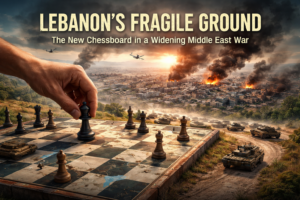
The hand hangs in the air, fingers tense around a black pawn. Below it lies Lebanon, rendered not as a nation of ancient cedars and bustling Beirut boulevards, but as a square on a strategic map. In the background, smoke billows from a residential skyline—real, burning, human. This single image, stark as it is, captures the terrifying duality of the current moment: to the world’s geopolitical strategists, southern Lebanon is a chess move; to the million-plus people fleeing its villages, it is a funeral pyre.
For decades, Lebanon has been the Middle East’s most sensitive seismograph, trembling every time regional tectonic plates shift. But the current escalation is different. What began as a solidarity front with Gaza has, in a matter of weeks, transformed into something far more existential. Experts are now warning that Lebanon is no longer just a “second front”—it is becoming the laboratory for a new Israeli doctrine aimed at fundamentally reshaping the region’s power map, with or without a formal declaration of war.
As Israeli tanks churn up the soil of the south and Prime Minister Benjamin Netanyahu vows to “smash” the Iran-aligned axis, a critical question emerges: Is this war about security, or is it about redrawing borders?
The Buffer Zone That Isn’t
To understand the gravity of the moment, one must look past the daily casualty counts and focus on a specific piece of geography: the Litani River. Running roughly 30 kilometers north of the Israeli border, this river has become the new Rubicon.
Israeli Defense Minister Israel Katz has been explicit. He speaks of creating a “security zone” and has ordered the demolition of Lebanese homes near the border to facilitate a military occupation stretching from the Blue Line (the de facto border) to the Litani. The official reasoning is defensive: push Hezbollah’s rocket arsenal out of range of Israeli kibbutzim. However, the methodology tells a different story.
In the past, buffer zones were demilitarized areas patrolled by international forces like UNIFIL. Today, Israel is leveling bridges across the Litani, striking infrastructure deep in the north, and telling civilians they cannot return. As analyst Heiko Wimmen notes, destroying the connective tissue of a country is not a defensive tactic; it is a preparatory act of permanent separation.
This is where the memory of older Lebanese generations kicks in—a cold dread that feels like 1982 all over again. Back then, Israel invaded with the stated aim of creating a 40-kilometer security zone. That “temporary” zone turned into an 18-year occupation that birthed the very Hezbollah Israel now claims to destroy. History has a cruel sense of irony in the Levant.
Michael Milshtein, a prominent Israeli analyst, points to the fundamental flaw in the buffer zone logic: the human beings who live there. Hundreds of thousands of Lebanese Shiites, farmers, and families are caught in the vice. “Who will take care of them?” Milshtein asks. “Who will supply them water, electricity, relief, education?” These are not logistical footnotes; they are the seeds of an insurgency. An occupied people denied basic services rarely surrender; they radicalize.
The ‘Smotrich Option’ and the End of Resolution 1701
While Katz talks about zones, Finance Minister Bezalel Smotrich talks about empire. His call for the annexation of southern Lebanon—declaring the Litani as “the new Israeli border”—shatters the last veneer of a limited conflict. Smotrich represents a political current that views the chaos of the post-October 7 world as an opportunity to correct a historical “mistake”: the withdrawal from Lebanon in 2000.
This is no longer just about Hezbollah. It is about the sovereign territory of a UN member state. For the United States, Australia, and European powers, Smotrich’s rhetoric is a nightmare, undermining the very framework of international law that has (tenuously) held the region together since the 2006 war. UN Security Council Resolution 1701, which ended the last major war, called for the disarmament of all militias and respect for Lebanon’s sovereignty. Israel is now effectively shredding that document, arguing that since Hezbollah violated it first, the resolution is void.
For Lebanon, this is a death by a thousand cuts. The newly elected government of President Joseph Aoun has publicly stated it wants to disarm Hezbollah, but it refuses to use force to do so. Why? Because the Lebanese Army is weak, deliberately kept so by a political system that fears civil war. Trying to disarm the party militarily would likely implode the country faster than any Israeli airstrike.
This creates a surreal dynamic: the Lebanese state agrees with Israel’s goal (curbing Hezbollah) but is being destroyed by Israel’s method (invasion). As researcher Bassel Doueik points out, the state is caught in a vice. It claims authority over war and peace, but Hezbollah’s actions have already made that claim laughable to the outside world.
The ‘Axis of Resistance’ on Life Support
To view this solely as Israel vs. Hezbollah is to miss the wider canvas. The timing is not accidental The opening of the Lebanese front coincides with intense pressure on Iran and the decimation of Hamas in Gaza.
Hezbollah entered this fight believing its vast missile arsenal would act as a deterrent—that Israel could not afford a two-front war. For a year, that logic held. But the assassination of senior Hezbollah commanders, the pager attacks, and the degradation of Iran’s air defenses have changed the risk calculus. Netanyahu believes he has momentum.
From Israel’s perspective, Lebanon is the “other front” in a war against the Iranian trunk. Hezbollah is the strongest branch of the Iranian tree; cut the branch, and the tree struggles to survive. This is why Israel has simultaneously struck targets in Syria and coordinated with US strikes on Iran. It is a synchronized decapitation strategy.
But Hezbollah is not Hamas. It is a veteran guerrilla army hardened by the Syrian civil war. While its leadership has been bloodied, its core fighting force remains intact and deeply embedded in the rocky hill country of the south. Analysts predict that if a full-scale ground invasion occurs, Israel should not expect a blitzkrieg. Instead, they anticipate a grinding, partisan-style warfare—a “walking through mud” campaign where every meter of asphalt comes at a high price in blood.
The Internal Collapse: Lebanon’s Ticking Clock
Perhaps the most immediate danger is not on the border, but inside Lebanese cities. The country is already a ghost of its former self. The 2019 economic collapse destroyed the middle class. The Beirut port explosion shattered trust in the ruling elite. Now, war is adding mass displacement to a society with no safety net.
There is a quiet fury brewing in Lebanon, and it is not directed solely at Israel. For the first time in years, public anger is pivoting toward Hezbollah. Many Lebanese Christians, Druze, and even some Shiites are asking the same question: Why are we dying for the sake of Gaza? Why is our infrastructure being destroyed for Iran’s chess game?
This is the “civil unrest” warning that analysts like Doueik are raising. Lebanon has a long and bloody history of sectarian strife. If the economic pain of displacement combines with the humiliation of military defeat, the country could turn its guns inward. The “other front” for Israel might not just be the Litani River, but the potential for Lebanon to descend into a self-cannibalizing chaos that makes the 1975 Civil War look tame.
The Human Cost of the Map
Returning to the chess metaphor: in geopolitics, pawns are sacrificed for position. In Lebanon, the pawns are children in Tyre, medics in ambulances, and farmers whose olive groves are now tank traps.
The data is numbing: over 1,000 dead, 1.3 million displaced, health workers targeted. But the data misses the texture of fear. It misses the sound of the IDF evacuation warnings sent to phones in the middle of the night, telling families in the south to flee north—only for those same families to find the bridges north already destroyed. The buffer zone is not a line on a map; it is a cage.
As Penny Wong and other foreign ministers voice “grave concerns” about sovereignty, the people on the ground are past concern. They are in survival mode. The difference between this war and previous conflicts is the absence of a clear exit. In 2006, the world eventually pushed for a ceasefire. Today, with Smotrich demanding annexation, Katz demolishing homes, and Trump’s Washington still defining its policy, there is no off-ramp visible.
What Comes Next?
Looking ahead, the immediate future of Lebanon hinges on two variables: the cohesion of Hezbollah’s rank-and-file and the patience of the Lebanese public.
If Hezbollah fractures under the weight of Israeli ground forces, the state may collapse entirely, leaving a vacuum that even the weakened Lebanese Army cannot fill. If the public turns against Hezbollah violently, Lebanon could enter a civil war more destructive than any Israeli invasion.
However, if Hezbollah holds—if it can bleed the IDF in the hills of the south for months—Israel may find itself stuck in a quagmire that international pressure eventually forces it to abandon. But that “victory” for Hezbollah would be pyrrhic: the country would be in ruins, and the group would be blamed for the catastrophe.
For now, Lebanon remains suspended in the grip of that hand holding the chess piece. The world watches as Israel moves to redefine its northern border not by negotiation, but by fire. Whether this is the “end” of Hezbollah or the beginning of a darker, more desperate chapter for Lebanon depends on decisions being made not in Beirut, but in Tel Aviv, Tehran, and Washington. The pawn is falling. The only question left is what it will crush when it lands.
You must be logged in to post a comment.