
Lebanon’s Crossroads: Caught Between Israel’s Military Ambitions and a Fragile Future
Lebanon’s Crossroads: Caught Between Israel’s Military Ambitions and a Fragile Future
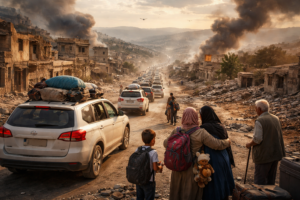
Along the dusty roads of southern Lebanon, where olive groves have given way to rubble and the air carries the acrid smell of smoke, families are once again packing whatever they can carry. For many, this is not their first displacement. But this time, something feels different.
The photographs circulating through WhatsApp groups show familiar scenes—lines of cars stretching toward Beirut, children clutching backpacks, elderly relatives being helped into overcrowded vehicles. Yet beneath the surface of this all-too-familiar tragedy, a fundamental shift is underway. Lebanon is no longer simply a battleground in someone else’s war. It is becoming the central stage for a transformation that could redraw the map of the Middle East.
The Buffer Zone That Isn’t Just a Buffer
When Israeli Defense Minister Israel Katz announced plans to establish a “security zone” stretching from the Blue Line to the Litani River, the language was carefully chosen. Security. Protection. These are words that resonate in any language, especially in a region where safety has become a luxury few can afford.
But ask the people who actually live in the villages between the border and the Litani what they see, and a different picture emerges. They see military bulldozers leveling homes that have stood for generations. They see bridges destroyed—not just any bridges, but the arteries that connect communities to hospitals, to markets, to the outside world. They see a pattern that looks less like defense and more like permanence.
The proposed buffer zone, covering approximately 850 square kilometers of Lebanese territory, would effectively recreate the occupation that lasted from 1982 until 2000. But there is a crucial difference this time. The international context has shifted, and with it, perhaps, the constraints that previously limited Israeli military ambitions.
Michael Milshtein, head of the Palestinian Studies Forum at Tel-Aviv University, puts his finger on the central contradiction. Speaking to SBS News, he acknowledged what many military planners prefer to gloss over: the buffer zone creates an impossible humanitarian puzzle. “Who will take care of them? Who will be the one who will supply them water, electricity, relief, education, health, everything?” he asked.
It is a question that has yet to receive a satisfactory answer.
The Domestic Tensions Beneath the Surface
In Beirut’s cafes, where conversations have always been a blend of politics, gossip, and survival, the mood has shifted. For decades, Hezbollah has positioned itself as Lebanon’s defender against Israeli aggression. But as the death toll climbs past 1,000—including 121 children and 42 health workers—that narrative is showing cracks.
Bassel Doueik, a researcher at the conflict monitoring organization ACLED, describes a quiet but significant transformation in Lebanese public opinion. “A significant portion of Lebanese citizens are increasingly blaming Hezbollah for the current escalation,” he told SBS News. “This sentiment has become more pronounced amid the latest developments, with public frustration rising over civilian casualties, displacement, and infrastructure damage.”
This internal pressure is something new. Lebanon’s sectarian divisions have historically meant that criticism of Hezbollah remained within certain political and religious boundaries. But the current crisis is cutting across those lines. When airstrikes destroy a bridge in a Christian village or level homes in a Druze community, the consequences ripple far beyond Hezbollah’s traditional support base.
The newly elected Lebanese President Joseph Aoun finds himself in an impossible position. His government has formally expressed a desire to disarm Hezbollah, but has ruled out using force to do so. The calculation is brutally pragmatic: any attempt to confront the group directly would almost certainly trigger internal conflict that Lebanon, already buckling under economic collapse, cannot survive.
The Iran Factor That Changes Everything
To understand what is happening in Lebanon, one must look beyond its borders. The current escalation cannot be separated from the broader confrontation between Israel and Iran—a confrontation that has been simmering for decades but has now reached a critical temperature.
When Israeli Prime Minister Benjamin Netanyahu announced that Israel was “smashing” Iran’s nuclear program, he was not simply making a rhetorical point. The strikes on Iranian facilities, conducted in coordination with the United States, represented a qualitative shift in the regional balance. And Lebanon, with its Hezbollah allies deeply embedded in Iran’s network, became an inevitable front in this expanded conflict.
Hezbollah’s decision to fire rockets into northern Israel on March 2 was framed as retaliation for specific actions—the killing of Iran’s Supreme Leader Ali Khamenei and alleged breaches of the November 2024 ceasefire. But the strategic logic ran deeper. For Hezbollah, maintaining the appearance of a unified regional front against Israel is existential. To stand aside while Iran absorbed blows would be to surrender its reason for being.
Yet that same logic has placed Lebanon in an extraordinarily dangerous position. Heiko Wimmen, the Beirut-based head of the International Crisis Group’s Iraq/Syria/Lebanon project, notes that Israel’s military posture suggests a deliberate, phased approach. “Recently, they have started a campaign to destroy bridges across the Litani, suggesting that a push for the river may be imminent,” he told SBS News.
The implication is clear: this is not a spontaneous escalation but a carefully calibrated operation designed to achieve specific objectives—objectives that extend far beyond merely pushing Hezbollah back from the border.
The Annexation Question That Won’t Stay Quiet
Perhaps the most troubling development for those concerned about Lebanon’s sovereignty has come not from military statements but from political ones. Far-right Finance Minister Bezalel Smotrich has openly called for annexation of southern Lebanon, arguing that the war should end with a fundamental redrawing of Israel’s borders.
“The new Israeli border must be the Litani,” Smotrich declared on Monday—a statement that, if implemented, would represent a dramatic violation of international law and a radical departure from decades of regional diplomacy.
Smotrich’s comments were quickly followed by Katz’s announcement about the buffer zone, creating a picture of coordinated policy rather than isolated rhetoric. For Lebanese officials watching from Beirut, the message was unmistakable: the ambitions of Israel’s far-right political faction were finding expression in military reality.
Australian Foreign Minister Penny Wong was among those expressing grave concern, joining a chorus of international voices warning about threats to Lebanese sovereignty. But in the region, there is a growing sense that international law and diplomatic norms are being overwhelmed by the momentum of events on the ground.
The Human Calculus of Displacement
Numbers can numb. One point three million displaced people. One thousand seventy-two killed. Forty-two health workers. The statistics scroll across screens, each one representing a life interrupted, a family shattered, a future foreclosed.
But the human reality of this crisis defies quantification. In the southern suburbs of Beirut, where Hezbollah’s influence is strongest, families who once supported the group are now questioning that allegiance as they crowd into schools converted into emergency shelters. In the north, communities that had no connection to the conflict find themselves hosting relatives they have not seen in years, straining resources already depleted by Lebanon’s economic collapse.
The displacement crisis is not just about numbers; it is about geography. Israel’s evacuation orders apply to civilians living south of the Litani River—an area that includes not just Hezbollah strongholds but also mixed communities, Christian villages, and towns that have traditionally stayed outside the sectarian conflicts that have plagued Lebanon.
When these civilians flee, they are not simply moving to safety. They are becoming part of a demographic transformation that could reshape Lebanon’s political landscape for generations. And with Israeli officials indicating that displaced residents will not be allowed to return south until northern Israel is secure—a condition that has no clear timeline—what begins as a temporary evacuation threatens to become permanent dispossession.
The Military Realities on the Ground
For all the political rhetoric and diplomatic maneuvering, the conflict in southern Lebanon will ultimately be decided by what happens on the ground. And here, the picture is complex.
Hezbollah has spent decades preparing for this moment. The group’s military infrastructure in southern Lebanon is extensive, with tunnels, bunkers, and missile launch sites embedded in civilian areas. Its fighters are battle-hardened from the Syrian conflict, where they gained experience in urban warfare and guerrilla tactics.
But Hezbollah has also suffered significant losses. Israeli strikes have targeted its leadership structure, supply lines, and weapons caches. The group’s ability to sustain a prolonged conflict—especially one that alienates the Lebanese population on which it depends—is untested.
The Israel Defense Forces, for their part, have learned from previous engagements. The 2006 war exposed vulnerabilities in Israel’s military approach; the current operation reflects years of preparation, intelligence gathering, and tactical innovation. The use of precision strikes, the systematic destruction of infrastructure, and the phased approach to ground operations all suggest a military that has studied its previous campaigns carefully.
Yet the terrain itself favors the defender. Southern Lebanon is hilly, densely populated, and honeycombed with defensive positions. An extended ground campaign would likely degenerate into the kind of partisan warfare that has historically proved costly for conventional armies. As Wimmen noted, “Hezbollah’s strategy seems geared to exact maximum cost from such an invading force, so we are probably looking at extended guerrilla, partisan-type warfare rather than a direct confrontation.”
The American Factor That Looms Over Everything
Throughout the region, there is a recognition that the ultimate direction of this conflict may be determined not in Beirut or Tel Aviv, but in Washington. President Donald Trump’s administration has signaled strong support for Israel, but the contours of that support remain unclear.
Milshtein’s observation that “the one who will really decide about it is, as always, Donald Trump” reflects a broader regional calculus. Will the United States use its leverage to restrain Israeli ambitions, or will it provide diplomatic cover for a more expansive operation? The answer to that question will shape everything that follows.
The Trump administration has already demonstrated its willingness to act decisively in the region, with joint strikes on Iranian targets signaling a more aggressive posture than previous American administrations. Whether that aggression extends to endorsing buffer zones and potential annexation remains to be seen.
For Lebanon, the American position is crucial. The country’s fragile economy and weak central government leave it with few cards to play in international diplomacy. The international community’s ability to influence events depends heavily on American willingness to use its considerable leverage with Israel.
The Long Shadow of History
Walking through the villages of southern Lebanon, one encounters layers of history. The remnants of Israeli occupation from the 1980s and 1990s. The scars of the 2006 war. The graves of those killed in countless conflicts stretching back to Lebanon’s civil war. Each generation has added its own chapter to a story that seems to have no ending.
But this time, something has changed. The regional context is different. Iran’s position has shifted. The United States has adopted a more interventionist posture. Israel’s political landscape has moved to the right. And Lebanon itself is weaker than it has been in decades, its economy in freefall, its political system paralyzed, its population exhausted.
The question now is whether this moment represents a tragic repetition of past cycles or the beginning of something genuinely new. If Israel’s ambitions extend to permanent occupation and potential annexation, then Lebanon faces a future that could make the last 50 years look like a prelude.
If, on the other hand, the current escalation is contained and the buffer zone remains a temporary security measure rather than a prelude to permanent territorial change, there may still be room for a diplomatic solution.
But for the families packing their belongings in southern Lebanon, such calculations are academic. They are focused on more immediate concerns: finding shelter for the night, keeping their children safe, holding onto the hope that they will one day return to homes that may no longer exist.
A Future That No One Can Predict
In the cafes of Beirut, in the refugee shelters of the south, in the corridors of power in Washington and Tel Aviv, people are asking the same question: what happens next?
The answer depends on factors that no single actor controls. The resilience of Hezbollah. The strategic calculations of Israel’s leadership. The diplomatic engagement of the United States. The capacity of Lebanon’s government to assert its authority. The patience of a Lebanese population that has endured more than its share of suffering.
What is clear is that Lebanon has become more than a flashpoint. It has become a test case for a new regional order—one that may be defined not by international law and diplomatic norms, but by military power and territorial ambition.
For the Lebanese people, who have survived civil war, occupation, economic collapse, and now this latest conflict, the stakes could not be higher. They are fighting not just for their homes, but for the very idea of Lebanon—a country that has always existed in the spaces between larger powers, navigating the currents of regional conflict with a resilience that has confounded its many would-be conquerors.
Whether that resilience will be enough this time is a question that only the coming weeks and months will answer.
You must be logged in to post a comment.