
Lawh Wa Qalam: The Museum That Reclaims MF Husain’s Legacy as a Global Bridge-Builder
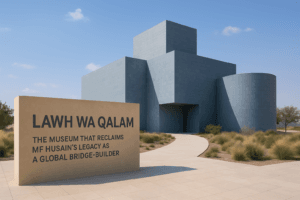
Lawh Wa Qalam: The Museum That Reclaims MF Husain’s Legacy as a Global Bridge-Builder
When the Lawh Wa Qalam museum dedicated to Indian modernist legend Maqbool Fida Husain opened in Doha, it did more than showcase art—it became a powerful act of cultural reclamation and dialogue. This museum is the world’s first dedicated entirely to Husain, an artist forced into exile from his homeland, who found creative sanctuary in Qatar.
The museum’s very existence asks us to reconsider the artist. Was he simply “the Picasso of India,” a celebrity artist chased out by controversy? Or was he a more profound figure—a connective thread between civilizations whose final, prolific chapter in Doha rewrites his entire story? A journey through this groundbreaking institution reveals the latter.
The Architecture: A Vision Realized in Stone and Shadow
The museum itself is the first clue that this is no ordinary tribute. Its striking geometric form, rising from the Doha skyline in shimmering blue-grey tiles, is a direct architectural translation of a sketch Husain himself made in 2008. For Indian architect Martand Khosla, tasked with bringing this sketch to life, the challenge was profound.
“A sketch does not have scale. It is an intent,” Khosla explained. The task was not to create a literal blueprint, but to develop a new architectural language from a philosophical starting point. The resulting building is a series of interconnected rectangular and cylindrical volumes, creating a labyrinthine layout that invites wandering and reflection.
This design philosophy mirrors Husain’s own artistic journey—rooted in an idea but boundless in its expression. The blue tilework, with origins in Central Asian architecture, is a material testament to the “shared cultural histories across South and West Asia” that the museum celebrates.
Inside the Narrative: A Life Reframed
Stepping inside the 3,000-square-meter space, visitors encounter over 150 works and objects—paintings, sculptures, films, tapestries, photographs, and personal artifacts like his old Indian passport. The curation consciously moves beyond a linear biography.
- An Intimate, Playful World: Curator Noof Mohammed states the intent was for visitors to experience the world as Husain did: “in an intimate, playful and reflective manner”. Galleries open with the artist’s own quotes, pulling visitors directly into his mindset.
- Beyond the Horses: While his iconic, muscular horses—some of contemporary art’s most recognizable and valuable images—rightly hold center stage, the museum pushes further. It gathers oral histories from his driver, friends, and collaborators to present the man behind the myth.
- The Late Qatari Chapter: The museum gives pride of place to a lesser-known but immensely significant period: the works Husain created in and for Qatar. In his final years, granted Qatari citizenship, he embarked on a major commission from Sheikha Moza bint Nasser, Chairperson of the Qatar Foundation.
This commission, a series on Arab civilization, represents one of his most ambitious late projects. In paintings like The Battle of Badr, Husain applied his signature dynamic lines and vibrant storytelling to Islamic history and philosophy, using warmer, earthen ochres inspired by the Gulf landscape. He was commissioned for 99 works but completed 35 before his death; these now form a core part of the collection.
The crowning jewel is Seeroo fi al ardh (Walk in the Land), a monumental multimedia installation that occupied his final years. This immersive work, which narrates the journey of human civilization through movement and sound, now has a dedicated gallery, fulfilling Husain’s own grand vision.
Exile and Sanctuary: The Political Canvas
To understand the deep resonance of this museum in Doha, one must confront the painful chapter that preceded it. Through the 1990s and 2000s, Husain—a Muslim artist in a majority-Hindu India—became a target of a concerted campaign by Hindu nationalist groups. His paintings from decades prior, which depicted Hindu deities in the nude, were branded obscene and sacrilegious.
The backlash was severe: hundreds of police complaints, ransacked homes, vandalized exhibitions, and relentless death threats. In 2006, in his 90s, he left India for his own safety, entering a state of exile. Though India’s Supreme Court later quashed the cases against him, he never felt safe to return.
Qatar offered more than just a safe harbor; it offered creative oxygen and recognition. Granted citizenship in 2010, he was “deeply engaged here, charmed and inspired by the Arab civilisation and culture,” as his friend, Qatari artist Yousef Ahmad, recalls. The museum, therefore, is not just a display case. It is a posthumous act of cultural sanctuary, affirming the value of an artist whom another part of the world had sought to silence.
As art historian Sonal Khullar notes, his exile was “an early sign of the kind of censorship and repression of speech, of expression that has become much more pervasive”. In this light, Lawh Wa Qalam stands as a monument to artistic freedom.
A Nexus of Soft Power and a Booming Market
The museum’s location within Qatar Foundation’s Education City is strategically and symbolically significant. This sprawling campus is already a hub for global education and modern Arab art, home to branches of universities like Georgetown and Northwestern and over 100 public art installations.
The opening of Lawh Wa Qalam is a cornerstone of Qatar’s long-term soft power strategy—using culture and education to build a progressive, knowledge-based global identity. For Qatar, dedicating a world-class museum to an Indian artist speaks directly to the over 850,000-strong Indian diaspora that forms a quarter of its population, strengthening a vital human and economic bond.
Simultaneously, the museum opens at a moment when Husain’s market is experiencing unprecedented heat. As shown in the table below, his auction records have skyrocketed, reflecting a surging global appetite for modern Indian art.
| Artwork | Sale Year | Auction House | Price (USD) | Significance |
| Untitled (Gram Yatra) | 2025 | Christie’s New York | $13.8 million | Current record; doubled the previous high for an Indian artist. |
| Various Works | Pre-2025 | Multiple | >$1 million (16 works) | Established his position in the high-value market. |
This commercial success underscores the museum’s role not just as a guardian of legacy, but as an institutional anchor that will further legitimize and contextualize his work for scholars, curators, and collectors worldwide.
The Final Brushstroke: A Legacy Connected
The Lawh Wa Qalam museum ultimately achieves something remarkable. It moves the conversation about M.F. Husain beyond the facile labels of “Picasso of India” or “controversial exile.” Instead, it presents him in full dimension: a rooted nomad, an eternal storyteller whose canvas stretched from Indian mythology to Islamic history.
The museum architect, Martand Khosla, perhaps put it best: “He had multiple identities simultaneously. And that layering is what makes this project incredibly rich”. In a world often fractured by cultural and religious polarization, Husain’s work—and the Doha museum that celebrates it—stands as a vibrant testament to the beauty and power of connection. It proves that an artist’s final home can become the place where his truest, most universal legacy is finally understood.
You must be logged in to post a comment.