
Land, Law, and Identity: The Roots of Conflict in Assam’s Karbi Anglong
The recent violence in Assam’s Karbi Anglong district, which led to fatalities, arson, and mass displacement, is the violent culmination of a protracted conflict rooted in competing land claims and demographic anxiety. Indigenous Karbi groups demand the eviction of non-tribal settlers (primarily Bihari and Bengali communities) from protected tribal lands under the Sixth Schedule, while settler families claim longstanding residence and have secured court stays against removal. The immediate flashpoint was the police’s handling of a Karbi hunger strike, which spiraled into riots, revealing a deeper crisis where constitutional protections for tribal autonomy have stalled amidst legal battles, political hesitation, and profound mutual distrust, leaving the region in a fragile and unresolved stalemate.
Land, Law, and Identity: The Roots of Conflict in Assam’s Karbi Anglong
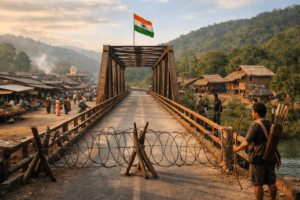
In the tribal-majority hills of Assam, a bridge over the Kopili River has become more than a structure of steel and concrete; it is now a stark symbol of division. On one side lies the Kheroni daily market, a hub for Bihari, Bengali, and Nepali settlers. On the other, villages of the indigenous Karbi community. In December 2025, this geographical fault line erupted into violence, claiming lives, burning homes, and exposing the deep fissures in a region constitutionally designed for peace. The clashes in West Karbi Anglong are not a spontaneous riot but the violent boiling over of long-simmering tensions over land, legal ambiguity, and existential fears in one of India’s protected tribal districts.
A Clash of Perspectives: Two Sides of the Kopili River
The conflict is rooted in two competing, deeply held narratives about history, rights, and belonging. The following table outlines the core grievances and demands of the primary groups involved.
| Perspective | Primary Grievance | Core Demand | Key Stated Fear |
| Karbi Indigenous Community | Illegal encroachment on protected VGR/PGR lands by non-tribal settlers. | Eviction of alleged illegal settlers to protect tribal land rights. | Becoming a minority in their own ancestral, constitutionally protected homeland. |
| Non-Tribal Settler Families | Being labeled “encroachers” despite decades of residence; facing hostility and violence. | Legal recognition and security for their homes and livelihoods. | Forced displacement and loss of life, property, and community without due process. |
| State Government | Legal constraints imposed by court stays on eviction drives. | A court-mandated or negotiated solution to resolve the standoff. | Breakdown of law and order and prolonged ethnic strife. |
From Simmering Tension to Violent Flashpoint
The path to violence was long, marked by legal petitions, protests, and a growing sense of grievance.
- The Historical and Legal Backdrop: The districts of Karbi Anglong and West Karbi Anglong are governed under the Sixth Schedule of the Indian Constitution, which grants tribal autonomous councils significant control over land, forests, and local governance to protect indigenous ways of life. The heart of the dispute is over Village Grazing Reserve (VGR) and Professional Grazing Reserve (PGR) lands—protected categories meant for community use. Karbi organizations allege that over 7,000 acres of such land have been encroached upon.
- The Catalysts: Tensions significantly escalated in early 2024 after an organization of the Bihari Nonia community submitted a memorandum seeking legalization for settlers present before 2011. This was perceived by the Karbi community as a direct challenge. Subsequent clashes and the Karbi Anglong Autonomous Council’s (KAAC) announcement to evict over 2,000 families created an atmosphere of fear and hostility. However, many of these families obtained interim stays from the Gauhati High Court, creating a legal deadlock that frustrated the Karbi community and left settlers in limbo.
- The Immediate Spark: In December 2025, the stalemate turned explosive. A group of nine Karbi individuals began an indefinite hunger strike in Phelangpi village, demanding action. In the early hours of December 22, police moved the protesters, stating they needed medical care. Rumors swiftly spread that their leaders had been arrested. This perceived provocation ignited the tinderbox. Protesters torched the ancestral home of KAAC leader Tuliram Ronghang, and violence quickly spread to the Kheroni market area.
The human cost was devastating. Suraj Dey, a disabled Bengali man, was tragically killed when his house was set ablaze. Athik Timung, a Karbi youth, died in clashes with police. Over 60 police personnel were injured by protesters armed with bows, arrows, and crude bombs. Mahima Dey’s account encapsulates the terror: “Our house was burned, and we jumped into the river to save ourselves… This morning, we found that nothing had been spared”.
The Constitutional and Political Quagmire
The violence lays bare the intense pressures on the Sixth Schedule framework. Created as a shield for tribal identity and resources, it is now straining under the weight of demographic change, political interests, and legal complexity.
Chief Minister Himanta Biswa Sarma acknowledged the government’s constrained position, stating, “We cannot forcefully remove people… due to legal constraints,” citing the High Court’s interim order. This legal paralysis feeds the Karbi community’s perception of neglect and political insincerity. As hunger strike leader Litsong Rongphar argued, the government’s inaction suits its broader political calculus.
Furthermore, the election of a Bihari leader as the local KAAC constituency member since 2017 has heightened Karbi anxieties about losing political control in their own autonomous council. The conflict thus exists at a painful intersection: constitutional protection, judicial process, and political demography.
The Aftermath and the Search for a Path Forward
In response to the violence, the state government imposed a curfew, suspended mobile internet services to curb rumor-mongering, and deployed heavy security, including columns of the Indian Army. An uneasy calm had returned by December 25.
Dialogue has been proposed as the way forward. State Minister Ranoj Pegu announced tripartite talks involving the government, the KAAC, and the protesters, initially scheduled for December 26. The government has reiterated its commitment to addressing the “broader issues related to [the] existence of the Karbi community”.
However, the road to resolution is steep. It requires navigating:
- A dense legal thicket of court cases to clearly define land ownership and occupancy rights.
- Genuine political dialogue that addresses not just the legality of settlements but the deep-seated ethnic and demographic fears of the Karbi people.
- A mechanism to provide justice and rehabilitation for victims of violence on all sides, and security for terrified communities.
The embers smoldering beneath the debris in Kheroni market are a metaphor for the region itself. The Sixth Schedule’s firewalls are being tested. The violence in Karbi Anglong is a stark reminder that legal autonomy alone cannot guarantee peace. It must be coupled with equitable governance, sensitive conflict resolution, and a shared vision for the future that acknowledges the rights and histories of all who call the fragile hills home. The bridge over the Kopili River awaits not just repair, but a reason for communities to cross it again in peace.
You must be logged in to post a comment.