
Kandla Port’s Silent Revolution: How IIT Madras-Backed LIM Tech Could Redefine India’s Cargo Future
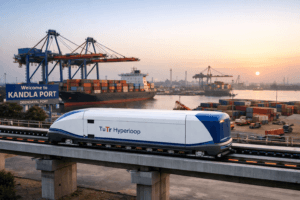
In a significant step for India’s logistics and deep-tech sectors, an IIT Madras-incubated startup, TuTr Hyperloop, has successfully tested an indigenous electromagnetic cargo transportation system at Gujarat’s Deendayal Port in Kandla. The trial of a Linear Induction Motor (LIM)-based prototype, which propels cargo pods along a track with minimal mechanical contact, marks a crucial transition from laboratory to a live port environment, directly addressing the pressing challenges of congestion, rising operational costs, and emissions.
Buoyed by this success, the port authority and startup are now exploring an advanced magnetic levitation (maglev) demonstration, positioning Kandla as a testbed for next-generation, sustainable port infrastructure. This collaboration exemplifies a pragmatic pathway for implementing homegrown innovation, aligning with national self-reliance goals while offering a scalable model to enhance the efficiency and environmental footprint of critical trade gateways.
Kandla Port’s Silent Revolution: How IIT Madras-Backed LIM Tech Could Redefine India’s Cargo Future
The air at Deendayal Port in Kandla is thick with the scent of salt, diesel, and global trade. Giant cranes swing like metronomes against the skyline, orchestrating the movement of containers that feed a nation’s economy. Here, efficiency is measured in minutes, and congestion is a multi-million dollar problem. It is in this gritty, real-world laboratory that a quiet but profound experiment recently concluded—one that may chart a new course for India’s maritime logistics.
An IIT Madras-incubated startup, TuTr Hyperloop, has successfully trialed an indigenous, electromagnetic cargo transport system. While the “Hyperloop” in its name evokes visions of vacuum tubes and supersonic speeds, the Kandla trial was something different, and perhaps more immediately revolutionary: a practical, scalable Linear Induction Motor (LIM) system moving cargo pods along a fixed track. This isn’t science fiction; it’s a deliberate, stepwise engineering approach to solving the twin crises of port congestion and emissions.
The Bottleneck at India’s Gateways
To understand the significance, one must first grasp the problem. India’s major ports handle over 95% of the country’s export-import volume. As trade grows, so does the pressure on the intricate ballet between ship, quay, yard, and gate. Traditional systems reliant on diesel-powered trucks and internal transfer vehicles (ITVs) create a cacophony of delays, high maintenance costs, and significant carbon footprints. Congestion at ports doesn’t just slow ships; it ripples through supply chains, increasing costs for everything from factory inputs to retail goods.
The challenge is twofold: velocity and verde (green). Ports must move cargo faster from ship to hinterland while slashing emissions to meet India’s 2070 net-zero pledge. Conventional wheeled transport, with its friction, wear, and fuel dependency, is hitting its limits. The search is on for a paradigm shift—a system that is electric, high-throughput, and inherently low-friction.
The Kandla Trial: Electromagnetism in Action
Enter TuTr Hyperloop’s LIM-based prototype. At its core, the technology is elegant. A Linear Induction Motor is essentially a conventional rotary motor unrolled flat. By sequentially energizing coils along a track, it creates a traveling magnetic field. A reaction plate on the cargo pod interacts with this field, producing thrust—no physical contact, no diesel combustion, just clean electromagnetic force.
The Kandla trial moved this concept from the controlled confines of an IIT lab to the dust and dynamism of a live port. The successful demonstration proved several critical points:
- Operational Resilience: The system functioned in a real-world environment with ambient dust, temperature variations, and operational interference.
- Control and Safety: Smooth acceleration and deceleration of cargo pods were achieved, crucial for fragile goods and container stability.
- Reduced Mechanical Complexity: With no engines, gearboxes, or drive axles on the pod itself, maintenance is centralized on the track, promising lower lifetime costs and higher uptime.
This is a crucial pivot. Rather than leaping directly to the complex and capital-intensive dream of maglev (magnetic levitation), TuTr is taking a pragmatic intermediate step. LIM-based transport keeps the pod on wheels or a simple guideway, using electromagnetism solely for propulsion. It’s a “tech infusion” strategy—introducing a disruptive core technology (electromagnetic propulsion) within a more familiar operational framework, thereby lowering the barrier to adoption.
The Maglev Horizon and the Strategic Roadmap
The LIM trial is not the final destination but a vital proof-of-concept. Encouraged by its success, Deendayal Port Authority and TuTr are already contemplating the next phase: a magnetic levitation (maglev) cargo demonstration. This is where the vision expands.
A maglev system would eliminate wheel-rail friction entirely, levitating the pod a few centimeters above the track using powerful magnets. The benefits are profound: near-silent operation, virtually zero wear on the guideway, and even higher energy efficiency. For a port like Kandla, deploying a maglev network for internal cargo transfer could mean moving thousands of containers daily with the whisper of electricity, dramatically cutting turnaround times for ships and trucks.
This phased approach—from LIM to maglev—reveals a sophisticated strategy. It de-risks innovation for the port authority, allowing them to test the underlying electromagnetic architecture before committing to a full levitation system. It positions Kandla not just as a user, but as a co-developer and global testbed for next-generation port logistics. In an era where port efficiency is a key national competitive advantage, this is strategic foresight.
The Bigger Picture: Indigenous Deep-Tech in the Real World
The narrative here transcends a single startup or port. It embodies a larger, often elusive, ambition: translating India’s formidable academic research into tangible, scalable industrial solutions. IIT Madras has long been a powerhouse of engineering brilliance, but the bridge to commercialization has sometimes been shaky. TuTr’s journey, culminating in a field trial at a major port, represents a maturation of India’s deep-tech ecosystem.
This collaboration is a blueprint for “Atmanirbhar Bharat” in critical infrastructure. It’s not about isolated import substitution, but about embedding home-grown innovation into the very sinews of the economy—ports, railways, highways. A successful, scaled implementation would provide a formidable reference case, convincing other risk-averse industrial operators that Indian deep-tech is robust, reliable, and ready.
Furthermore, it reframes the hyperloop narrative. While the ultimate vision of passenger capsules speeding through low-pressure tubes faces regulatory and economic mountains, the underlying propulsion and pod-control technologies have found a pragmatic, immediate application. It’s a lesson in technology spin-off: sometimes the most valuable part of a moonshot is the ladder you build on the way up.
Challenges on the Track Ahead
The path forward, however, is not without its curves. An economic feasibility study will be paramount. The capital expenditure for laying electromagnetic guideways across a sprawling port will be significant, weighed against long-term savings in fuel, maintenance, and efficiency gains. Regulatory standards for such novel transport systems within hazardous port zones will need to be developed. Workforce training for a new kind of maintenance paradigm will be essential.
Yet, these are challenges of scaling, not of viability. The Kandla trial has proven the fundamental science works in the field. The next phase is about engineering, economics, and visionary leadership.
Conclusion: A Silent Symphony in the Making
The true success at Kandla may not be the sight of a cargo pod moving silently along a test track. It is the alignment of a startup’s innovation, a port authority’s ambition, and a nation’s strategic need. In the cacophony of a busy port, TuTr Hyperloop is composing a new, silent symphony of logistics—one powered by magnetic fields and strategic foresight.
If this vision holds, the ports of the future may no longer be defined by the rumble of diesel engines, but by the efficient, silent pulse of electromagnetism, moving the lifeblood of trade with precision and clean energy. Kandla’s trial run is the first, tentative note in that symphony, and its echo could resonate across every gateway to India’s economy. The race to redefine port logistics is on, and India has just placed a smart, indigenous bet.
You must be logged in to post a comment.