
Judicial Review of Palestine Action Ban: A Constitutional Battle Over Terrorism Definitions and Civil Liberties
Scotland’s highest civil court has granted permission for a judicial review of the UK government’s ban on Palestine Action, which was proscribed as a terrorist organization following a 2025 break-in at RAF Brize Norton that caused millions in damage. Brought by former diplomat Craig Murray and set for a substantive hearing in March 2026, the challenge argues the ban unlawfully curtails freedoms of expression and assembly under human rights law, constituting a case of “great constitutional significance.” The review centers on the disputed definition of terrorism, with government prosecutors citing a campaign of property damage against defense firms, while critics and a disclosed Scottish counter-terrorism assessment contend the group’s actions do not meet the statutory threshold, representing instead a dangerous expansion of anti-terror powers that criminalizes political protest and has led to thousands of arrests across the UK.
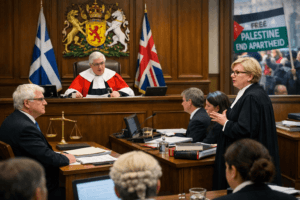
Judicial Review of Palestine Action Ban: A Constitutional Battle Over Terrorism Definitions and Civil Liberties
A judge at Scotland’s highest civil court has greenlit a challenge that questions not just a government ban, but the very definition of terrorism in modern Britain.
Scotland’s Court of Session has granted permission for a judicial review of the UK government’s controversial decision to proscribe the direct action group Palestine Action as a terrorist organisation. This ruling, handed down by Lord Young, sets the stage for what lawyers describe as a case of “great constitutional significance” that pits national security concerns against fundamental civil liberties .
The case, brought by former diplomat Craig Murray, will proceed with a procedural hearing on 23 February 2026 and a substantive two-day hearing on 17-18 March 2026. This Scottish challenge runs parallel to separate proceedings in England, potentially creating a constitutional dilemma if courts in different UK jurisdictions reach conflicting conclusions about the legitimacy of the ban .
The Catalyst: From Protest to Proscription
The UK government’s decision to proscribe Palestine Action followed what former Home Secretary Yvette Cooper described as “the disgraceful attack on Brize Norton” on 20 June 2025 . During this incident, activists broke into the Oxfordshire airbase and caused what Defence Secretary John Healey later confirmed was £7 million in damage to two RAF Voyager aircraft, spraying paint that reportedly entered the engines .
Palestine Action claimed responsibility for the break-in as a protest against UK support for Israel’s military actions in Gaza. The government responded swiftly, with Cooper announcing the proscription decision just three days later on 23 June 2025, and Parliament voting overwhelmingly (385-26 in the Commons) to add Palestine Action to the list of proscribed organisations under the Terrorism Act 2000 .
The group, founded in July 2020 by Huda Ammori and Richard Barnard with the stated goal of ending British complicity in what it calls Israel’s “genocidal and apartheid regime,” has conducted a campaign targeting defense contractors, particularly those with links to Israel . According to government statements, their activities have included attacks on facilities belonging to Thales in Glasgow (2022), Instro Precision in Kent, and Elbit Systems in Bristol, with damage running into millions .
Table: Timeline of Key Events
| Date | Event | Significance |
| 20 June 2025 | Brize Norton break-in | Catalyst for proscription decision |
| 23 June 2025 | Home Secretary announces proscription | Formal decision made |
| 5 July 2025 | Proscription order comes into force | Support becomes criminal offense |
| 12 January 2026 | Court of Session hearing | Permission for judicial review granted |
| 17-18 March 2026 | Scheduled substantive hearing | Core legal arguments to be heard |
The Legal Challenge: Grounds for Review
Craig Murray’s petition presents three primary grounds for challenging the proscription order. First, he argues that the decision was procedurally unfair, made without prior consultation with those affected despite what he characterizes as the “draconian” nature of proscription powers. Second, he contends the order disproportionately interferes with freedom of expression under Article 10 of the European Convention on Human Rights (ECHR). Third, he claims it similarly violates freedom of association under Article 11 of the ECHR .
Joanna Cherry KC, representing Murray, emphasized the constitutional dimensions of the case, telling the court: “This proscription has curtailed those liberties” protected by Articles 10 and 11 . The petition asks the court to declare the 2025 Order “ultra vires” (beyond legal authority) and to quash it .
The UK government, represented by Baroness Smith of Cluny KC, initially opposed the Scottish proceedings on two grounds: questioning Murray’s standing (as he is not a Palestine Action member) and arguing the Scottish case duplicated the ongoing challenge in England. However, Lord Young ruled it appropriate for the Scottish review to proceed independently despite the English case being at a more advanced stage .
The Core Debate: Where Does Protest Become Terrorism?
At the heart of this legal battle lies a fundamental disagreement about the definition of terrorism and its application to protest movements. The government’s case, as outlined in parliamentary debates, emphasizes Palestine Action’s “nationwide campaign of direct criminal action” targeting “key national infrastructure and defence firms” .
Crucially, the government points to what it describes as an escalation in methods, including the distribution of “The Underground Manual,” which allegedly provides “practical guidance on how to carry out activity against private companies and Government buildings” and encourages “the creation of cells” . Home Secretary Cooper told Parliament she had received “disturbing information” about “ideas and planning for future attacks,” though she claimed this could not be publicly disclosed due to ongoing criminal proceedings .
Critics challenge this characterization on multiple fronts. Legal scholars note that while the Terrorism Act 2000 definition includes “serious damage to property,” applying this to direct action groups represents what one analysis calls an “unprecedented” expansion of anti-terrorism powers . The Scottish Palestine Solidarity Campaign (SPSC) contends that proscription represents the “misuse of counter-terrorism legislation to suppress political expression” .
Perhaps most significantly, Freedom of Information disclosures revealed that the Scottish counter-terrorism board concluded in May 2025 that Palestine Action’s activities were “not close to meeting the statutory definition of terrorism” . This assessment directly contradicts the UK government’s position and may significantly influence the Scottish court’s deliberations.
The Human Rights Dimension: A Chilling Effect on Speech
Since the proscription took effect on 5 July 2025, thousands of arrests have been reported across the UK for activities ranging from wearing Palestine Action t-shirts to displaying signs at protests . The legal framework created by proscription includes severe penalties: up to 14 years imprisonment for membership or inviting support, and up to 6 months for wearing clothing or displaying articles that arouse “reasonable suspicion” of support .
These broad restrictions create what legal analysts describe as a significant chilling effect on free speech. As one constitutional law blog notes, “A person might speak supportively of a proscribed organisation as a shorthand way to express solidarity with its cause, without wishing to endorse the means employed by the organisation” . The distinction becomes legally blurry under the current framework.
Former First Minister Humza Yousaf has called for exemptions for “peaceful protesters” supporting Palestine Action, while SPSC spokesman Mick Napier describes the arrests as “this escalating madness” . According to advocacy groups, more than twenty people are currently imprisoned without trial, with some facing up to two years of detention before their cases are heard .
Broader Implications: Constitutional Questions and Precedents
This case extends beyond the specific fate of Palestine Action to touch on fundamental constitutional questions. The possibility of divergent rulings between Scottish and English courts raises the prospect of what campaign group Defend Our Juries calls a “constitutional crisis,” with the ban potentially annulled in Scotland but remaining in force in England and Wales .
The case also tests the boundaries of devolution and legal autonomy. As Joanna Cherry KC emphasized in court, this case “impacts on fundamental liberty and human rights of people living and working in Scotland” . The Scottish court’s willingness to proceed with an independent review despite ongoing English proceedings signals confidence in Scotland’s distinct legal jurisdiction.
More broadly, the outcome may establish important precedents for how Western democracies balance security concerns with protest rights in an era of heightened geopolitical tensions. Legal scholars warn that if the proscription survives challenge, it could “pave the way for proscription to be used in relation to a broader range of groups in future” . This concern echoes Palestine Action’s own comparison of themselves to suffragettes, suggesting historical protest movements might have faced similar bans under contemporary terrorism laws .
The Security Response and Ongoing Actions
While the legal battle proceeds, security measures have been enhanced at potential targets. Defence Secretary John Healey announced that RAF Brize Norton is now “much safer” following the installation of new technology, surveillance systems, and additional security guards . Meanwhile, five individuals charged in connection with the Brize Norton incident have pleaded not guilty, with a trial scheduled for January 2027 at the Old Bailey .
Palestine Action’s campaign continues despite the ban, with the group claiming responsibility for various actions including the unexpected closure of Elbit’s Aztec West site in September 2025, though the company’s lease reportedly ran until 2029 . The government notes the group has expanded its targets beyond defense contractors to include “financial firms, charities, universities and Government buildings” .
Looking Ahead: What the March Hearing May Decide
As the case moves toward its substantive hearing in March 2026, several key questions will dominate proceedings:
- Procedural fairness: Was the expedited process (just two weeks from announcement to implementation) justified, or did it prevent proper scrutiny? Critics note that Parliament voted on Palestine Action’s proscription alongside two other groups (the Maniacs Murder Cult and Russian Imperial Movement), potentially limiting focused consideration .
- Proportionality: Even if Palestine Action meets the technical definition of terrorism, is proscription a proportionate response compared to using existing criminal laws for property damage? The Scottish counter-terrorism board’s assessment that the group’s activities fall short of terrorism will likely feature prominently in this analysis .
- Devolved implications: How will the court address the apparent contradiction between the UK government’s terrorism designation and the Scottish counter-terrorism board’s contrary assessment? This tension highlights the complex interplay between reserved and devolved matters in UK constitutional law.
- Evidence scrutiny: How much weight will the court give to the government’s undisclosed intelligence about alleged future plots? As legal analysts note, such arguments “invite the public to accept the case for proscription as a matter of trust” .
The outcome will reverberate beyond courtrooms to affect protest policing, free speech boundaries, and the very definition of legitimate dissent in contemporary Britain. As both sides prepare for the March hearing, this case continues to pose enduring questions about how democracies can protect both security and liberty in increasingly polarized times.
You must be logged in to post a comment.