
JSW Motors Enters the Fray: Can the Boxy Jetour T2 Reshape India’s SUV Landscape?
JSW Motors is set to enter the Indian automotive market with the debut of the boxy and rugged Jetour T2 SUV around Diwali 2026, aiming to disrupt the premium mid-size segment with its distinctive Land Rover Defender-inspired design, a feature-packed cabin highlighted by a 15.6-inch screen and Level 2 ADAS, and a choice of powerful turbo-petrol engines. While its commanding presence, loaded feature list, and focus on five-seat luxury position it as a stylish alternative to established rivals like the Tata Harrier and Mahindra XUV700, its success will hinge on overcoming the challenges of a new brand’s service network, the absence of a diesel option, and a starting price expected around Rs 30 lakh, making it a bold and intriguing new player in the market.
JSW Motors Enters the Fray: Can the Boxy Jetour T2 Reshape India’s SUV Landscape?
The Indian automotive landscape is about to get a new player, and it’s arriving with a bang rather than a whimper. The JSW Group, a name synonymous with steel and energy, is officially venturing into the passenger vehicle market with JSW Motors. Their debutant? The unmistakably bold Jetour T2.
Scheduled for a launch around Diwali in November 2026, this isn’t just another facelift or a rebadged compact SUV. It’s a statement of intent. As the headline quips, “another day, another new SUV” might be the initial reaction, but the Jetour T2, with its Defender-esque silhouette and rugged promise, warrants a deeper look.
This isn’t just about a new model; it’s about a new brand entering a fiercely competitive arena. Here’s an in-depth exploration of what the JSW Jetour T2 means for you, the Indian consumer, and the market at large.
The Grand Entrance: Why JSW Motors and Why Now?
The JSW Group’s foray into automobiles is a calculated and significant move. India is currently the world’s third-largest car market, and the SUV segment is the undisputed king, consistently posting double-digit growth figures. By entering with a lifestyle SUV, JSW is tapping directly into the vein of Indian consumer aspiration.
But why partner with Jetour? Jetour is a brand under the umbrella of Chery, China’s largest automotive exporter. For JSW, this partnership provides a readymade product platform with global appeal and proven engineering, bypassing the decades-long process of developing an all-new vehicle from scratch. For Jetour, it’s a gateway into one of the most promising auto markets in the world, with a powerful and trusted Indian conglomerate as its guide.
This debut, slated for late 2026, gives JSW Motors ample time to set up a dealership network, finalize localization strategies to keep costs competitive, and build pre-launch hype. The choice of Diwali—a festival of new beginnings—is a masterstroke in cultural marketing.
Design Deconstructed: A Love-Letter to the Box
The first thing that strikes you about the Jetour T2 is its unapologetically boxy design. In a world of coupe-like rooflines and swooping curves, the T2 stands upright and proud.
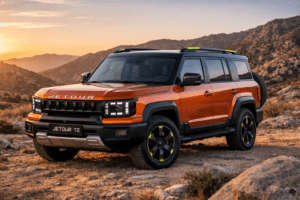
The “Defender” Vibe is Real (and That’s Okay) Let’s address the elephant in the room: the design inspiration. The T2’s silhouette, with its square wheel arches, clamshell bonnet, and upright tailgate, does echo the modern Land Rover Defender. However, in the automotive world, inspiration is a given. The key is execution. Jetour has managed to blend these influences into a cohesive identity of its own. The front fascia, with its massive grille bracketed by pixel-style LED headlamps, is aggressive and distinctive. It’s a face that won’t get lost in a parking lot.
The Devil in the Neon Details This is where the T2 tries to carve its own niche. The design brief seems to be “rugged meets futuristic.” The pixelated LED elements in the headlamps and tail lamps scream “tech,” while the chunky bumpers and pronounced skid plates whisper “trail.”
The neon accents—seen on the alloy wheels and within the roof rails—are a quirky touch. It’s a design gamble. Some will find it fresh and sporty, while others might wish for a more understated approach. This youthful flair suggests JSW is targeting not just the traditional SUV buyer but a younger, more style-conscious demographic.
Size and Stance At nearly 4.8 meters in length and with a ground clearance of 220mm, the T2 is a commanding presence. It’s important to note that the article compares it to the Tata Harrier and Mahindra XUV700 in terms of size, but it is actually longer and wider than both. Its width, at over 2 meters, is particularly noteworthy. This will translate to immense road presence and cabin spaciousness, but it could also be a point of contention in narrow city streets and tight parking spots. This is a crucial “human insight” point for potential buyers: do you have the garage space for it?
The tailgate-mounted spare wheel is a classic off-road cue, but here it’s presented in a modern, almost sculptural way. It’s not just functional; it’s a design centerpiece.
Inside the Cockpit: A Blend of Minimalism and Tech
Step inside, and the T2’s cabin aims to be a sanctuary of space and technology. The horizontally laid-out dashboard is a masterclass in making a wide car feel even wider.
Screen Central The 15.6-inch central touchscreen is the undisputed star of the show. In an era where screens are getting bigger, this one promises to be a powerhouse of infotainment and vehicle control. The challenge for JSW will be in the software. A big screen is useless without intuitive, lag-free software. They will need to ensure the user interface is tailored for Indian users, with seamless smartphone connectivity and possibly even local language support.
The 10.25-inch digital instrument cluster is another welcome feature, putting all critical driving information directly in the driver’s line of sight.
Material World The mention of “soft-touch materials” and an “upmarket look” is critical. The starting price is expected to be around Rs 30 lakh, which places it in the premium mid-size SUV category. At that price point, hard, scratchy plastics would be a deal-breaker. JSW Motors needs to ensure that the cabin quality matches the premium price tag. The use of leatherette and the option of a brown interior theme suggest they are aiming for a “premium lounge” feel, which could be a strong differentiator against more utilitarian rivals.
Practical Touches The inclusion of grab handles on the pillars is a thoughtful touch, acknowledging the vehicle’s significant step-in height. The sliding and reclining rear seats are a fantastic feature for a five-seater, allowing passengers to prioritize either legroom or boot space. This level of flexibility is often overlooked but highly valued by Indian families who use their SUVs for everything from daily commutes to long road trips.
Features and Safety: Loaded to the Gills
The Jetour T2 is entering the Indian market with a “fully loaded” strategy. The feature list reads like a checklist of everything a modern SUV buyer desires:
- Comfort & Convenience: Dual-zone automatic climate control, a panoramic sunroof, and a powered tailgate are becoming standard expectations. The T2 goes a step further with ventilated front seats—a near-essential feature for Indian summers—and even adds massage and memory functions, pushing it into true luxury territory.
- Audio Experience: A 12-speaker Sony sound system is a significant selling point for the music-loving Indian audience. It signals that the in-cabin experience is a top priority.
- Safety Net: The inclusion of Level 2 ADAS is a massive win. Features like autonomous emergency braking, adaptive cruise control, and lane-keep assist are no longer just novelties; they are becoming important safety benchmarks. This, combined with multiple airbags, a 360-degree camera, and ESC, positions the T2 as one of the safest vehicles in its segment on paper.
The Powertrain Puzzle: What’s Under the Hood?
This is where the story gets most interesting and where JSW Motors will have to make its most crucial decisions.
Globally, the T2 offers a range of options, but the Indian market has its own unique demands.
- The 2.0-litre Turbo Petrol (254 PS / 390 Nm): This is the “hero” engine. With 4WD and serious torque, this is the powertrain that backs up the T2’s rugged looks. For driving enthusiasts and those who genuinely venture off the beaten path, this will be the one to watch. However, a 2.0-litre petrol engine in India comes with a significant tax (cess) and will likely have higher fuel consumption. It will be the halo model, commanding the highest prices.
- The 1.5-litre Turbo Petrol (184 PS / 290 Nm): This is the likely volume driver. With 184 bhp, it’s no slouch and offers strong performance for daily driving. Paired with a 7-speed DCT and front-wheel drive, it will be more fuel-efficient and affordable. This variant will be the one that does battle with the petrol versions of the Tata Harrier and Mahindra XUV700.
- The Plug-In Hybrid (156 PS): The article suggests this is “unlikely to make its way to our shores,” and for now, that’s a sensible decision. Plug-in hybrids often occupy a confusing middle ground in India, lacking the full EV benefits and being priced higher than常规 hybrids. However, with increasing scrutiny on fuel efficiency, JSW might keep it as a future option.
The Missing Manual and Diesel Dilemma The absence of a manual gearbox will alienate a small but passionate group of driving purists. However, the Indian market has overwhelmingly shifted towards automatics, especially in the premium segments. The 7-speed DCT is a sound choice, offering a good balance of performance and efficiency.
The bigger question is the absence of a diesel engine. The SUV market in India was built on the back of diesel’s torque and fuel economy. While the landscape is changing, a significant portion of buyers in this segment (especially in the 2.0-litre category) still prefer diesel. JSW Motors is essentially betting that the T2’s design, features, and powerful petrol engines will be enough to lure buyers away from established diesel rivals. It’s a bold, and potentially risky, gamble.
The Road Ahead: Pricing, Rivals, and the Verdict
Expected Price: The estimated Rs 30 lakh (ex-showroom) starting price is a fascinating proposition. This would place it slightly above the top-end variants of the Tata Safari and Mahindra XUV700 but below the Jeep Meridian. It’s a smart positioning—entering as a premium alternative to the mass-market kings.
Who is it Rivaling? The list provided (Harrier, Safari, XUV700, Hector, Meridian) is accurate, but it highlights a unique opportunity. The T2 is essentially trying to be all things to all people:
- Against the Harrier and XUV700, it offers a more distinctive, rugged design and a potentially more premium interior.
- Against the Jeep Meridian, it promises similar road presence and a 7-seater option? (Wait, is it a 7-seater?) The article clearly states it’s a five-seater. This is a critical point. The Safari and Meridian offer three rows. By sticking to five seats, the T2 is prioritizing outright comfort for passengers over maximum capacity. Its rivals will be the spacious five-seat versions of the XUV700 and the top-end Harrier.
The Final Word: The “Human” Perspective
The JSW Jetour T2 is more than just a new car; it’s a new flavour in a market that was in danger of becoming homogeneous.
For the buyer, the genuine value lies in this: You’re getting a head-turner of a vehicle with a commanding road presence, a plush and tech-loaded cabin, and a choice of powerful, modern engines. It’s for someone who wants to stand out, who values design and features as much as, if not more than, brand legacy. It’s for the buyer who might have considered a Jeep Compass but wanted more space, or an XUV700 but desired a more exclusive feel.
The challenges are real. The lack of a diesel engine, the establishment of a new brand’s service network, and the final on-road pricing are all factors that will make or break its success.
The JSW Motors Jetour T2 is a tantalizing prospect. It promises the space and practicality of a family SUV with the visual drama of a lifestyle off-roader. If JSW Motors can price it aggressively, back it with a robust sales and service experience, and deliver on the promise of a premium cabin, they won’t just be introducing a new SUV; they’ll be introducing a serious new contender that could disrupt the established order. Diwali 2026 just got a lot more interesting.
You must be logged in to post a comment.