
Joy Denied: How War and Blockade Have Turned Eid Toys Into a Luxury Gaza Families Can’t Afford
Amid severe Israeli import restrictions during the ongoing war, toys have become nearly impossible to bring into Gaza, causing shortages and price hikes of up to 300 percent—a doll that once cost $5 now sells for $20. Parents like Rania al-Saudi, displaced and struggling to afford even basic necessities, find themselves unable to buy Eid gifts for their children, leading to heartbreak at toy stalls across Gaza City. Vendors say they are forced to charge exorbitant prices because they obtain merchandise through risky, unofficial routes at great cost, and many families now leave empty‑handed. With the blockade effectively barring non‑essential goods, Gaza’s children—many of whom have lost homes and loved ones—are left to celebrate the holiday with makeshift games in the sand, their joy another casualty of war.
Joy Denied: How War and Blockade Have Turned Eid Toys Into a Luxury Gaza Families Can’t Afford
In the cramped alleyways of Gaza City’s al-Rimal market, the usual pre-Eid bustle carries a distinctly different tone this year. The scent of fresh bread and frying falafel still drifts from nearby stalls, but the joy that once accompanied the approach of the holiday has been replaced by something heavier—a quiet desperation that settles over parents and children alike as they confront the brutal economics of celebration during wartime.
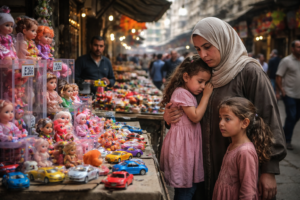
Rania al-Saudi arrived at a modest toy stall with two promises wrapped in her heart. The first was to her six-year-old daughter Razan, who had been asking for a doll for months. The second was to herself—a quiet vow that this Eid would not pass without some small token of normalcy for her children. But as she moved from one toy to another, asking prices that seemed to multiply with each inquiry, she felt those promises crumbling in her hands.
“The prices are extremely high,” she told Al Jazeera, her voice carrying the exhaustion of a mother who has learned to measure love in what she can afford. “The vendors tell us that toys have not entered Gaza since the start of the war. But what did our children do to deserve this?”
It is a question that echoes across the Gaza Strip this Eid season, where the simple act of giving a child a toy has become an exercise in financial reckoning. A doll that once cost 15 shekels—roughly $5—now commands 60 shekels, or $20. Small toy cars have leaped from 40 shekels to 150. Even a basic ball, the universal currency of childhood joy, now costs ten times what it did before the war began in October 2023.
The Economics of Scarcity
For vendors like Anwar al-Huwaity, who has spent two decades building a business around children’s smiles, these prices are not the product of greed but of a supply chain that has been systematically dismantled. The main commercial crossing at Karem Abu Salem—Kerem Shalom—has been closed or severely restricted for much of the war. What little merchandise reaches Gaza now moves through informal channels, with each handoff adding layers of cost and risk.
“Today, we go from one trader to another, searching,” Anwar explained. “Sometimes we find toys with someone who had them stored, but they sell it at a very high price, up to three times its normal price.”
The math is brutal. Middlemen demand as much as 12,000 shekels—nearly $3,900—for a small shipment, with no guarantee that it will arrive intact. If Israeli authorities confiscate the goods or airstrikes destroy them before they reach market, the loss belongs entirely to the trader who took the risk. Those risks are then passed along to parents who can barely afford to feed their families.
Before the war, Anwar’s holiday season sales would range between $6,500 and $10,000. This year, he considers himself fortunate if he moves $1,000 worth of stock. Most of that comes from bulk sales to other traders rather than the individual customers who once formed the heart of his business.
Nearby, Ahmed Ziara, a 24-year-old who once worked in major toy exhibitions, described a trade that has gone underground. “Now toys rarely enter, and we often have to smuggle them, sometimes hidden inside clothes or other goods,” he said. Most of what he sells is old stock that was already in Gaza when the war began—inventory that grows more precious with each passing month.
Children Caught in the Crossfire
For parents like Rania, these market realities translate into painful conversations with children who cannot understand why the world has changed so dramatically. Her younger daughter Lulwa began to cry when she realized the doll she wanted would not be coming home with them. Rania tried to explain, but how do you explain blockade economics to a child who only knows that Eid is supposed to mean gifts?
“My daughters will not be happy this Eid,” she said quietly. “I wanted to compensate by getting them dolls, but even that is impossible.”
The psychological toll on Gaza’s youngest residents is immeasurable. Most families have been displaced, often multiple times. Homes that once held collections of toys have been reduced to rubble. The familiar comforts of childhood—stuffed animals, building blocks, dolls that could be dressed and named—have been replaced by the harsh realities of life in displacement camps, where children have learned to create games from whatever materials they can find.
“All the children in the camp face the same situation, so they spend their time playing simple street games like hopscotch, hide-and-seek, or drawing in the sand,” Rania said. “But my daughters always wished for a doll. I once tried to make one for them, but they didn’t like it.”
That last detail—the homemade doll that failed to capture her daughters’ affection—speaks to something deeper than material deprivation. It is the story of a mother trying to manufacture joy from scraps, and the quiet heartbreak of falling short.
More Than Just Toys
What is being denied to Gaza’s children extends far beyond plastic dolls and remote-controlled cars. The absence of toys represents a larger pattern of deprivation that has come to define life under blockade—the systematic restriction of anything that might be considered “non-essential” while families struggle to secure food, water, and medicine.
Though no official Israeli law explicitly bans the import of toys, the combination of closed crossings, security restrictions, and the prioritization of humanitarian goods has effectively made their entry impossible. The United Nations has documented how restrictions on commercial goods have affected the availability of both essential and non-essential items, but for families on the ground, the distinction between what is essential and what is not blurs when a child asks why there is no gift for Eid.
The timing compounds the tragedy. Eid al-Fitr, the holiday that marks the end of Ramadan, is supposed to be a time of celebration—new clothes, family gatherings, and the ritual of children receiving gifts. Across the Muslim world, parents save for months to ensure their children feel the joy of the holiday. In Gaza this year, that joy has become another casualty of war.
The Vendors’ Dilemma
For the men who run the toy stalls, the situation has become almost unbearable. Anwar al-Huwaity says he has begun to hate his workday—a remarkable confession from someone who built his career on the simple pleasure of making children happy.
“I know the prices are exorbitant, and when the children and families see the toys, they get upset, especially during the holidays,” he said. “People come to buy toys and beg me to lower the price. They say, ‘This child is an orphan, that child is an orphan … his parents were killed in the war.’ It feels like all children in Gaza have become orphans.”
The hyperbole carries the weight of truth. In a conflict that has killed tens of thousands of Palestinians, the number of children who have lost one or both parents is staggering. For them, a toy would represent more than a gift—it would be a small gesture of normalcy in lives that have been defined by loss.
Ahmed Ziara described the same moral calculus. “Sometimes I have to sell below the expected price just to clear stock, but most of the time we must raise prices due to high costs and difficulty obtaining toys.” He paused, reflecting on his work. “Sometimes I sit alone and tell myself what I am doing is unfair because prices are extremely high. But despite everything, we love to bring joy to children, even for a short time.”
A Holiday Haunted by Loss
This Eid arrives under the shadow of a conflict that shows no signs of abating. A ceasefire declared in October has reduced the intensity of fighting, but Israeli strikes continue regularly, and the economic siege remains largely intact. Famine was declared in northern Gaza in 2025, a stark reminder that for many families, the question of how to celebrate Eid is secondary to the question of how to survive it.
Rania al-Saudi knows this calculus intimately. Displaced from her home in Shujayea in eastern Gaza, she now lives with her daughters in the western part of the city, navigating a reality where even the modest tradition of new clothes for Eid has become unaffordable. The dolls she hoped to buy were meant to compensate for what she could not provide—a small consolation for children who have already lost so much.
“The prices are extremely high,” she repeated, as if saying it again might make it less true. “Everything is expensive and overpriced.”
As she spoke, her daughter Lulwa’s cries subsided into the defeated silence of a child who has learned not to expect too much. It is a silence that speaks louder than any complaint—the quiet acceptance of a childhood interrupted by forces no child should have to understand.
The Path Forward
Vendors like Anwar and Ahmed hold out hope that conditions will improve, that the crossings will open to commercial goods, that the artificial scarcity driving prices beyond reach will ease. “If conditions improve and toys are allowed in normally, prices will return to normal, and children and families will be able to enjoy the holiday as before,” Ahmed said.
But for now, the stalls in al-Rimal market remain mostly untouched. Parents stop to ask, to hope, to bargain, and then walk away empty-handed. The toys sit on display, bright and colorful against the gray backdrop of a city under siege—small symbols of a normal life that remains just out of reach.
In the end, Rania gathered her daughters and began the walk back to their displacement camp. She had come looking for joy and found only the painful arithmetic of survival. Her daughters would mark another Eid without gifts, another holiday defined by absence rather than abundance.
“What did our children do to deserve this?” she had asked. It is the question no one can answer—the question that hangs over every stall, every empty-handed parent, every child who has learned to celebrate without celebration.
For the children of Gaza, this Eid will pass like so many days have passed since October 2023: with simple games in the sand, with drawings that fade in the wind, with mothers who try to manufacture joy from nothing. The toys remain on the shelves, colorful and bright, priced in a currency that no one can afford to pay.
And somewhere in the camp, a mother will try again to make a doll from scraps, hoping that this time, it might be enough.
You must be logged in to post a comment.