
Jaipur Art Week 5.0: Where Heritage City Becomes Living Canvas for Contemporary Dialogue
Jaipur Art Week’s fifth edition successfully transformed the historic Pink City into a dynamic, living canvas for contemporary art, activating public spaces from Central Park to the Amer Fort as integral parts of the exhibition. Organized by the Public Arts Trust of India with an artist-first and publicly accessible ethos, the festival fostered a profound dialogue between the city’s rich architectural heritage and urgent modern themes, showcased through standout works like Poojan Gupta’s blister-pack installation on medical ritual and Āyāhi’s digital exploration of machine intelligence. By thoughtfully integrating art into civic life with bilingual texts and inclusive programming, the event not only served as an incubator for artistic talent but also repositioned Jaipur as a vital cultural capital where the past and future converge in a reflective, sensorial, and deeply engaging public experience.
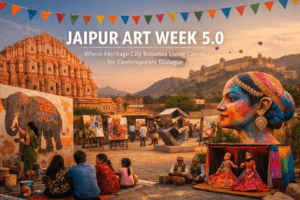
Jaipur Art Week 5.0: Where Heritage City Becomes Living Canvas for Contemporary Dialogue
As dawn broke over Jaipur on January 27, 2026, an unusual transformation began. The Pink City, celebrated for its historic palaces and bustling bazaars, quietly morphed into a sprawling, open-air gallery. The fifth edition of Jaipur Art Week had commenced, unfolding across eleven heritage venues from Central Park to the Amer Fort. Organised by the Public Arts Trust of India (PATI), this eight-day festival represents more than an art exhibition—it’s a bold reimagining of public space, a dialogue between centuries, and a deliberate shift of India’s contemporary art scene beyond its traditional metropolitan hubs.
Founded by visionary arts entrepreneur Sana Rezwan, Jaipur Art Week has rapidly evolved into one of India’s most significant contemporary art platforms. This year’s edition is its most ambitious yet, featuring over 100 selected artists from more than 450 global applications, presenting their work in a city-wide celebration that is entirely free to the public. What unfolds is not just an art festival, but a cultural experiment: can a city renowned for its past become a vital, living stage for the urgent conversations of our present?
The Guiding Philosophy: An Artist-First Ethos in a Public Realm
At the heart of Jaipur Art Week lies a radical, artist-first philosophy. Unlike curated festivals with rigid themes, it maintains a “co-curated approach” through an international open call, inviting artists to propose the work they genuinely want to create, free from “pre-set curatorial boundaries”. This year, a distinguished jury including Anita Dube, Renu Modi, and Aindrea Emelife selected the participants, who then received mentorship from established artists like Vibha Galhotra and Gigi Scaria.
This support system is substantive. Selected artists receive grants ranging from ₹15,000 for group shows to ₹1.5 lakh for large-scale installations, coupled with virtual studio visits from their mentors. This structure empowers early and mid-career artists to create ambitious, often site-specific work, positioning the festival as a genuine incubator for talent.
The festival’s founder, Sana Rezwan, established PATI in 2022 to democratize arts and culture in a landscape where state and philanthropic support is limited. Her vision is clear: art belongs to everyone. This is evident in every detail—from wall texts presented bilingually in English and Hindi to the charpais (traditional woven cots) placed before video installations, inviting not just viewing, but resting and lingering. The city isn’t merely a backdrop; it is an active “site and collaborator.”
A Tapestry of Venues: When Architecture Meets Art
Jaipur Art Week 5.0 spreads itself with intentionality across a diverse tapestry of spaces, from grand Mughal-era monuments to intimate, modern galleries. This choice of venue is a curatorial statement in itself, creating a continuous dialogue between the art, its architectural container, and the city’s layered history.
Table: The Diverse Venues of Jaipur Art Week 5.0
| Venue Type | Examples | Artistic Dialogue Created |
| Monumental Heritage Sites | Hawa Mahal, Amer Fort, Jal Mahal | Contemporary works converse with Mughal and Rajput history, power, and aesthetics. |
| Public & Civic Spaces | Central Park, Badi Chaupad, Choti Chaupad | Art enters daily life, fostering accessibility and unexpected public encounters. |
| Cultural Institutions | Jawahar Kala Kendra (JKK), Albert Hall Museum | Bridges institutional legacy with contemporary practice and critical discourse. |
| Private Studios & New Hubs | Pink City Studio, PATI Headquarters | Offers a glimpse into the creative process and platforms emerging talent. |
A prime example is the Jawahar Kala Kendra (JKK), the festival’s intellectual nucleus. Designed by Charles Correa, the building is itself a profound architectural meditation, based on the nine-square Navagraha mandala that also inspired Jaipur’s original 1727 city plan. Within its galleries and its central amphitheater—a void representing the cosmos—the art engages in a meta-dialogue about space, form, and community.
Similarly, at the iconic Hawa Mahal (Palace of Winds), artists Monique Romeiko and Lorenzo Vitturi present works exploring “observation, visibility, and the interplay of tradition and modernity”—themes that resonate deeply with the palace’s original purpose of allowing royal women to observe the world unseen. This thoughtful pairing of art and venue ensures that the city’s heritage is not just preserved, but actively reinterpreted.
Standout Works: Conversations in Material and Mind
The artistic program is staggering in its diversity, but several works crystallize the festival’s core themes of material transformation, ecological consciousness, and digital introspection.
In Central Park, Poojan Gupta’s A Sacred Walk transforms a mundane object of medical consumption into a site of ritual. The installation, a corridor constructed from stitched-together, empty pharmaceutical blister packs, reframes this waste product as a “material archive of belief”. Gupta invites viewers to see the act of pill-taking as a contemporary ritual, “imbued with a devotional intensity” that speaks to our shared anxieties about health and the environment.
At the Amrapali Museum, Maya Kumari Suthar’s The Desert Land offers a powerful historical critique. By placing familial memories alongside colonial-era ethnographic archives of Rajasthan’s Thar Desert, the work exposes the “silences within the archive” and the “cultural and spatial displacement” caused by colonial governance. It’s a poignant exploration of how history is recorded, who is left out, and how personal narrative can reclaim agency.
Meanwhile, the digital exhibition Here and Now at JKK grapples with our technological present. The standout work Machine, Am I? by the duo Āyāhi presents a deconstructed computational entity. Drawing on philosophical concepts, it questions the nature of intelligence—is it an abstract process, or is it material, contingent, and entangled with identity?. In an age of AI, it prompts a deeply human reflection on the essence of cognition itself.
The City as Catalyst: Public Programs and Lasting Impact
Beyond static exhibitions, the festival pulses with life through an extensive program of over 50 events. Each day is a rich itinerary: morning satsangs with classical music at the Amer Fort, curator-led walkthroughs, intimate studio visits, and fiery panel discussions.
The opening day’s vernissage featured a pivotal panel on public-private partnerships in Indian culture, moderated by Kabir Jhala and featuring luminaries like Dr. Amin Jaffer and curator Anita Dube. This set a tone of serious cultural inquiry, establishing that the week is as much about thinking as it is about seeing.
The impact of this model is multifaceted. For artists, it provides unparalleled exposure, mentorship, and the chance to create at scale. For the local community, it fulfills PATI’s mission of democratizing art, making world-class contemporary work a free and accessible part of civic life. For the city of Jaipur, it recalibrates its global identity. No longer just a tourist destination for history, it is now a dynamic, contemporary cultural capital—an “evolving constellation of ideas, people, and futures,” as envisioned in James Johnson-Perkins’ digital installation Jaipur Galore at Badi Chaupad.
Conclusion: A New Blueprint for Cultural Festivals
As Jaipur Art Week 5.0 draws to a close on February 3, its echoes will linger long after the installations are dismantled. It has demonstrated a potent blueprint for the 21st-century cultural festival: one that is deeply rooted in place yet global in outlook, fiercely supportive of artists, and genuinely open to the public.
By activating the city as both site and collaborator, the festival does more than display art; it stages a profound conversation. It asks how we can honor the past without being trapped by it, how we can critique the present with both rigor and compassion, and how public space can foster not just consumption, but community and reflection.
In the quiet moments—a visitor resting on a charpai before a video projection, a local discovering a futuristic installation in a 300-year-old square—the “quiet, enduring magic” of Jaipur Art Week is felt. It proves that when art steps out of the white cube and into the vibrant, complex heart of a living city, it doesn’t just transform the space; it has the power to transform how we see our world, our history, and each other.
You must be logged in to post a comment.