
‘It’s Time To Go Now’: Inside India’s First Passive Euthanasia Case as Family Bids Heartbreaking Farewell to Harish Rana After 13 Years
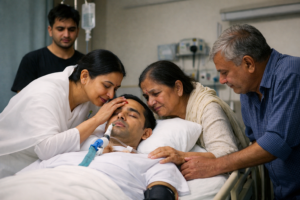
In a historic and deeply emotional moment for India, the family of Harish Rana, a 32-year-old who spent 13 years in a persistent vegetative state following a 2013 accident, bid him a tearful farewell before he became the country’s first individual to undergo passive euthanasia at AIIMS Delhi, following Supreme Court approval. A viral 22-second video captured the raw intimacy of their goodbye, showing a Brahma Kumari sister applying tilak on Harish’s forehead and gently telling him, “It’s time to go now,” as his mother sat beside him, ending a 13-year ordeal of unwavering hope, mounting medical costs, and silent sacrifice. This landmark case not only highlights the family’s agonizing journey but also reignites India’s conversation on death with dignity, living wills, and the ethical balance between prolonging life and allowing a natural, peaceful death when medical intervention no longer offers meaningful recovery.
‘It’s Time To Go Now’: Inside India’s First Passive Euthanasia Case as Family Bids Heartbreaking Farewell to Harish Rana After 13 Years
A 22-Second Video That Captured 13 Years of Unspoken Love
The 22-second video begins quietly. A woman in white, a Brahma Kumari sister, leans close to a man lying motionless on a hospital bed. Her voice is soft but steady as she utters words that no family should ever have to say: “Sabko maaf kar do, sabse maafi maang lo. Ab jaane ka time ho gaya, theek hai?” — “Forgive everyone, apologise to everyone. It’s time to go now, okay?”
On the bed lies Harish Rana, 32 years old, his eyes closed, his body still. For the past 13 years, this has been his reality—a persistent vegetative state from which he never awoke. Beside him, his mother struggles to maintain composure, her hand reaching out to touch her son one last time as the Brahma Kumari sister applies tilak on his forehead in a final blessing.
This wasn’t a scene from a film. This was real life unfolding at the Palliative Care Centre of the All India Institute of Medical Sciences (AIIMS) in Delhi on March 15, 2026. And it marked a historic moment for India—the country’s first case of passive euthanasia approved by the Supreme Court for an individual.
The Day That Changed Everything: Harish Rana’s Accident in 2013
To understand the weight of this moment, we must travel back 13 years. The year was 2013. Harish Rana, then a vibrant 19-year-old from Ghaziabad, had his entire life ahead of him. He was visiting Chandigarh when, in a tragic turn of events, he fell from the fourth floor of a building.
The fall shattered more than his bones—it shattered his family’s world. Rushed to a hospital, Harish survived but never regained consciousness. He entered what doctors call a “persistent vegetative state” (PVS), a condition where the body may breathe, may open its eyes, may even go through sleep-wake cycles, but there is no awareness, no response, no recognition of loved ones.
For most of us, a moment of tragedy is followed by a period of grief and then, gradually, a return to normalcy. For the Rana family, normalcy ceased to exist. Every single day for 13 years, they woke up to the same reality: their son, their brother, lying motionless, dependent entirely on machines and medical care.
13 Years at the Bedside: A Family’s Unseen Sacrifice
What the viral video doesn’t show is the 4,745 days that preceded it. The sleepless nights. The mounting medical bills. The gradual depletion of savings. The whispered prayers in the dark. The moments of desperate hope when a finger twitched or an eyelid fluttered, only to be told by doctors that these were involuntary reflexes, not signs of awakening.
Harish’s parents, now in their advancing years, spent their entire savings on his care. They watched their son’s body age while his mind remained trapped in an eternal sleep. They celebrated his birthdays beside a hospital bed. They spoke to him, read to him, played his favourite music—never knowing if any of it reached him.
The family’s association with the Brahma Kumaris, a socio-cultural organisation, provided them with spiritual strength during these years. But spiritual strength doesn’t pay medical bills, and it doesn’t ease the agony of watching your child exist without truly living.
The Long Road to Court: Seeking Legal Permission for Dignified Exit
India’s legal framework around euthanasia has evolved slowly and carefully. In 2011, the Supreme Court allowed passive euthanasia in a landmark judgment in the Aruna Shanbaug case, but with strict guidelines. Aruna Shanbaug was a nurse who spent 42 years in a vegetative state after being sexually assaulted, and the court’s ruling laid the groundwork for future cases.
However, each case requires individual judicial approval. The process is neither quick nor easy. For Harish’s family, approaching the Supreme Court was not their first instinct—it was their last resort after years of exhausting every possible medical option.
Their petition argued that Harish had no chance of recovery, that he was being kept alive artificially without any meaningful existence, and that continuing life support amounted to prolonging his suffering and that of his family. Medical experts corroborated their claim, confirming that 13 years in a vegetative state with no signs of improvement left no scope for hope.
The Supreme Court heard their plea with sensitivity. Recognising the medical evidence and the family’s unwavering commitment to Harish’s welfare throughout these years, the court granted permission for passive euthanasia—a decision that balanced legal scrutiny with human compassion.
Understanding Passive Euthanasia: What It Really Means
As India confronts this historic moment, many are seeking to understand what passive euthanasia actually entails. Unlike active euthanasia, where a substance is administered to end life, passive euthanasia involves the withdrawal or withholding of life-sustaining treatments that are keeping a person alive artificially.
In practical terms, this means removing ventilators, stopping dialysis, discontinuing chemotherapy, or withdrawing artificial nutrition and hydration. The underlying medical condition is allowed to take its natural course. The person dies not because something is done to them, but because the artificial interventions that were postponing death are removed.
This distinction is crucial in ethical and religious contexts. Passive euthanasia is more widely accepted across cultures because it respects the natural process of dying rather than intervening to cause death directly. In Harish’s case, it means allowing his body to let go after 13 years of being sustained by machines.
The Viral Video: Why It Resonated Across India
The footage shared on X (formerly Twitter) by user BALA (@erbmjha) struck a chord unlike any other. Within hours, it had been viewed millions of times, shared across platforms, and discussed in homes, offices, and news studios across the country.
What made this video so powerful was its raw authenticity. There were no cameras from news channels, no staged moments for public consumption. It was a family’s private goodbye, accidentally captured and shared with the world. The Brahma Kumari sister’s gentle voice, the mother’s tear-streaked face, the stillness of Harish on the bed—every frame conveyed a truth that words cannot capture.
The comments section overflowed with empathy. Strangers expressed sorrow for a family they had never met. Many shared their own stories of loved ones in comas or vegetative states, of the agonising decisions they faced, of the guilt and grief that accompany such impossible choices.
Some questioned whether the video should have been shared, whether such private moments deserve public consumption. Others argued that it opened a necessary conversation about death, dignity, and the right to choose, and that Harish’s story would help countless families facing similar situations.
The Ethical Dimensions: What This Case Means for India
India is a country where death is often discussed in hushed tones, where life support is continued long after hope is gone because “what will people say?” Harish Rana’s case forces us to confront uncomfortable questions about the nature of life, the meaning of dignity, and the limits of medical intervention.
From an ethical standpoint, this case represents a shift in how we think about death. For decades, medical advances have focused on prolonging life, often without asking whether that prolonged life has any quality. We celebrate when technology keeps someone alive, but we rarely discuss when it might be kinder to let go.
The Rana family’s decision was not made lightly. It came after 13 years of watching, waiting, and hoping. It came after consultations with doctors, spiritual advisors, and legal experts. It came after they satisfied themselves that every possible avenue had been explored and that continuing treatment would only prolong suffering—both Harish’s and their own.
The Medical Reality: What 13 Years in a Vegetative State Means
To truly understand this case, we must understand what 13 years in a persistent vegetative state actually means for the human body. A PVS patient may appear awake at times—eyes open, cycles of sleep and wakefulness—but there is no awareness of self or environment. The cerebral cortex, responsible for thought and emotion, is not functioning, though the brainstem may still regulate basic functions like breathing and heart rate.
Over 13 years, the body undergoes profound changes. Muscles atrophy from lack of use. Joints contract and stiffen. The risk of infections, bedsores, and complications is constant. Patients require round-the-clock care—turning to prevent bedsores, tube feeding for nutrition, suctioning to clear airways, and constant monitoring for any sign of distress.
For families, the toll is equally physical and emotional. Many spend their life savings, quit jobs, and dedicate themselves entirely to caregiving. Siblings put their lives on hold. Parents age prematurely under the weight of responsibility and grief. The person lying in the bed becomes both a beloved family member and a constant source of pain.
The Brahma Kumaris Connection: Faith at the End of Life
The presence of the Brahma Kumari sister in the viral video was not incidental. The Rana family’s association with the organisation provided them not only with spiritual guidance but also with practical support in navigating the legal system to pursue Harish’s euthanasia plea.
The Brahma Kumaris, known for their emphasis on meditation and spiritual living, approach death with a philosophy that focuses on the soul’s journey rather than merely the body’s existence. This perspective may have helped the family find peace with their difficult decision, viewing it not as abandoning their loved one but as releasing his soul from a body that could no longer serve him.
In the video, the sister’s words carry the weight of both spiritual authority and human compassion. She speaks not of death as an ending but as a transition—a going, a release, a return. For a family about to lose their son after holding onto him for 13 years, this framing may offer the only comfort available.
What Happens Now: The Final Moments
As of now, Harish Rana has been admitted to AIIMS Delhi’s Palliative Care Centre. Unlike the intensive care units where he has spent much of the past 13 years, surrounded by machines and monitors, the palliative care setting is designed for comfort rather than intervention.
The process of passive euthanasia is not instantaneous. Life support will be withdrawn gradually, and Harish will be kept comfortable as his body naturally shuts down. Palliative care specialists will manage any discomfort, ensuring that his final moments are peaceful rather than painful. His family will likely remain by his side, holding his hand, speaking to him, being present in these last hours as they have been present throughout these 13 years.
For the medical team at AIIMS, this is uncharted territory. While hospitals have withdrawn life support before, usually after families make the decision privately, this case carries the weight of being India’s first formally approved passive euthanasia. Every step is being documented, every protocol followed meticulously.
The National Conversation: Death With Dignity in India
Harish Rana’s case has reignited conversations about end-of-life care, living wills, and the right to die with dignity in India. In 2018, the Supreme Court recognised the right to die with dignity as a fundamental right and allowed living wills—documents in which individuals specify their wishes for medical treatment if they become unable to communicate.
However, implementation has been slow. Few Indians have created living wills. Many doctors remain uncertain about how to handle them. Families often override patients’ stated wishes because they cannot bear to “give up.” Cultural and religious beliefs complicate decisions that should, ideally, be guided by the patient’s own preferences.
Harish did not leave a living will—he was 19 when his accident occurred, too young to contemplate such documents. His family made the decision for him, based on their understanding of what he would have wanted. This is the reality for most families: decisions made by proxy, based on love and hope and, eventually, acceptance.
A Landmark for India, A Tragedy for One Family
As India marks this historic moment—the first approved case of passive euthanasia—we must not lose sight of what this truly represents. This is not a legal victory to be celebrated. It is not a precedent to be analysed in law journals alone. It is a family saying goodbye to their son after 13 years of fighting to keep him.
The headlines call it “India’s first passive euthanasia case.” The news channels dissect the legal implications. The social media posts analyse the ethics. But for the Rana family, this is simply the end of a very long road. It is the moment they have both dreaded and prepared for. It is love taking its most difficult form: letting go.
In those 22 seconds of video, we see something profound. A mother’s hand on her son’s body. A spiritual guide offering final blessings. Words of forgiveness and farewell spoken into ears that may not hear but have been spoken to for 13 years nonetheless. This is not a story about law or medicine or ethics. It is a story about family, about love, about the impossible choices that life sometimes demands.
The Legacy of Harish Rana
When the machines are finally turned off, when Harish’s body takes its last natural breath, when his family walks out of AIIMS without him for the first time in 13 years—what will his legacy be?
For his family, he will always be the son who was taken too soon, the brother who never got to live, the loved one they fought for and finally released. For India, he will be the face of a national conversation about death and dignity. For countless families facing similar situations, his case may provide a path forward, a legal precedent, a source of hope that they too can find peace.
The Brahma Kumari sister’s words echo beyond that hospital room: “It’s time to go now.” After 13 years, 4,745 days, 113,880 hours of waiting and hoping and loving, it is finally time. Time for Harish to go. Time for his family to begin the long process of grieving and healing. Time for India to continue the conversation his case has started.
As one chapter closes at AIIMS Delhi, another opens—in the hearts of a family learning to live without their son, and in a nation learning to talk about death with honesty, compassion, and dignity.
You must be logged in to post a comment.