
Israel’s Two-Tier Aid Policy: How Commercial Control is Weaponized in Gaza
Israel’s Two-Tier Aid Policy: How Commercial Control is Weaponized in Gaza
The disparity in what is allowed to enter Gaza is not a security oversight but a calculated policy of control, creating a humanitarian marketplace where survival is a commodity and aid is a political weapon.
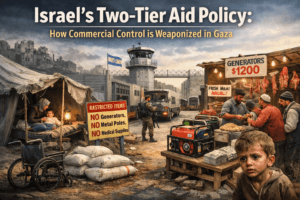
In the shattered landscape of Gaza, a generator is not just a power source—it is a symbol of life and a marker of a system of control. For months, humanitarian organizations pleading to bring in these basic items for hospitals and shelters have been met with a firm “no” from Israeli authorities, who classify generators as “dual-use items” that could be exploited by militant groups . Yet, at the same time, those same generators have been appearing in Gaza’s open markets, having passed through the same tightly controlled Israeli checkpoints . This contradiction reveals a parallel system of control that is reshaping humanitarian aid, war economies, and the very survival of Gaza’s population.
The policy has created what aid officials describe as a “two-tier system,” where commercial entities can secure permits for items completely barred to international relief organizations . This system goes beyond logistical inconsistency to become a tool of political and economic leverage in a territory where nine out of ten homes have been destroyed and winter conditions are claiming lives .
- The Dual-Use Paradox: Security or Control?
The Israeli government’s “dual-use” list encompasses a vast and often baffling range of items deemed to have potential military applications. The list is sweeping in scope and secretive by nature, revealed only when an item is rejected for entry . It includes not only obvious items like communications equipment but also basic humanitarian supplies:
- Shelter materials: Metal tent poles, crucial for constructing sturdy shelters to withstand winter rains, are banned for aid groups . Meanwhile, commercial traders have been permitted to bring in metal pallets, which are more durable than wood in mud .
- Medical and mobility aids: Past restrictions have included crutches, wheelchairs, and walkers .
- Energy and safety equipment: Solar panels and smoke detectors have also been barred .
- Food supplies: While aid organizations are limited to shipping chicken, commercial traders can import all kinds of meat, including beef and mutton .
Table: Examples of “Dual-Use” Item Restrictions in Gaza
| Item | Official Justification | Humanitarian Impact | Availability via Commercial Channels |
| Generators | Could power militant operations | Hospitals, water pumps, shelters lack power | Yes, at high markup |
| Metal Tent Poles | Could be used to build weapons | Flimsy tents collapse in winter rains | Yes (similar metal items allowed) |
| Frozen Beef/Mutton | Not an “urgent humanitarian need” | Limits nutritional diversity for malnourished population | Yes |
| Paper & Pencils | Not an urgent need | 600,000 children lack school supplies for 2 years | Information not specified |
Tania Hary of the Israeli rights group Gisha observes that the restrictions often have little to do with “the inherent risk or danger of the item itself,” but rather revolve around the question: “Whose hands is it in?” . This selective enforcement suggests the policy is less about absolute security and more about controlling which actors wield power and influence within Gaza’s devastated economy .
- The Business of Survival: A New War Economy
The parallel system has given rise to a distorted and highly profitable market. Items on the dual-use list command “huge premiums” inside Gaza because they are scarce and essential . Sam Rose, the acting director for Gaza for UNRWA, notes that “the only way to get a generator right now is on the private sector,” and that there is a significant markup .
This commerce involves a complex network. According to Rose, business interests on “all sides – Israeli, Egyptian, Palestinian – with some of the security companies that enjoy Israeli protection also taking a cut alongside other criminal elements” are profiting, fostering an illegal economy . While it is unclear if Hamas directly profits, analysts like Ahmed Alkhatib of the Atlantic Council note that commercial deliveries likely involve paying “fees and taxes to Hamas in Gaza” as well as to “merchants on the Israeli side” . He bluntly states, “We all know that Gaza was and will always be a massive market for the Israeli economy” .
The policy effectively funnels humanitarian need into a commercial monopoly, allowing select traders to profit from desperation while international agencies, bound by principles and procurement rules, are sidelined.
- The International Response: Frustration and Failed Leverage
The international community, including Israel’s closest allies, has been aware of these restrictions but has struggled to change the policy. The U.S. military, which established a Civil-Military Coordination Center (CMCC) in October to facilitate aid, quickly found its biggest challenge was political, not logistical .
U.S. officers at the CMCC clashed with Israeli counterparts almost immediately, particularly over the tent pole restrictions. They compiled a list of at least a dozen key humanitarian items they wanted removed from the dual-use list, but weeks later, Israel had not lifted restrictions on any of them . A Western source concluded, “It is clearly not security interests that are driving decision-making here. The dual-use list is just another way to control what enters Gaza” .
Diplomatic pressure has also “flagged over the last two years,” even with the CMCC’s creation . The recent move by Israel to suspend 37 major international NGOs—including Doctors Without Borders, CARE, and the Norwegian Refugee Council—for failing to meet new registration rules further demonstrates Israel’s willingness to defy international calls . The EU has stated the NGO law “cannot be implemented in its current form,” and UN human rights chief Volker Türk called the suspensions “outrageous” . However, these condemnations have not translated into effective enforcement action .
- A Longstanding Strategy of Control
The current dual-use restrictions are not an aberration but an escalation of a longstanding policy. Israel withdrew its settlers and troops from Gaza in 2005 but maintained control over its borders, airspace, and coastline, imposing a blockade. For nearly two decades, groups like Gisha have documented how this control is used to regulate the “wellbeing of the population,” from economic development to the bare minimum of humanitarian standards .
What is new is the starkness of the disparity and the context of near-total destruction. The policy weaponizes aid not through complete denial, but through selective channeling. It strengthens commercial actors (who may be more easily influenced or taxed) while weakening independent international humanitarian organizations that provide oversight, bear witness, and operate based on need rather than profit.
As a result, Gaza’s reconstruction and the daily survival of its people are made dependent on a political and economic calculus set by Israel. This undermines the foundations of international humanitarian law, which requires that aid be provided based on need alone and that occupying powers facilitate—not control or profit from—relief efforts .
The Path Forward
Breaking this cycle requires moving beyond statements of concern to concrete consequences. As outlined by Palestinian human rights groups and some international advocates, potential steps include:
- Enforcing existing legal rulings: The International Court of Justice (ICJ) has issued provisional measures ordering Israel to ensure the “unhindered provision” of basic supplies and to open land crossings . Member states have a legal obligation to ensure compliance with these orders.
- Conditioning support: Linking bilateral relations, arms sales, and trade agreements to demonstrable improvements in humanitarian access and the lifting of arbitrary restrictions.
- Supporting accountability mechanisms: Cooperating with international judicial processes, such as the International Criminal Court’s investigation, which includes the alleged war crime of using starvation as a method of warfare .
The two-tier system for Gaza’s aid is more than a bureaucratic inconsistency. It is a deliberate mechanism that transforms humanitarian need into political leverage and economic gain. It ensures that even in ceasefire, Israel retains decisive control over life in Gaza, not by providing aid, but by regulating who can sell it. In the process, it sacrifices humanitarian principles on the altar of political control, leaving a population to navigate a marketplace where their most basic needs are commodified and their survival is contingent on a permit.
You must be logged in to post a comment.