
Israel’s ‘Guillotine’ Law: How a 62-Vote Knesset Majority Just Rewrote the Rules of Occupation
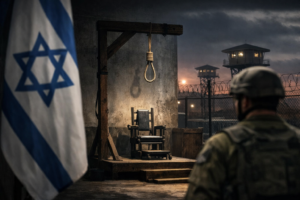
Israel’s ‘Guillotine’ Law: How a 62-Vote Knesset Majority Just Rewrote the Rules of Occupation
By a Senior Political Analyst
In the annals of the Israeli-Palestinian conflict, there are legislative moments that serve not merely as policy shifts, but as tectonic movements—events that fundamentally alter the landscape of justice, occupation, and human rights. The evening of March 30, 2026, marked one such moment. With a final vote count of 62 in favor, 48 against, and one abstention, the Israeli Knesset passed a law that legalizes the death penalty for Palestinian prisoners convicted of attacks resulting in the death of Israelis.
To the casual observer, this might appear as a mere legal amendment—a hardening of Israel’s stance on “terrorism.” But to the 9,500 Palestinian and Arab detainees currently held in Israeli prisons, to the families of the 326 prisoners who have died in Israeli custody since 1967, and to the international legal community, this is something far more sinister. It is the institutionalization of what Israeli security and rights sources have chillingly dubbed the “Guillotine” law.
This is not merely a law about punishment; it is a law about the dismantling of legal safeguards, the weaponization of the Knesset against the military court system, and the clearest signal yet that the current Israeli government is prepared to sacrifice the last vestiges of due process on the altar of political expediency.
The Mechanics of a Political Execution
To understand the gravity of what passed in Tel Aviv on Monday, one must dissect the law’s architecture. Unlike the rare and complex death penalty statutes that existed previously—which required unanimous judicial approval—this new legislation strips away judicial discretion.
The law introduces a mandatory death sentence for anyone found guilty of “intentionally causing the death of a person within the framework of an act classified as terrorism.” The word “mandatory” is the linchpin here. It removes the judge’s ability to weigh mitigating circumstances, the defendant’s age, or the nuances of the case. If a conviction is secured, the sentence is automatic.
Furthermore, the law imposes a draconian timeline. Executions, to be carried out by hanging by the Israeli Prison Service, must occur within 90 days of the sentence’s confirmation. While the Prime Minister can request a delay under “special circumstances,” that postponement cannot exceed 180 days. In practical terms, this creates a judicial conveyor belt where a Palestinian detainee could theoretically be sentenced and executed within three to six months, leaving little time for appeals or international intervention.
Perhaps the most legally perverse aspect of the legislation is its geographic and jurisdictional duality. The law differentiates between implementation inside Israel proper and in the occupied West Bank. In the West Bank—territory widely considered occupied under international law—the death penalty becomes the “primary punishment.” Military courts are only allowed to impose life imprisonment under “special circumstances,” effectively reversing the hierarchy of sentencing.
This distinction is crucial. By elevating the penalty in the occupied territories, the Knesset is extending the long arm of Israeli civil law into an area governed by military law, blurring the lines of jurisdiction in a way that legal scholars warn constitutes a war crime. Moreover, the law grants the far-right Minister of National Security, Itamar Ben-Gvir—who championed the bill—the authority to determine the judicial body responsible for prosecuting suspects. This centralization of power places the fate of defendants in the hands of a politician known for his explicit support of settler expansion and punitive measures against Palestinians.
Breaking the Historical Precedent
To appreciate the anomaly of this legislation, one must look back at the history of capital punishment in Israel. Since its founding, the state has carried out exactly one execution: that of Nazi official Adolf Eichmann in 1962. Even in that case, the trial was a landmark event meant to symbolize Jewish sovereignty confronting the horrors of the Holocaust.
Despite decades of conflict, war, and countless acts of violence, Israeli courts have historically refrained from imposing the death penalty on perpetrators of militant attacks. The Jewish legal tradition (Halakha), while complex, leans heavily toward the sanctity of life and the difficulty of imposing capital punishment. Secular Israeli jurisprudence similarly favored life imprisonment as the harshest penalty, viewing the death penalty as a tool of authoritarian regimes, not a liberal democracy.
By bulldozing this precedent with a simple 62-vote majority, the Knesset is not just changing the law; it is repudiating the judicial restraint that defined Israel’s highest courts for generations. The dismissal of over 2,000 objections submitted against the bill during the National Security Committee’s deliberations underscores the accelerated, steamroller nature of this process. It was a legislative act designed not for justice, but for retribution.
Human Cost: The Faces Behind the Numbers
For the Palestinian community, this law is not an abstract legal concept; it is a death sentence waiting to be signed. The statistics provided by the Palestinian Prisoners Society paint a grim picture of the current reality. With roughly 9,500 Palestinians currently held in Israeli prisons, and with 97 bodies being withheld by Israel (86 of them since the war on Gaza began), there is already a profound crisis of accountability.
The new law transforms the status of these prisoners from detainees—some held in administrative detention without charges—into potential death row inmates. Human rights organizations have long documented the conditions inside facilities like the Sde Teiman detention camp, where reports of torture, medical neglect, and systemic abuse have surfaced. Under the new framework, a detainee who survives brutal conditions in such camps could then be shuffled into a military court where the sentence is predetermined.
The death penalty law also creates a direct assault on the principle of prisoner exchanges, which have historically been a cornerstone of Palestinian-Israeli negotiations. In the past, the bodies of dead soldiers or living prisoners have been used as bargaining chips. Under this law, if a Palestinian prisoner is executed, they are removed from the equation entirely. This is a deliberate strategy to break the “bargaining chip” cycle that has, in the past, led to the release of thousands of Palestinian prisoners in exchange for Israeli soldiers.
International Isolation and the ‘Apartheid’ Accusation
The international reaction to the law, while swift, highlights the widening chasm between Israel and its Western allies. The joint statement from the United Kingdom, Germany, France, and Italy—four of Israel’s staunchest European supporters—was remarkable in its bluntness. They urged Israel to abandon the legislation, stressing that the death penalty constitutes an “inhuman and degrading” form of punishment that does not serve as a deterrent.
Amnesty International went further, warning that the law could “further entrench an apartheid system” and that its implementation “could amount to a war crime.” This language is significant. While Israel has long rejected the “apartheid” label, the legislative targeting of a specific national group (Palestinians) with a unique, harsher judicial system than that applied to Israeli citizens, particularly in the occupied territories, lends substantial weight to these claims.
The law creates a two-tiered system of justice: one for Israelis, where the death penalty is virtually non-existent; and one for Palestinians, where it is mandatory for certain crimes. This dual legal system, operating within the same geographic space of the West Bank and the same prison system, is a structural manifestation of inequality that the international community is finding increasingly difficult to ignore.
The Regional Fallout: Al-Aqsa and the Arab League
In the immediate aftermath, the Palestinian leadership has moved swiftly to internationalize the crisis. The call for an emergency Arab League meeting, specifically to address both the “Al-Aqsa crisis and the prisoners’ death penalty,” signals that Palestinian officials view this law as inextricably linked to the volatile situation in Jerusalem.
The timing of the law, coinciding with tensions around the Al-Aqsa Mosque compound during the holy month of Ramadan, is seen by many as a deliberate provocation. By linking the “Al-Aqsa crisis” with the death penalty in the upcoming Arab League meeting, Palestine is attempting to frame the issue not merely as a matter of criminal justice, but as an existential threat to Palestinian identity and holy sites.
Fatah’s declaration of a general strike in protest further indicates that this issue is likely to trigger widespread civil unrest. When political factions that are often at odds unite over a specific grievance, it suggests the issue has reached a critical threshold of consensus.
The ‘Guillotine’ as a Political Strategy
Why now? The push for this law, championed by Ben-Gvir and other far-right members of Prime Minister Benjamin Netanyahu’s coalition, serves multiple political purposes.
First, it is a concession to the coalition’s extremist base. With the coalition often teetering on the brink of collapse, delivering on a long-promised “hard line” issue like the death penalty solidifies the far-right’s hold on the government.
Second, it is an attempt to change the narrative of the war in Gaza. With the death toll in Gaza exceeding 72,000 since October 2023—a figure that continues to rise despite a ceasefire—the international narrative has been dominated by the humanitarian catastrophe inflicted on Palestinians. By passing this law, the Israeli government is shifting the domestic and international conversation back to “Israeli security” and the punishment of Palestinian attackers.
Third, it is a test of the international community’s resolve. The muted sanctions from the US and the European Union in response to previous settlement expansions and military campaigns have emboldened the coalition. The passing of this law with a comfortable margin suggests that the far-right believes it can weather the diplomatic storm that follows.
Conclusion: A Point of No Return?
As the Knesset finalizes this legislation, the Israeli Prison Service is now tasked with preparing gallows. For the first time in over 60 years, a hangman may soon be at work within the Israeli penal system.
But the true impact of this law will not be measured by how many prisoners are executed, but by how it degrades the rule of law and exacerbates the conflict. By lowering the threshold for execution to a simple legislative vote, and by placing the authority to prosecute in the hands of a radical minister, Israel is entering uncharted legal waters.
The warnings from Israeli security and rights sources—who termed this law the “Guillotine”—should not be dismissed as hyperbole. They represent the fears of those who understand that once the state acquires a taste for capital punishment targeted at a specific national group, it is nearly impossible to turn back.
As the Arab League prepares to meet on Thursday, and as the bodies of the 97 prisoners withheld by Israel remain in limbo, the “Death Penalty Law” stands as a stark monument to the current era of the conflict. It is a law born of vengeance, written in political expediency, and destined to deepen the wounds of a land already soaked in blood. For the 9,500 detainees looking over their shoulders in Israeli prisons, the long shadow of the gallows has just grown much, much darker.
You must be logged in to post a comment.