
Israel’s Demolition of UNRWA Headquarters: A Systemic Assault on International Law
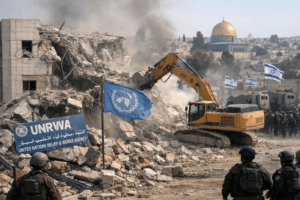
On January 20, 2026, Israeli forces demolished the UNRWA headquarters in East Jerusalem, an act condemned by the United Nations as an unprecedented violation of international law that breaches the inviolability of UN premises.
This demolition represents the culmination of a systematic, years-long campaign against the agency, including a 2024 law banning its operations, and exacerbates a severe humanitarian crisis by crippling aid distribution while aligning with a broader political effort to undermine multilateral, rights-based frameworks for Palestinian refugees. By celebrating the action domestically as a “historic day” while facing widespread international condemnation, Israel has created a perilous precedent where national sovereignty and security claims are wielded to override established international legal protections, signaling a dangerous erosion of the rules-based global order.
Israel’s Demolition of UNRWA Headquarters: A Systemic Assault on International Law
The morning of January 20, 2026, marked a grim escalation in the long-standing tensions between Israel and the United Nations. As bulldozers tore through the United Nations Relief and Works Agency (UNRWA) headquarters in East Jerusalem, surrounded by Israeli forces, the world witnessed what UN officials describe as an unprecedented and deliberate assault on the international legal order itself. This was not an isolated act of property seizure but the culmination of a systematic, years-long campaign targeting the primary UN agency serving Palestinian refugees.
This event’s significance extends far beyond the rubble in Sheikh Jarrah. It represents a dangerous challenge to the foundational principles of multilateral diplomacy, the inviolability of UN premises, and the established rules governing occupied territories. The demolition, carried out under the watchful eye of Israel’s far-right National Security Minister Itamar Ben-Gvir—who called it a “historic day” and a “holiday”—signals a troubling new phase where political ideology openly confronts international institutions.
The Systematic Campaign Against UNRWA: A Timeline of Escalation
The demolition of the Jerusalem headquarters is the most visible, physical manifestation of a pressure campaign that has been building through legislative, financial, and administrative measures. To understand the full gravity of the demolition, one must view it as the keystone in an arch of obstruction designed to dismantle UNRWA’s operational capacity.
Table: Escalating Israeli Measures Against UNRWA (2024-2026)
| Date | Action | Stated Justification | International Response |
| Oct 2024 | Israeli Knesset passes law banning UNRWA operations in Israel and East Jerusalem. | Allegations of agency bias and infiltration by Hamas. | Canada criticizes the act as a “dangerous precedent”. |
| 2025 | Legislation severs all state contact with UNRWA. | Further codifies the 2024 ban into state policy. | UN Secretary-General threatens ICJ action over laws targeting UNRWA. |
| Early 2026 | Israeli forces raid and order a 30-day closure of an UNRWA health clinic in East Jerusalem; plan to cut water/power to other facilities announced. | Part of enforcement of anti-UNRWA laws; cited “public safety”. | UN Human Rights Chief expresses “outrage”; warns of “escalating disregard for international law”. |
| Jan 20, 2026 | Demolition of UNRWA Headquarters Compound in East Jerusalem. | Land ownership claims and vacancy of premises; agency called a “greenhouse for terrorism”. | Widespread condemnation from UN, EU; called an “unprecedented attack”. |
The Legal and Diplomatic Firestorm
The international outcry following the demolition has been swift and severe, centering on clear violations of established legal conventions. At the heart of the dispute is the 1946 Convention on the Privileges and Immunities of the United Nations, which explicitly grants UN premises inviolability, protecting them from “search, requisition, expropriation, and any other form of interference”.
UN Secretary-General António Guterres condemned the demolition “in the strongest terms,” reiterating that the compound was and remains inviolable UN premises. EU Commissioner for Crisis Management Janez Lenarčič echoed this, stating the action violated Israel’s obligations under the same convention and recalling a recent International Court of Justice (ICJ) opinion that obligates Israel not to impede UN operations.
Israel’s legal justifications have shifted and been widely contested. Initial claims that UNRWA owed property taxes were denied by the agency. During the demolition, officials argued the premises were vacant and therefore immune status did not apply—a claim a UN official dismissed as “absolute nonsense”. The core Israeli position, articulated by Foreign Ministry spokesperson Oren Marmorstein, is that UNRWA has degraded into a “greenhouse for terrorism,” and thus the state’s security concerns override other considerations.
This stance creates a perilous precedent. As UNRWA chief Philippe Lazzarini warned: “What happens today to UNRWA will happen tomorrow to any other international organisation or diplomatic mission… International law is risking irrelevancy in the absence of response by Member States”.
The Humanitarian Catastrophe: Beyond the Rubble in Jerusalem
While the world’s attention is fixed on Jerusalem, the campaign against UNRWA is exacerbating a humanitarian disaster of staggering proportions, particularly in Gaza. UNRWA is not merely an office block; it is a lifeline for millions. The agency provides schooling, healthcare, and social services to Palestinian refugees across the region.
In Gaza, despite a ceasefire, the situation remains “catastrophic”. Jonathan Fowler, UNRWA’s Director of Communications, warns of winter storms, rampant respiratory illnesses, and the world’s highest rates of limb loss among children. He stresses that Gaza needs a massive expansion of aid, not the new restrictions Israel is imposing on the registration of humanitarian organizations. The demolition of the Jerusalem compound, which stored aid for the West Bank and Gaza, directly impedes this relief effort.
Furthermore, the agency is being crippled from within by a severe financial and staffing crisis. Over 300 UNRWA staff have been killed in Israeli strikes in Gaza. Concurrently, the agency is undergoing what some sources describe as a deliberate internal dismantling, with the mass termination of hundreds of Palestinian staff under controversial financial pretexts. These terminations—affecting teachers, security personnel, and other key workers—gut the agency’s operational capacity and, critics argue, align with the Israeli objective of eroding UNRWA’s Palestinian core.
Broader Implications: A Multipronged Assault on the Multilateral System
The demolition of the UNRWA headquarters is a symptom of a deeper crisis. Analysts frame it as part of a coordinated US-Israeli campaign to eliminate UNRWA and undermine the UN-based multilateral system that recognizes Palestinian refugees as rights-holders. This effort seeks to replace rights-based frameworks with discretionary political arrangements.
Table: International Responses to the Demolition
| Actor | Statement/Position | Core Argument |
| UN Secretary-General | Condemned demolition “in the strongest terms”; demanded restoration of compound. | Violation of UN premises’ inviolability under international law. |
| UNRWA Commissioner-General | “A new level of open and deliberate defiance of international law”. | Part of a pattern of attacks; sets dangerous global precedent. |
| EU Commissioner | Condemned action as violation of Convention on UN Privileges. | Undermines rules-based international order and UN’s work. |
| Israeli National Security Minister | Called it a “historic day” and “holiday”. | National sovereignty and security override international law. |
| UK Middle East Minister | Said he was “appalled” by the reports. | Implicit condemnation aligning with UN and EU legal stance. |
This aligns with initiatives like the proposed U.S. “Board of Peace” for Gaza, which would sideline established UN agencies and binding international law in favor of politically managed solutions. The physical replacement of the UN flag with the Israeli flag at the demolished compound is a potent symbol of this push to supplant the multilateral system with national sovereignty.
Domestically, the action plays to the base of Israel’s governing coalition, particularly its far-right elements. Figures like Itamar Ben-Gvir and Deputy Mayor of Jerusalem Aryeh King, who called UNRWA a “Nazi” organization, derive political capital from such defiant demonstrations of “governance”. This transforms a point of international law into a tool of domestic politics.
The Path Forward: Accountability or Irrelevance?
The central question now is whether the international community will mount an effective response. Verbal condemnations, as numerous as they are, have so far failed to deter the escalating campaign. Secretary-General Guterres has previously threatened to take Israel to the ICJ over laws targeting UNRWA. Whether this proceeds will be a critical test.
The stakes could not be higher. If such a blatant violation of UN immunities is met with impunity, it signals that international law is enforceable only against the weak. It would embolden other states to interfere with UN operations and diplomatic missions worldwide, eroding the foundational security that allows humanitarian and diplomatic work to proceed in conflict zones.
For the Palestinians who depend on UNRWA, the immediate future is bleak. The hollowing out of the agency through killings, terminations, and physical destruction of its infrastructure occurs precisely when needs are most acute. The agency’s unique mandate and deep community trust make it irreplaceable for any future reconstruction in Gaza.
The rubble in East Jerusalem is more than debris from a demolished building. It is the material evidence of a profound rupture in the international order. The world’s response will determine whether this rupture is repaired or widens into a chasm where power reigns supreme over law, and the most vulnerable are left without protection or hope. The “unprecedented attack” of January 20, 2026, may well be remembered as the day the world decided the fate of its own rules-based system.
You must be logged in to post a comment.