
Israel’s Aid Agency Ban in Gaza: A Deepening Crisis at the Heart of a Fragile Ceasefire
Israel announced on December 30, 2025, that it would revoke the operating licenses of dozens of major international aid agencies, including Médecins Sans Frontières and Oxfam, for failing to comply with a new registration framework requiring detailed staff information, which the organizations argued violated data protection laws and endangered personnel. This move comes amid a catastrophic humanitarian situation in Gaza, where severe winter storms have destroyed shelters and exacerbated the crisis, prompting a joint statement from ten nations expressing serious concern and calling for the lifting of Israeli restrictions on aid. Israel frames the ban as a necessary security measure to prevent aid diversion by militant groups, while the affected agencies and the international community warn it will cripple specialized life-saving services, deepen human suffering, and risk destabilizing the fragile ceasefire in place since October 2025.
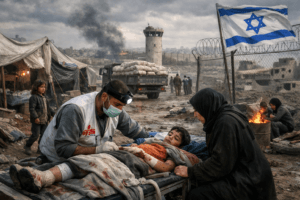
Israel’s Aid Agency Ban in Gaza: A Deepening Crisis at the Heart of a Fragile Ceasefire
The Ban and Its Immediate Fallout
Israel announced on December 30, 2025, that it will revoke the operating licenses of at least 37 international aid organizations working in Gaza and the West Bank, effective January 1, 2026. Among the affected groups are some of the world’s most prominent humanitarian agencies, including Médecins Sans Frontières (Doctors Without Borders), Oxfam, CARE International, the Norwegian Refugee Council, and ActionAid.
The Israeli Ministry of Diaspora Affairs stated the ban was due to the groups’ failure to comply with new registration rules introduced in March 2025. These regulations required organizations to submit comprehensive details about their staff, funding, and operations. Minister Amichai Chikli framed the decision as a security necessity: “The message is clear: humanitarian assistance is welcome — the exploitation of humanitarian frameworks for terrorism is not”.
The immediate operational impact is severe. Banned organizations must cease all activities within 60 days. Their offices in Israel and occupied East Jerusalem will close, and they will be unable to send international staff or external aid shipments into Gaza. For groups like MSF, which supports approximately 20% of hospital beds and one-third of births in Gaza, the suspension threatens to collapse critical parts of an already decimated health system.
Why Now? The New Registration Framework and a Pattern of Scrutiny
The current ban is the culmination of a nine-month regulatory standoff. Israel introduced the new registration framework in March 2025, giving NGOs ten months to comply. The rules went beyond logistical transparency, incorporating explicitly political and ideological criteria for rejection.
Table 1: Grounds for Registration Rejection Under Israel’s New Framework
| Grounds for Rejection | Examples |
| Denial of Key Events | Denying the Holocaust or the Hamas-led attacks of October 7, 2023. |
| Political Stances | Calling for a boycott of Israel or supporting the prosecution of Israeli forces in international courts. |
| Challenging Statehood | Denying Israel’s existence as a Jewish and democratic state. |
| Support for Armed Struggle | Supporting armed struggle against Israel by an enemy state or terrorist organization. |
This move fits a broader pattern of Israeli scrutiny over aid channels. A primary target has been UNRWA, the UN agency for Palestinian refugees, which Israel has long accused of being infiltrated by Hamas. In October 2025, the International Court of Justice (ICJ) issued an advisory opinion stating Israel must support UN relief efforts in Gaza and found allegations against UNRWA to be unsubstantiated. Just a day before the NGO ban was announced, Israel passed a law severing UNRWA from essential services like water, electricity, and banking.
Israeli defense body COGAT argues the banned groups contributed less than 1% of total aid entering Gaza since the October 2025 ceasefire and brought in none at all during that period, implying the humanitarian impact will be minimal. However, aid organizations counter that their work involves specialized, life-saving services—such as MSF’s medical care or Oxfam’s water and sanitation programs—that are not measured by truckload volume alone.
A Catastrophic Humanitarian Backdrop
The ban comes at a moment of extreme vulnerability for Gaza’s 2 million residents. A fragile ceasefire has held since October 2025, but the humanitarian situation, described by ten nations as “catastrophic,” has not recovered.
Winter storms have compounded the disaster. Heavy rains and cold temperatures have destroyed thousands of makeshift tents, leaving 1.3 million people in urgent need of shelter support. The collapse of sanitation infrastructure has exposed 740,000 people to risks from toxic flooding. Aid groups, racing to distribute winter kits and tarpaulins, warn that needs “continue to outpace the ability of humanitarians to respond”.
The health system is on its knees. More than half of health facilities are only partially functional, crippled by shortages of essential equipment. A July 2025 report by Physicians for Human Rights (PHR) documented how Israeli restrictions on “dual-use” items have blocked the entry of basic medical supplies, including anesthesia, antibiotics, surgical tools, and insulin. The report contains harrowing testimonies of medical professionals forced to perform amputations without anesthesia on screaming children.
Food security remains perilous. Although the UN reports improvements since the ceasefire, 100,000 people were still experiencing “catastrophic conditions” in November. Aid agencies have had to cut food rations, with current packages covering only half of a family’s minimum caloric needs for December.
The Clash of Principles: Neutrality vs. Security
The core of the dispute lies in a fundamental clash of principles. Israel frames its registration process as a legitimate security screening to prevent militant groups like Hamas from diverting aid or infiltrating humanitarian organizations. Officials allege, for instance, that an investigation found two individuals with alleged links to Palestinian militant groups employed by MSF.
Aid organizations reject this, arguing the requirements force them to violate core humanitarian principles of neutrality, independence, and “do no harm.” They cite grave safety concerns: since October 2023, over 500 aid workers have been killed in Gaza, 98% of them Palestinian. Submitting staff lists to a party to the conflict, they argue, could expose local employees to targeting.
Furthermore, NGOs point to conflicts with European data protection laws (GDPR) and note that Israel has refused to guarantee the data would not be used for military or intelligence purposes. Some groups offered compromises like third-party vetting, which Israel rejected. This has led the humanitarian community to condemn the rules as “vague, arbitrary, and highly politicised”.
International Reactions and Mounting Diplomatic Pressure
The Israeli decision triggered swift and sharp international rebuke. In a significant coordinated move, the foreign ministers of ten nations—the UK, Canada, Denmark, Finland, France, Iceland, Japan, Norway, Sweden, and Switzerland—issued a joint statement expressing “serious concerns”.
They warned the ban would have a “severe impact on access to essential services including healthcare” and called the humanitarian situation “catastrophic”. The statement urged Israel to ensure INGOs can operate in a “sustained and predictable way,” lift “unreasonable restrictions” on dual-use imports, and open land crossings to increase aid flow.
Japan’s inclusion is notable. While its 2025 Diplomatic Bluebook reaffirms support for Israel’s right to self-defense, it also details over $230 million in aid to Palestinians since October 2023 and expresses clear support for UN resolutions calling for ceasefire and humanitarian access.
Israel’s Foreign Ministry dismissed the joint statement as “false but unsurprising,” accusing the nations of making “one-sided demands” while ignoring the “essential requirement of disarming Hamas”. This exchange underscores the widening gap between Israel’s security-centric view of aid and the international community’s focus on unconditional humanitarian imperatives.
The Human Cost: Beyond the Bureaucratic Battle
Behind the bureaucratic confrontation lies immense human suffering. The PHR report provides gut-wrenching testimony from medical volunteers:
- A surgeon in January 2024 described holding only the tip of a scalpel blade to perform amputations, as handles were banned.
- A doctor recalled a 7-year-old girl screaming for anesthesia as she was wheeled into surgery with half her leg gone; the anesthesiologist, with no drugs, could only sing her a lullaby.
- Medical professionals summarized a “vicious pattern”: survivors of bombing often died from a lack of medical care or subsequent malnutrition, as healing wounds requires protein and hydration that were unavailable.
These stories illustrate why aid groups argue their oweaD84eufY are irreplaceable. The ban also shifts the entire workload onto “exhausted local staff” who remain in Gaza, now cut off from their international organizations’ support and supply networks.
The Path Forward and Unanswered Questions
As the ban takes effect, several critical questions loom:
- Appeal and Adaptation: The banned groups can appeal the decision. Will any negotiations or compromises emerge? Some NGOs may attempt to continue operations through local partners, though without the ability to import supplies, their capacity will be severely limited.
- The Fraying Ceasefire: The ceasefire agreement obliges Israel to allow “full aid” into Gaza. Major donor nations may argue this ban violates that commitment, potentially destabilizing the fragile truce.
- Aid Delivery Remodeled: Israel states aid will continue through approved UN agencies and other vetted organizations. This consolidates control over the remaining aid pipeline. The international community will watch closely to see if these channels can scale up to meet the enormous need or if, as aid workers fear, this represents a deliberate “dismantling of the humanitarian aid system”.
The crisis in Gaza is at a precipice. The banning of dozens of aid agencies is not an isolated bureaucratic event but a pivotal moment that risks turning a catastrophic humanitarian situation into an unmanageable one. It forces a stark confrontation between security doctrines and humanitarian law, between state sovereignty and global responsibility. The weeks ahead will test whether diplomacy can bridge these divides or whether the most vulnerable will pay the ultimate price for their failure.
You must be logged in to post a comment.