
Is Now the Right Time to Buy? Decoding the Insane iPhone 17 Price Drop in India
The eye-catching low price of Rs 48,742 for the iPhone 17 in India is a best-case scenario requiring a high-value exchange and a specific premium credit card—most buyers will pay significantly more, though direct discounts and bank offers still make this one of the best pricing windows before the iPhone 18 launch later this year. Offline retailers like Croma and Vijay Sales often allow room for negotiation on exchange values, while online platforms may offer matching prices but with less flexible trade‑in processes. For pragmatic buyers who don’t need to own the latest model on day one, this spring sale represents genuine value, especially on the standard iPhone 17; just be sure to calculate your actual out‑the‑door cost by factoring in your old device’s real‑world trade‑in worth and the specific card discounts you qualify for.
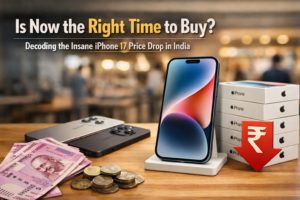
Is Now the Right Time to Buy? Decoding the Insane iPhone 17 Price Drop in India
If you’ve been holding out on upgrading to Apple’s latest flagship, the universe (and the Indian retail market) is finally throwing you a lifeline. As of March 2026, the iPhone 17 series is available at its lowest price since its launch last year. The headlines are flashy—proclaiming a starting price as low as Rs 48,742 for a device originally marked at Rs 82,900.
But before you rush to click “buy now” or head to your nearest electronics store, let’s cut through the marketing noise. In the world of high-end smartphone purchases, the “final price” is often a labyrinth of terms, conditions, and trade-offs. As a tech journalist who has tracked the Indian smartphone market for years, I’m here to decode what these offers actually mean for your wallet, and whether this is the genuine “sweet spot” to buy or just another retail illusion.
The Headline Number: Fact vs. Fiction
The eye-watering figure of Rs 48,742 for the base iPhone 17 (presumably the 128GB variant, though the article mentions 256GB models in sales) is certainly attention-grabbing. It represents a staggering 41% drop from the launch price of Rs 82,900. However, it is crucial to understand that this price is the result of a “perfect storm” of discounts—a scenario that applies to a very specific type of customer.
According to the reports, this price point is achieved through a combination of:
- A direct price cut from the retailer (like Vijay Sales or Croma).
- Bank offers (typically instant discounts of up to Rs 4,500 for specific credit cards like HDFC, ICICI, Axis, or OneCard).
- Exchange bonuses (the often-opaque variable that can make or break the deal).
For the average consumer walking in without an old iPhone to trade in or without the specific premium credit card required, the effective price will be significantly higher. Retailers often advertise the “lowest possible price” to drive footfall, but the reality for a cash buyer is usually just the direct discount plus a standard bank offer, landing closer to the Rs 75,000–78,000 range for the Pro models.
The “Exchange” Factor: Getting Real Value for Your Old Device
The biggest variable in achieving that rock-bottom price is the exchange offer. The report mentions the iPhone 17 Pro is listed at Rs 1,32,490 (down from Rs 1,34,900) before bank offers. To get to the sub-Rs 50,000 bracket for the standard model, you would likely need to exchange a relatively recent flagship device.
If you are holding onto an iPhone 15 or 16 in pristine condition, this is where you can extract maximum value. However, there is a human element to this that the fine print doesn’t capture.
Insider Insight: Offline retailers like Vijay Sales and Croma often have more flexibility with exchange values than online platforms. While online exchanges are algorithmic and strictly based on the phone’s physical condition (checked by a delivery agent), offline stores allow for human negotiation. A minor scratch that might deduct Rs 5,000 online can sometimes be overlooked by a store manager looking to meet his daily sales target. If you are planning to exchange an older device, I highly recommend visiting a physical store. You can often negotiate the exchange value of your old phone, especially if you are bundling it with a high-value purchase like the iPhone 17 Pro Max.
The Pro vs. Standard Dilemma: Where Is the Real Value?
The Indian market has always had a peculiar fascination with the “Pro” models. However, with the price gap narrowing during this sale, the decision becomes more interesting.
The iPhone 17 (Standard) At a theoretical low of Rs 48,742, the standard iPhone 17 becomes an incredible value proposition. It offers the core Apple experience—the new design language, the A19 chip, and the improved battery life—without the heavy price tag. For users coming from an iPhone 13 or 14, this upgrade at this price point is a no-brainer. It’s the best “value flagship” you can buy right now in the Apple ecosystem.
The iPhone 17 Pro On the other hand, the Pro models are seeing substantial discounts but are still a significant investment. The reported price of Rs 1,32,490 for the Pro (down from Rs 1,34,900) is a modest direct discount, but the bank offers and exchange bonuses are where the heavy lifting happens.
If you are a content creator or a professional relying on the enhanced camera system (especially the rumored periscope zoom upgrades), the Pro is irreplaceable. However, if you are simply buying it for the “status” of the third camera lens, the standard model might be the smarter financial play, especially given the current economic climate where disposable income is being scrutinized.
The Great Indian Retail Battle: Online vs. Offline
The article highlights both Vijay Sales (offline/online hybrid) and Croma (physical stores). This points to a growing trend in India: the resurgence of offline retail for high-value electronics.
Why does this matter for you?
- Offline (Croma, Vijay Sales): You get to physically inspect the unit. More importantly, you get “instant” gratification. You walk in, hand over your old phone, pay the difference, and walk out with a new device. There is also a higher chance of scoring a “store-specific” loyalty discount if you are a returning customer.
- Online (Amazon, Flipkart): While the article focuses on offline players, these sales usually trigger a price war. Typically, within 48 hours of such news breaking, e-commerce giants will match or slightly undercut these prices to remain competitive. However, the exchange process online can be a hassle. I’ve seen cases where the pickup executive devalues the phone at the doorstep, leaving the buyer with a dilemma: accept the lower value or cancel the order.
My advice: Use the online prices as a baseline for negotiation in offline stores. Show the salesman the online price; they often have the authority to match it or throw in an accessory (like a case or screen protector) to close the deal.
The “Upgrade” Trap: Should You Wait for the iPhone 18?
We are in March 2026. Apple’s next iteration, the iPhone 18, is roughly six months away (typically launching in September). This is the classic “spring sale” dilemma.
When you see prices this low in March and April, it is a clear inventory clearance strategy. Retailers are offloading stock to make room for the next big thing. If you are someone who needs the latest model on day one, this sale is a trap. You will be buying a phone that will feel “last-gen” in just a few months.
However, if you are pragmatic, this is the best time to buy. The iPhone 17 is a mature product now. The iOS updates have ironed out the initial bugs, and the hardware is proven. You are getting a premium device at a mid-range price. Historically, Apple devices hold their value well, but the steepest depreciation curve happens right before the next launch. By buying now, you are avoiding that “new phone premium” tax.
How to Maximize Your Deal: A Quick Checklist
If you are determined to take advantage of these offers, here is a strategic checklist to ensure you aren’t leaving money on the table:
- Check Your Plastic: Do you have the specific credit cards mentioned (HDFC, ICICI, Axis, OneCard)? The “up to Rs 4,500” discount is usually only applicable if you use these cards. Some banks also offer no-cost EMI options that, when combined with the discount, can significantly ease the cash flow burden without adding interest.
- Audit Your Old Phone: Don’t guess the exchange value. Use online tools (like Cashify or the retailer’s own exchange calculator) to get a realistic estimate of your current phone’s value. If the difference between the online estimate and the store offer is more than Rs 2,000, consider selling your phone separately on a second-hand marketplace rather than exchanging it.
- Read the Fine Print: “Up to Rs 4,500” is a vague term. Often, the maximum discount is reserved for the highest-priced model (the Pro Max). The standard iPhone 17 might only get Rs 2,000–3,000 off via bank offers.
- Look for Bundles: Sometimes, the best deals aren’t on the phone alone but on bundles. If you are planning to buy a new Apple Watch or AirPods, ask the retailer if there is a “combo offer.” Often, the discount increases when you purchase multiple items, even if it isn’t advertised prominently in the headline.
Final Verdict: Genuine Value or Marketing Hype?
This is genuinely one of the best pricing windows for the iPhone 17 series in India.
The combination of the seasonal “Summer Sale” and the impending arrival of the next generation has created a perfect storm for buyers. While the sub-Rs 50,000 price is achievable only for a minority (those with high-value exchanges and premium credit cards), the overall discount structure is robust.
If you are looking for a reliable, high-performance smartphone that will last you the next 4 to 5 years, and you don’t suffer from “FOMO” (Fear Of Missing Out) regarding the iPhone 18, this is the time to strike.
Just go in with your eyes open. Walk into the store with your old phone in hand, your eligible credit card ready, and a clear budget in mind. Don’t let the flashy “lowest ever price” headline push you into a Pro Max model you don’t need. Stick to your use case, calculate the actual out-the-door cost after your exchange, and you’ll walk away with one of the best tech deals of the year.
You must be logged in to post a comment.