
Ireland’s Diplomatic Stand Against Israel’s UNRWA Demolition: A Crisis for International Law
Ireland has issued a forceful condemnation of Israel’s demolition of the UNRWA headquarters in East Jerusalem, framing it as a severe violation of international law and part of a sustained campaign to dismantle the agency. Irish Foreign Minister Helen McEntee demanded Israel immediately halt all attacks on UNRWA, stressing that its humanitarian work is indispensable for Palestinian refugees and that obstructing it deepens the crisis. Ireland backed its stance with significant financial support and anchored its position in the inviolable privileges and immunities of UN institutions, warning that this attack sets a dangerous precedent that undermines the entire multilateral humanitarian system.
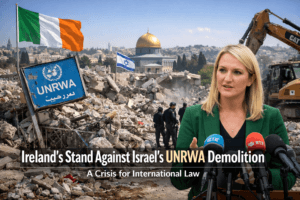
Ireland’s Diplomatic Stand Against Israel’s UNRWA Demolition: A Crisis for International Law
“UN installations are inviolable under international law. What happens today to UNRWA will happen tomorrow to any other international organization,” declared Philippe Lazzarini, UNRWA Commissioner-General, hours after witnessing bulldozers destroy his agency’s East Jerusalem headquarters.
On January 20, 2026, Israeli bulldozers accompanied by police and government officials converged on the Sheikh Jarrah neighborhood of occupied East Jerusalem. Their target was not a residential building or a military site, but the headquarters of the United Nations Relief and Works Agency for Palestine Refugees (UNRWA). Within hours, a compound that had served as a humanitarian nerve center for decades was reduced to rubble. This calculated demolition, justified by Israeli authorities as a legal reclamation of state land, has ignited a firestorm of international condemnation and presented a fundamental challenge to the established global order.
Ireland, with its distinctive history of neutrality and consistent advocacy for international law, has emerged as one of the most vocal critics. Irish Foreign Minister Helen McEntee did not mince words, calling the action “appalling” and demanding Israel “immediately halt all attacks and measures directed at the Agency”. This incident transcends a single building’s destruction; it represents a critical collision between national sovereignty claims, the inviolability of international institutions, and the dire humanitarian needs of millions of Palestinian refugees.
The Sheikh Jarrah Demolition: An Unprecedented Escalation
The events of January 20 were neither spontaneous nor isolated. They marked the culmination of a years-long campaign by the Israeli government against UNRWA. Israeli authorities forcibly entered the UNRWA compound in the early hours, expelling private security guards and confiscating equipment before deploying heavy machinery to demolish the structures.
Israeli officials framed the action as a straightforward legal enforcement. The Israeli Foreign Ministry stated the “State of Israel owns the Jerusalem compound” and argued that since UNRWA had ceased operations there, the site “does not enjoy any immunity”. Far-right National Security Minister Itamar Ben-Gvir celebrated the demolition on-site, calling it “a historic day” and “a day of celebration” for the restoration of governance in Jerusalem. This rhetoric aligns with a series of legislative moves. In late 2024, the Israeli Knesset passed laws banning UNRWA operations within Israel (which it defines as including East Jerusalem) and barring official contact with the agency. Further legislation in December 2025 paved the way for reclaiming UNRWA land.
The international response was swift and severe. UNRWA’s chief, Philippe Lazzarini, labeled it “an unprecedented attack against a United Nations agency and its premises” and “a new level of open and deliberate defiance of international law”. UN Secretary-General António Guterres urged Israel to cease the demolition and restore the compound. The agency’s position is rooted in the 1946 Convention on the Privileges and Immunities of the United Nations, to which Israel is a party. This convention explicitly states that UN premises “shall be inviolable” and immune from “any form of interference”. A significant U.S. federal court decision in September 2025 reinforced this principle, affirming that UNRWA, as a UN subsidiary organ, is entitled to absolute immunity under international law.
Ireland’s Forceful Condemnation and Tangible Support
Ireland’s reaction stood out for its moral clarity and concrete action. Foreign Minister Helen McEntee’s statement was a comprehensive rebuke, framing the demolition not as an aberration but as part of a “wider and sustained effort to undermine and dismantle UNRWA’s operations”.
Table: Key Elements of Ireland’s Response to the UNRWA Demolition
| Element | Description | Source |
| Diplomatic Condemnation | Called for an immediate halt to all attacks on UNRWA and demanded respect for international law and UN immunities. | |
| Financial Support | Announced €20 million in funding for UNRWA (part of a €42 million package for Palestinian aid). | |
| Humanitarian Focus | Stressed that obstructing UNRWA “deepens the humanitarian crisis and place[s] civilian lives at even greater risk.” | |
| Legal Framework | Explicitly cited the “privileges and immunities of the United Nations and its staff” as protected under international law. |
Ireland’s stance is deeply embedded in its foreign policy tradition. As a neutral country with a strong record in UN peacekeeping and a history of empathy with displaced peoples, Ireland has long advocated for a rights-based approach to the Israeli-Palestinian conflict. Its commitment goes beyond rhetoric. The €20 million in funding announced just last week is a tangible lifeline for an agency facing existential threats. McEntee emphasized that at “a time of immense and worsening humanitarian need,” the work of UNRWA is “indispensable”. This action positions Ireland as a leading European voice holding Israel accountable for actions that many in the international community view as violations of the rules-based order.
Broader Implications: A Multifaceted Crisis
The demolition of the UNRWA headquarters is a symptom of a much deeper crisis with global ramifications. UNRWA is not a minor NGO; it is a principal organ of the United Nations established in 1949. It provides essential services—including education, healthcare, and food security—to approximately 5.7 million registered Palestinian refugees across Gaza, the West Bank, East Jerusalem, Jordan, Lebanon, and Syria. Dismantling its operations would create an immediate humanitarian vacuum that no other organization is currently equipped to fill.
Israel’s campaign against UNRWA is predicated on serious allegations. The government accuses the agency of being a “greenhouse for terrorism” and of collaborating with Hamas, pointing to allegations that a small number of its staff were involved in the October 2023 attacks. While UNRWA vehemently denies being an arm of Hamas and has internal mechanisms to address staff misconduct, these allegations have been used to justify a broad-brush strategy of restriction and dismantlement. This strategy extends beyond UNRWA. New Israeli legislation imposes stringent conditions on all NGOs, requiring them to dismiss staff accused of “delegitimising Israel” and submit detailed staff lists, measures that groups like Médecins Sans Frontières have warned will worsen the humanitarian crisis.
The attack on UN immunities sets a dangerous precedent. If the premises of one UN agency can be seized and demolished without overwhelming global consequence, the security and integrity of all international organizations are undermined. As Lazzarini warned, “What happens today to UNRWA will happen tomorrow to any other international organisation or diplomatic mission”. This is why Ireland’s defense of the “privileges and immunities of the United Nations” is a defense of the entire multilateral system.
A Defining Challenge for Global Diplomacy
The rubble in Sheikh Jarrah represents more than a destroyed building. It symbolizes an escalating assault on the principles of humanitarian protection and the institutions designed to uphold them. Ireland has drawn a clear line, coupling its diplomatic condemnation with vital financial support and anchoring its position in the bedrock of international law. The path forward is fraught. It requires the international community to move beyond statements of concern to decisive diplomatic and legal action that reaffirms the inviolability of UN operations. The world must now decide whether to uphold the system designed to protect the most vulnerable or allow it to be dismantled piece by piece. The fate of UNRWA and the millions who depend on it may well determine the answer.
You must be logged in to post a comment.