
Iran’s ‘Axis of Resistance’: Inside the web of proxy forces reshaping the Middle East
Based on the analysis, Iran’s “Axis of Resistance” represents a strategic, four-decade-long effort by Tehran to project power and challenge Western and Israeli influence across the Middle East by cultivating deep relationships with allied militias and political movements—including Hezbollah in Lebanon, Hamas in Gaza, the Houthis in Yemen, and various Shiite militias in Iraq—that have become deeply embedded in their respective societies through military, political, and social services; while the recent U.S.-Israeli strikes that killed Iran’s Supreme Leader have created significant uncertainty about the future coordination of this network, the individual groups themselves are likely to persist as influential local actors given their entrenched positions and popular support, even if Iranian direction weakens.
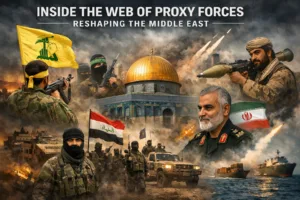
Iran’s ‘Axis of Resistance’: Inside the web of proxy forces reshaping the Middle East
From Tehran to the Mediterranean, how decades of strategic alliances have created a powerful network challenging Western influence
The announcement came with the kind of stark language that has defined Donald Trump’s political career. Standing before cameras Saturday, the president declared that joint U.S.-Israeli attacks on Iran were partly a response to what he called “terrorist militias that have soaked the earth with blood and guts.”
But behind the rhetoric lies a complex geopolitical reality that has fundamentally altered the Middle East over four decades. Iran’s network of allied militias and political movements—collectively known as the “Axis of Resistance”—represents one of the most sophisticated proxy strategies in modern military history.
The strategic logic behind Iran’s proxy network
To understand why Iran invests so heavily in foreign militias, you have to start with a map.
Iran is a Persian Shiite nation surrounded by mostly Arab Sunni neighbors. It fought a devastating eight-year war with Iraq in the 1980s that killed hundreds of thousands. It has been subject to crippling international sanctions for decades. Its conventional military, while formidable, cannot match the technological superiority of the United States or Israel.
The proxy strategy emerged from these constraints.
“The Islamic Republic learned early that it couldn’t fight its enemies symmetrically,” says Sanam Vakil, director of the Middle East and North Africa program at Chatham House. “Building influence through local actors became a way to project power without triggering a full-scale war that Iran would likely lose.”
The approach traces back to Lebanon in the early 1980s. When Israel invaded Lebanon in 1982, Iran’s Revolutionary Guards saw an opportunity. They deployed forces to the Bekaa Valley, a predominantly Shiite region, and began recruiting, training, and funding local fighters. That effort became Hezbollah.
Today, that playbook has been replicated across four Arab countries, creating a web of alliances that allows Iran to threaten Israel from multiple borders, challenge U.S. naval power in the Red Sea, and maintain a land corridor stretching from Tehran to the Mediterranean.
Hezbollah: The crown jewel of Iranian influence
On the southern outskirts of Beirut, past billboards honoring “martyrs” killed in conflicts with Israel, lies the heart of Hezbollah’s political and social infrastructure. Here, the group runs hospitals that treat patients regardless of sect, schools that educate thousands of children, and supermarkets where prices are subsidized for loyalists.
Hezbollah is not merely a militia. It’s a state within a state.
The group holds seats in Lebanon’s parliament—part of a delicate power-sharing arrangement with other political factions. It operates a television station, Al-Manar, that broadcasts across the Arab world. Its social service network has earned it deep loyalty among Lebanon’s Shiite community, many of whom feel marginalized by the country’s traditional political elite.
But it’s the military capability that concerns Israel most.
Before the 2024 Israeli campaign that significantly degraded Hezbollah’s forces, the group was estimated to possess an arsenal of more than 100,000 rockets and missiles—far surpassing the firepower of most national armies. Many of these weapons are precision-guided, supplied by Iran via overland routes through Iraq and Syria.
“Hezbollah is the most heavily armed non-state actor in the world,” says Matthew Levitt, director of the Countering Terrorism and Extremism Program at The Washington Institute. “They’ve built an army that can inflict serious damage on Israeli cities.”
The 2006 war between Hezbollah and Israel lasted 34 days and ended in a stalemate that many in the Arab world viewed as a Hezbollah victory. For Iran, that outcome validated the proxy strategy: a non-state actor had fought the region’s most powerful military to a draw.
The group’s longtime leader, Hassan Nasrallah, who was killed in an Israeli airstrike in 2024, was a charismatic figure who studied in the Iranian city of Qom. His relationship with Tehran was complex—Hezbollah always maintained some independence—but the strategic alignment never wavered.
Hamas: An unlikely alliance of Sunni and Shiite
When Hamas fighters crossed from Gaza into Israel on October 7, 2023, killing some 1,200 people and taking 251 hostage, they set in motion a chain of events that would reshape the region. But the attack also highlighted one of the more unusual relationships in Middle East politics: the alliance between Shiite Iran and Sunni Hamas.
Hamas was founded in 1987 as an offshoot of Egypt’s Muslim Brotherhood. Its ideology is Sunni Islamist, and its early funding came from Gulf Arab sources, not Tehran. Iran didn’t become a major patron until the 1990s, when shared opposition to the Oslo peace process created common ground.
There’s a bitter irony here that Palestinians often note. According to Israeli press accounts, Israel initially tolerated—and in some ways encouraged—Hamas’s emergence as a counterweight to the secular Palestine Liberation Organization. The strategy of dividing Palestinian factions would later haunt Israeli policymakers.
The relationship between Iran and Hamas has weathered significant strains. When the Syrian civil war began in 2011, Hamas initially backed the Sunni opposition against the Iranian-backed government of Bashar Assad. Iran cut off funding in response. It took years to rebuild the relationship.
But shared enemies have a way of smoothing over differences. Both Iran and Hamas view Israel as an existential adversary. Both oppose U.S. influence in the region. And both see themselves as defenders of Palestinian rights, even if their interpretations of what that means differ.
The Gaza war has devastated Hamas. Israeli forces have killed thousands of its fighters, including many senior commanders. The group’s tunnel network has been partially dismantled. Its ability to govern Gaza has been shattered.
But in the eyes of many Palestinians, Hamas achieved something that decades of diplomacy couldn’t: it put the Palestinian cause back at the center of regional politics. For Iran, that’s a victory worth supporting.
The Houthis: From Yemeni mountains to international shipping lanes
Perhaps no Iranian proxy has surprised the world more than the Houthis.
When this group of mountain fighters from northern Yemen began launching drones and missiles at commercial ships in the Red Sea after the Gaza war started, few expected them to fundamentally disrupt global trade. But by late 2023, major shipping companies were rerouting vessels around Africa, adding weeks to transit times and billions to costs.
The Houthis, officially known as Ansar Allah (“Supporters of God”), emerged from a distinct religious tradition. They belong to the Zaidi branch of Shiite Islam, which differs from the Twelver Shiism dominant in Iran. Zaidi imams ruled Yemen for centuries, and the Houthi movement grew partly from resentment of the central government’s marginalization of northern tribes.
The group seized control of Yemen’s capital, Sanaa, in 2014, triggering a civil war that drew in a Saudi-led coalition. That conflict, which the United Nations once called the world’s worst humanitarian crisis, created an opening for Iran.
Tehran provided weapons, training, and technical expertise. The Houthis learned to build drones that could fly hundreds of miles. They developed ballistic missiles that could reach deep into Saudi Arabia. And they proved remarkably resilient, surviving years of Saudi bombing that killed thousands of civilians but failed to dislodge them from power.
“People used to dismiss the Houthis as just another tribal militia,” says Nadwa Dawsari, a Yemeni analyst and senior fellow at the Middle East Institute. “But they’ve shown an ability to adapt and learn that’s rare in non-state armed groups.”
Their Red Sea campaign demonstrated this adaptability. When the U.S. and U.K. began striking Houthi targets in response to shipping attacks, the group simply changed tactics. They began targeting vessels with less direct connection to Israel, arguing they were defending Palestinians. Western officials privately admit the campaign hasn’t stopped Houthi attacks.
Trump’s recent comment about the Houthis—”They’re tough, they’re fighters”—reflects a grudging respect that military planners have long held. The group’s informal name comes from Hussein Badreddin Houthi, a political and religious leader killed by Yemeni forces in 2004. His family name now represents a movement that has challenged both regional powers and the United States.
The Iraqi militias: America’s unintended legacy
The 2003 U.S. invasion of Iraq was supposed to create a democratic ally in the heart of the Middle East. Instead, it opened the door for Iranian influence on an unprecedented scale.
Saddam Hussein, whatever his crimes, had contained Iran. His secular Baathist regime viewed the Islamic Republic as a mortal enemy and fought a bloody war with Tehran in the 1980s that claimed hundreds of thousands of lives. When U.S. forces toppled Saddam, they eliminated Iran’s primary regional counterweight.
What followed was a complex and often violent struggle for influence in Iraq. Iran’s Revolutionary Guards saw an opportunity and seized it. They began cultivating Iraqi Shiite militias, providing weapons, training, and funding. Some of these groups targeted U.S. troops, using a tactic that would become familiar: explosively formed penetrators, a type of roadside bomb that could pierce armored vehicles.
The U.S. death toll in Iraq exceeded 4,400. The Pentagon attributes hundreds of those deaths to Iranian-backed militias.
Today, these groups operate under the umbrella of the Popular Mobilization Forces, a collection of militias that technically answer to the Iraqi government but maintain their own command structures and loyalties. Some receive direct support from Iran’s Quds Force, the external operations arm of the Revolutionary Guards.
The most dramatic moment in this proxy conflict came in January 2020, when Trump ordered a drone strike near Baghdad International Airport. The target was Qassem Suleimani, the charismatic commander of the Quds Force and architect of Iran’s proxy strategy.
Suleimani was more than a military commander. He spoke Arabic fluently, traveled frequently among the militias, and cultivated personal relationships with their leaders. Under his guidance, Iran’s proxies evolved from simple attack forces into sophisticated political actors.
His killing was meant to degrade Iran’s network. Instead, it demonstrated how deeply embedded that network had become. Iraqi militias demanded U.S. withdrawal from Iraq. The Iraqi parliament passed a non-binding resolution calling for American forces to leave. And Iran’s proxies continued operating, adapting to Suleimani’s death as they had to previous setbacks.
The future of the Axis
The killing of Iran’s Supreme Leader Ayatollah Ali Khamenei in the recent U.S.-Israeli strikes represents the most significant escalation in this conflict since the 1979 Iranian Revolution. Khamenei had ruled Iran for decades, maintaining a careful balance between revolutionary ideology and pragmatic governance. His death creates uncertainty not just for Iran, but for the entire proxy network he helped build.
Will the Axis survive without its central patron?
The answer depends on how you define survival. The militias themselves aren’t going anywhere. They’re embedded in their societies, with political representation, social services, and popular support that would exist even without Iranian funding. Hezbollah will remain a force in Lebanon. The Houthis control Yemen’s capital and most populous regions. Iraqi militias are part of the security apparatus.
But the coordination and strategic direction Iran provided may weaken. Tehran’s new leadership, whoever emerges, will face immense pressure. The economy is crippled by sanctions. The population is restive. And the Revolutionary Guards, long the backbone of the proxy strategy, have suffered significant blows.
What comes next may be a more fragmented Axis—individual groups pursuing local interests rather than a coordinated regional strategy. That could reduce the threat to Israel and U.S. forces in the short term. But it could also create new dangers, as militias with weapons and training act independently, potentially triggering conflicts their patrons never intended.
For the people living under these groups’ influence—in Gaza, where Hamas governed; in southern Lebanon, where Hezbollah provides services; in Sanaa, under Houthi control; in Baghdad, where militias patrol the streets—the future is uncertain. The Axis of Resistance was always about more than fighting Israel and America. It was about building alternative structures of power in societies where the state had failed.
Those structures remain, even if their Iranian support weakens. And that may be the most lasting legacy of Iran’s proxy strategy: not the weapons or the training, but the creation of parallel institutions that have become woven into the fabric of four Arab countries.
You must be logged in to post a comment.