
Inside IndiGo’s Meltdown: How New Safety Rules and Systemic Strain Grounded India’s Aviation Giant
IndiGo’s unprecedented cancellation of over 1,000 flights in four days was triggered by new pilot fatigue safety rules that capped night operations and mandated longer rest periods, but the crisis exposed deeper systemic failures within India’s dominant airline. The carrier’s business model, which relied on maximizing aircraft use through tight schedules and extensive night flights, collapsed under the new regulations due to inadequate pilot recruitment and poor contingency planning. This operational meltdown stranded thousands of passengers, caused airfares on other airlines to skyrocket, and forced emergency government intervention to temporarily relax the rules, revealing the severe risks of India’s aviation market over-dependence on a single carrier and the need for more phased implementation of critical safety reforms.
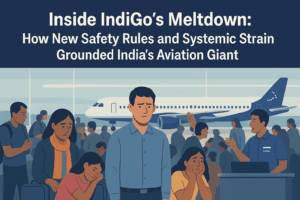
Inside IndiGo’s Meltdown: How New Safety Rules and Systemic Strain Grounded India’s Aviation Giant
A Nationwide Travel Nightmare Unfolds
For thousands of Indian air travelers this week, the journey began with hope and ended in chaos. As India’s largest airline, IndiGo, faced an unprecedented operational meltdown, scenes of frustration and helplessness played out across the country’s major airports. Images of weary passengers huddled on terminal floors, children sleeping on luggage, and travelers pleading with overwhelmed staff members became emblematic of what would become one of India’s most significant aviation disruptions in recent years.
By Friday, December 5th, the scale of the crisis was staggering: over 1,000 flights cancelled in just four days, affecting nearly half of the airline’s daily operations. What began as isolated delays quickly cascaded into systemic failure, leaving passengers stranded from Delhi to Bengaluru, Hyderabad to Kolkata. The airline, which commands an overwhelming 63% share of India’s domestic air travel market, had effectively ground to a halt, exposing the vulnerabilities of a system that had become dangerously dependent on a single carrier.
The Regulatory Spark: Understanding the New FDTL Rules
At the heart of this crisis lies a well-intentioned but poorly implemented regulatory change: the updated Flight Duty Time Limitations (FDTL) rules. Instituted by the Directorate General of Civil Aviation (DGCA) and rolled out in two phases—July 2024 and November 1, 2025—these regulations aimed to address longstanding concerns about pilot fatigue and flight safety.
What Changed for Pilots?
The new FDTL regulations introduced several crucial changes to pilot work schedules:
- Extended Mandatory Rest: Pilots are now required to have 48 hours of uninterrupted weekly rest, significantly more than previous requirements.
- Restricted Night Operations: A cap of only two night landings per week (between 12 AM and 6 AM), down from six previously allowed.
- Stricter Night Duty Windows: Extended definitions of night duty hours and reduced permitted night flying hours.
These changes, while designed to enhance safety, dramatically altered the operational mathematics for airlines that depend heavily on night flights to maximize aircraft utilization.
Table: Key Changes in FDTL Rules Impacting IndiGo Operations
| Regulation Aspect | Previous Norm | New FDTL Rules (Effective Nov 1, 2025) | Operational Impact on IndiGo |
| Weekly Rest Period | Less than 48 hours | 48 hours mandatory uninterrupted rest | Reduced available pilot hours |
| Night Landings | Up to 6 per week | Maximum 2 per week (12 AM–6 AM) | Disrupted high-utilization schedules |
| Night Flying Hours | More flexible limits | Stricter caps on consecutive night operations | Reduced aircraft utilization |
| Rest Substitution | More flexible | Initially no leave substitution for weekly rest | Reduced roster flexibility (later relaxed) |
The Perfect Storm: Why IndiGo Was Uniquely Vulnerable
While all Indian airlines faced the same regulatory changes, IndiGo’s business model and operational structure made it particularly susceptible to disruption. The airline’s success has been built on an aggressive strategy of maximizing aircraft utilization through quick turnarounds and extensive night operations—precisely the areas targeted by the new FDTL rules.
IndiGo operates a staggering 2,200-2,300 flights daily with a fleet of over 400 aircraft, making it the world’s fourth-largest carrier by scheduled domestic seat capacity. This enormous scale meant that even a minor disruption would cascade through the system exponentially. When the new FDTL rules immediately made a significant portion of its pilots unavailable for night rotations, the airline lacked the operational slack to absorb the shock.
Pilot Unions Point to Management Failures
Pilot organizations have been vocal in their criticism of IndiGo’s preparedness. The Federation of Indian Pilots and the Airline Pilots’ Association of India allege that the airline ignored repeated warnings about the impending regulatory changes.
According to union representatives, IndiGo maintained a hiring freeze despite knowing the new rules were imminent, pursued a “lean manpower” strategy to cut costs, entered into non-poaching agreements with competitors, and continued pilot pay freezes even as operational demands increased. “While all other airlines planned ahead and hired adequately,” noted one union statement, “IndiGo inexplicably adopted a hiring freeze”.
The Human Toll: Passengers Caught in the Crossfire
For ordinary travelers, the regulatory and operational explanations offered little comfort. The human impact of the crisis was both immediate and severe.
At Delhi’s Indira Gandhi International Airport, a passenger’s social media post captured dozens of young children sitting on the terminal floor with the caption: “Kids waiting since 4am for their IndiGo flight… hungry, tired, sleepy”. In Hyderabad, a traveler recounted how airline staff repeatedly promised resolution “in just two more hours” for 12 straight hours, with no provisions for food or accommodation.
The disruption exposed a critical communication breakdown. Many passengers arrived at airports only to discover their flights had been cancelled hours earlier. “There was no proper communication, food, or water as we waited for hours,” reported a stranded traveler at Chennai airport. The airline’s on-time performance—a key reliability metric—plummeted from an industry-leading position to just 19.7% during the peak of the crisis.
Economic Ripple Effects and Alternative Transport
The IndiGo meltdown created economic shockwaves beyond the aviation sector:
- Skyrocketing Airfares: With IndiGo’s massive capacity suddenly removed from the market, fares on competing airlines surged to unprecedented levels. Last-minute tickets on major routes like Delhi-Bengaluru crossed ₹80,000, while Kolkata-Mumbai flights reached ₹90,000—three to four times normal rates.
- Railways to the Rescue: As air travel became unaffordable or unavailable, thousands of stranded passengers turned to Indian Railways. The national rail operator responded by adding 116 additional coaches across 37 trains and operating 114 augmented trips to accommodate the surge.
- Broader Economic Impact: Business travelers missed crucial meetings, tourists altered itineraries, and the reputation of Indian aviation suffered internationally. The crisis even reached diplomatic circles, with the Singapore High Commissioner reportedly missing a staff member’s wedding due to cancelled flights.
Government Response and Regulatory Reversal
Facing mounting political pressure and public outrage, the government and aviation regulator intervened with a series of emergency measures:
- Temporary Rule Suspension: The DGCA placed the FDTL orders “in abeyance with immediate effect” for IndiGo, though the 48-hour weekly rest requirement remained intact.
- Targeted Exemptions: The airline received temporary relief until February 10, 2026, from certain night operation restrictions, particularly the two-landing-per-week cap.
- High-Level Inquiry: Civil Aviation Minister Ram Mohan Naidu announced a formal investigation to “determine accountability wherever required”.
The regulatory rollback highlighted a troubling reality: safety regulations, however well-intentioned, had been implemented without adequate consideration of operational realities. As Congress MP Karti Chidambaram noted, “When they gave that directive, they should have done an impact assessment”.
The Deeper Systemic Issues Exposed
Beyond the immediate triggers, the crisis revealed structural vulnerabilities in India’s aviation ecosystem:
- Market Concentration Risks: With nearly two-thirds of the domestic market, IndiGo’s problems quickly became the nation’s problems. This near-monopoly position raised questions about systemic resilience. As former Union Minister P. Chidambaram observed on social media, “Duopoly prevails in many sectors of the Indian economy; the airline industry is one”.
- Technology Vulnerabilities: The disruption was compounded by technical failures in IndiGo’s crew-rostering software and an emergency Airbus A320 software patch that further complicated scheduling. The airline’s technological infrastructure proved inadequate for managing complex regulatory changes under operational pressure.
- Infrastructure Strain: At Pune airport, the crisis became physically visible when all available parking bays were occupied by IndiGo aircraft that couldn’t operate due to crew unavailability, forcing temporary halts to all landings until space was cleared.
The Path Forward: Lessons for Indian Aviation
As operations gradually stabilize—with IndiGo CEO Pieter Elbers projecting normalcy by December 15 and full regulatory compliance by February 10, 2026—the aviation sector must confront difficult questions.
The tension between safety imperatives and operational realities requires more sophisticated management. Regulatory changes affecting complex systems demand phased implementation, robust impact assessments, and closer collaboration between regulators and operators. As one aviation expert noted, “IndiGo’s high-frequency, low-cost dominance and aggressive scaling are incompatible with tighter fatigue-control norms unless staffing grows proportionately”.
For passengers, the crisis offers hard lessons about the risks of overreliance on a single carrier and the importance of travel insurance during peak seasons. For the industry, it serves as a stark reminder that efficiency gains achieved through lean operations can become liabilities when systems are stressed.
Most importantly, for India’s aviation authorities, the meltdown underscores that in an interconnected system where one carrier dominates, regulatory oversight must evolve from monitoring individual airlines to safeguarding the resilience of the entire network. The skies may be clearing for now, but the structural clouds revealed by this crisis will take far longer to disperse.
You must be logged in to post a comment.