
Inside India’s Silicon Sanctuaries: A Journey to the Heart of the AI Revolution
Based on the provided news article, the long-form feature explores the hidden physical reality behind AI chatbots, taking readers inside a massive, high-security data centre in Greater Noida that serves as the “refinery” for artificial intelligence. It reveals that the seemingly magical responses from tools like ChatGPT are actually the result of billions of complex calculations performed in vast, fortress-like warehouses where thousands of power-hungry servers (especially GPUs) are kept alive by intricate cooling systems and redundant power backups. The piece delves into the immense physical infrastructure—the concrete, copper, and colossal energy consumption—required to power the AI revolution, highlighting how these facilities are not just tech hubs but critical national infrastructure in India’s race to build sovereign AI capabilities, ultimately framing them as the silent, industrial foundation of our virtual digital world.
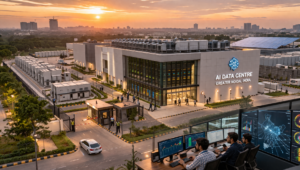
Inside India’s Silicon Sanctuaries: A Journey to the Heart of the AI Revolution
[Subtitle: Beyond the chatbot screen lies a world of concrete, copper, and colossal computation. Welcome to the data centres powering India’s AI future.]
The prompt is deceptively simple: “Explain quantum computing like I’m five.” You type it into a ChatGPT window, hit enter, and within seconds, a clear, patient explanation appears. The experience feels almost magical, ethereal—a ghost in the machine doing our bidding.
But magic, as Arthur C. Clarke famously noted, is just technology we don’t understand yet. And the reality behind that seemingly simple interaction is anything but ethereal. It is physical, immense, and astonishingly loud. It is rooted not in the cloud, but in the earth—in vast, windowless monoliths of concrete and steel that are sprouting up on the outskirts of India’s metropolitan cities.
To find the true source of that chatbot answer, you don’t look to the sky. You drive to Greater Noida, through stretches of dusty road lined with trucks and under-construction flyovers, until you arrive at a 20-acre campus that looks more like a maximum-security prison than a hub of digital innovation.
This is a data centre. Or rather, this is a data centre park—a fortified city dedicated to a single, monumental task: thinking for us.
The Fortress of Thought
Getting inside is not easy. Security checkpoints, biometric scans, and a palpable sense of controlled paranoia mark the entrance. The air itself feels different—cooler, drier, scrubbed clean of the dust and pollution that are the enemies of the delicate machinery within. My guide, a facilities manager who asks to remain anonymous (a common request in an industry that prizes secrecy), explains the rationale.
“This building doesn’t exist on any public map you’d find easily,” he says, his voice echoing slightly in the stark white entryway. “We’re not just protecting data from hackers; we’re protecting it from floods, from fire, from electromagnetic pulses, and, yes, from people who might want to cause physical harm. This is critical national infrastructure now.”
We pass through a final airlock-style door, and the world changes. The silence of the lobby is obliterated by a deep, pervasive hum. It’s not a sound you hear so much as feel—a low-frequency vibration that seems to originate from the very core of the building and travels up through the floor, into your bones. It’s the sound of a billion calculations happening every second. It’s the sound of thinking, industrialized.
We have entered the data hall.
The Cathedral of Computation
The sheer scale of the room is the first thing that hits you. It’s a cavernous space, with ceilings soaring nearly 40 feet high. Running the entire length of the hall, in perfect, impossibly straight lines, are rows upon rows of black server racks. They stand like silent sentinels, stacked to the ceiling, each one a towering bookshelf packed not with books, but with the collective knowledge and processing power of the modern world.
Coloured fibre-optic cables, neatly bundled and suspended from overhead trays, cascade down into the racks like digital vines, carrying torrents of data at the speed of light. Small, winking LEDs—green, blue, amber—flicker across the front of every server, a constellation of artificial stars in this otherwise sterile landscape.
“This is our AI refinery,” my guide shouts over the roar of the cooling fans. It’s an apt metaphor. Just as an oil refinery takes crude oil and cracks it into petrol, jet fuel, and plastics, this data hall takes raw electricity and refines it into intelligence.
The rows closest to us are filled with a different kind of hardware. These aren’t the standard server racks you might find in a corporate IT room. The racks are denser, the cabling more complex, and the servers themselves are studded with what look like oversized graphics cards. These are the workhorses of the AI revolution: GPU (Graphics Processing Unit) servers.
Where a traditional CPU (Central Processing Unit) is a brilliant scholar, capable of solving complex problems one after another with great precision, a GPU server is like a thousand math tutors working in parallel. It’s this massively parallel architecture that is essential for training large language models (LLMs) like the one powering ChatGPT. Processing vast swathes of text, recognizing patterns, and fine-tuning responses isn’t a linear task; it’s a task of brute-force, parallel computation.
Every time you ask an AI to summarize an email or generate a recipe, a tiny fraction of the work is done here, or in a thousand other data centres just like it. Your prompt gets broken down into packets of data, routed across the internet, and assigned to a specific GPU in a specific rack in a specific building. The GPUs then perform their complex matrix multiplications, the result is reassembled, and the answer is fired back to your screen. All in the time it takes you to blink.
The Thirst for Power and the River of Cool
But this immense computational power comes with an equally immense physical cost. As we walk down the central aisle, the roar of the fans intensifies. We’re approaching the rear of the server racks, where the real story of this place is told.
“Follow the heat,” my guide says with a wry smile. “That’s the first rule of understanding a data centre.”
We turn a corner into a narrower, sweltering hot aisle. The air, which was cool and dry just feet away, is now a blast furnace. This is where all the waste heat from the servers is dumped. Each one of those GPUs is a tiny, powerful electric heater. Multiply that by tens of thousands, and you have a monumental thermal management problem. If not handled, the servers would melt down in minutes.
This brings us to the second great physical reality of the AI refinery: water and electricity.
To combat the heat, an intricate dance of cooling takes place. Chilled water, circulating through pipes embedded in the floors and running above the racks, absorbs the heat. Giant air handling units, the size of shipping containers, roar on the roof, pushing the cold air down into the “cold aisles” in front of the racks. The servers suck it in, and exhaust it out the back into the “hot aisles.”
The electricity required to run this operation is staggering. This single facility draws as much power as a small town. To ensure it never, ever goes down, the power architecture is a masterpiece of redundancy. Massive transformers step down power from the national grid. If that fails, giant battery banks, occupying rooms of their own, kick in instantaneously. And if the outage lasts longer than a few minutes, colossal diesel generators, housed in a separate soundproofed bunker, rumble to life, capable of powering the entire facility for weeks.
“The grid is the starting point, not the only point,” my guide explains. “For AI, an outage isn’t just an inconvenience. If the power dips while a model is being trained—a process that can take months and costs millions of dollars—you could lose all that progress. The entire training run is corrupted. The cost is incalculable.”
The Human Element in the Automated World
For all its automation, the data centre is not devoid of people. In a sterile, quiet corner of the facility, away from the roar of the machines, is the Network Operations Centre (NOC). It looks like a scene from a NASA control room—a wall of giant screens displaying real-time graphs of power usage, network traffic, and internal temperatures.
Here, a small team of engineers monitors the digital heartbeat of the refinery. They are the system administrators, the “server whisperers.” One of them, a young woman named Anjali, scrolls through a feed of alerts.
“Most of the work is proactive,” she says, not taking her eyes off the screen. “We’re looking for anomalies. A gradual temperature increase in Rack 7, Row C. An unusual spike in latency from a specific set of GPUs. We have to anticipate problems before they happen. If a single drive fails, the system is designed to route around it. But if a cooling pump fails, we have minutes, not hours, to act.”
Anjali’s presence is a reminder that even in this hyper-automated world, human intuition and pattern recognition are still the ultimate fail-safe. The AI that runs on these servers can write poetry and code, but it can’t walk into a hot aisle and diagnose a failing fan by the change in its pitch. Not yet, anyway.
India’s AI Ascent and the Geopolitics of Compute
As we leave the data hall and walk back towards the administrative building, the scale of the ambition becomes clear. The campus has room to double, even triple its capacity. More buildings are in the planning stages. This isn’t just about meeting today’s demand for ChatGPT prompts; it’s a bet on the future.
India is in a unique position. It has a massive pool of engineering talent, a booming digital economy, and a government pushing for sovereign AI capabilities. The idea is to build AI models that are trained on Indian languages, Indian data, and for Indian problems. But you can’t build a sovereign AI without sovereign compute.
This is where these “refineries” become geopolitical assets. Currently, a huge amount of the world’s AI compute is concentrated in the US and China. For India to be a true player in the next industrial revolution, it needs its own infrastructure. The monoliths in Greater Noida, Mumbai, and Hyderabad are the physical foundation of that ambition. They are the engine blocks for a new kind of economy.
But the challenges are immense. The power consumption of these facilities is at odds with India’s climate commitments. There is a frantic search for sustainable solutions—solar farms, green hydrogen, and more efficient liquid cooling techniques that can reduce the reliance on massive amounts of electricity and water.
The Unseen Cost
Standing outside, the setting sun glinting off the otherwise featureless white facade, the sheer incongruity of it strikes you. Inside that building, a college student in Kerala is learning about economics, a programmer in Bengaluru is debugging code, and a manager in Delhi is wording a difficult email. The entire, chaotic, creative, and curious energy of a nation’s digital life is being processed, in parallel, in this one spot.
The data centre is the ultimate physical manifestation of the virtual age. It’s a place of paradoxes: incredibly fragile yet massively fortified; perfectly ordered yet processing the chaotic mess of human thought; hyper-efficient yet voraciously consuming resources. It is the factory floor of the 21st century, devoid of smokestacks, but humming with a power just as transformative.
As I get back into the car and the gate slowly closes behind me, the hum of the refinery fades, replaced by the chaotic honking of the Noida traffic. I pull out my phone and, almost instinctively, type another prompt into an app. The answer comes back in seconds. But this time, it feels different. It feels less like magic, and more like the distant echo of a million spinning fans and a billion blinking lights, working away in the silent monolith just down the road.
You must be logged in to post a comment.