
Infosys, TCS, HCLTech In Focus As India AI Summit Kicks Off: A Reality Check On The Disruption Fear
The Indian IT sector, featuring major players like Infosys and TCS, is under intense scrutiny as the India AI Impact Summit 2026 commences, following a sharp market sell-off last week driven by fears of AI-led disruption. However, OpenAI CEO Sam Altman has set an optimistic tone ahead of the summit, declaring that India has “all the ingredients to be a full-stack AI leader,” citing its vast talent pool and proactive national AI strategy. This dichotomy encapsulates the current dilemma for investors: while the fear is that AI will commoditize traditional IT services, the summit’s focus on human-centric AI and India’s unique digital infrastructure suggests a potential pivot for these companies from low-cost service providers to high-value AI solution architects. Ultimately, the market turbulence presents a need for discernment, as the future will likely favor IT firms that successfully reinvent themselves by leveraging AI to build proprietary solutions, rather than those that merely defend their legacy business models.
Infosys, TCS, HCLTech In Focus As India AI Summit Kicks Off: A Reality Check On The Disruption Fear
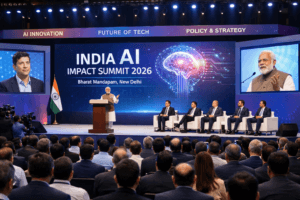
As the sun rises on Monday, February 16, 2026, the bustling grounds of Bharat Mandapam in New Delhi are not just preparing for a conference; they are setting the stage for a potential paradigm shift. The India AI Impact Summit 2026 has officially begun, and with it, a wave of anticipation—and apprehension—sweeps through the country’s financial markets. For investors in particular, the spotlight is intensely focused on a single sector: Information Technology.
After a brutal week that saw the NIFTY IT index plummet over 8.6%, erasing billions in market capitalization, stocks like Infosys (INFY), Tata Consultancy Services (TCS), HCL Technologies (HCLTECH), and Wipro (WIPRO) are once again in the crosshairs. The trigger for the sell-off was a familiar, yet increasingly potent, specter: the fear of AI-led disruption. But as global leaders gather in the capital to discuss the future of artificial intelligence, a crucial question emerges: Is this fear a rational response to an imminent threat, or is it a dramatic overreaction that has created a buying opportunity?
This week, the conversation around AI shifts from abstract speculation to tangible policy and strategy. The outcomes of the India AI Impact Summit will likely dictate the narrative for IT stocks for the rest of the year.
The Summit’s Shadow: Why the Market is on Edge
To understand the market’s jitters, one must look beyond the headline-grabbing stock charts. Last week’s sell-off wasn’t just about a vague unease with technology. It was a reaction to a growing consensus that the business models of traditional IT services companies—built on labour arbitrage, managing legacy systems, and providing bodies for projects—are the most vulnerable to an AI-powered world.
For decades, Indian IT giants have thrived by offering cost-effective solutions to global corporations. Their workforce of millions has been their greatest asset. However, generative AI threatens to automate a significant portion of the routine coding, testing, and maintenance work that forms the bedrock of this industry. The market is now pricing in a future where a client might need one highly skilled AI architect instead of a team of ten junior developers.
This is the context in which the India AI Impact Summit begins. It’s a high-stakes event where the narrative around AI’s role in the economy will be shaped. Will the summit’s message be one of replacement or one of empowerment? Investors are hanging on every word.
Sam Altman’s “Full-Stack” Vision: A Blueprint for Indian IT?
Ahead of his arrival in New Delhi, OpenAI CEO Sam Altman set a decidedly optimistic tone. In a column for The Times of India, he declared that India possesses “all the ingredients to be a full-stack AI leader.” He praised the country’s technical talent, the government’s proactive IndiaAI Mission, and the nation’s rapid adoption of AI tools, noting the staggering figure of “100 million weekly active users”—the second-largest base globally.
This statement is a far cry from his infamous 2023 comment that trying to build foundational AI models in India was “hopelessly ambitious.” The evolution in his tone reflects a massive shift in India’s AI landscape over the past three years.
But what does “full-stack AI leader” mean for a company like Infosys or TCS? Altman’s vision provides a crucial framework. He highlighted the IndiaAI Mission’s goals: expanding compute capacity, supporting startups, and accelerating multilingual applications in sectors like healthcare and agriculture.
This is the blueprint for the Indian IT sector’s survival and evolution. The opportunity is no longer just about servicing the IT needs of Western clients. It’s about leveraging India’s unique position to become an AI solution creator for the world.
- From Service Provider to Solution Architect:The Indian IT firm of the future won’t just write code for a US bank; it will build an AI-powered fraud detection system tailored for the Indian market and then adapt it for other emerging economies. The deep understanding of diverse, large-scale populations—a skill honed in India—becomes a competitive advantage.
- The “India Stack” Advantage:India’s digital public infrastructure—Aadhaar, UPI, DigiLocker—is a living lab for AI. IT companies that master the integration of AI with this stack to solve problems in logistics, governance, and financial inclusion will create proprietary solutions that can be exported.
- The Talent Pool 2.0:The fear is that AI will render Indian tech talent obsolete. Altman’s point suggests the opposite: that this talent is the very resource that will build the next generation of AI. The challenge is a massive reskilling effort. Companies like TCS and Infosys have already invested billions in retraining their workforce on AI and machine learning. The success of this internal transformation will determine their future relevance.
Decoding the Stock Movement: Fear vs. Opportunity
Given this context, how should investors interpret the sharp decline in IT stocks? The knee-jerk reaction suggests a market gripped by fear. But a closer look reveals a more nuanced picture.
- The Case for Caution (The Bear Case): The disruption is real. The high-margin, commoditized services that have fueled growth for decades are under threat. Pricing power may erode as AI tools become ubiquitous. Furthermore, global macroeconomic uncertainty, particularly in the US and Europe (the primary markets for Indian IT), continues to weigh on spending. The summit could amplify these fears if the discussions focus heavily on the job displacement potential of AI.
- The Case for Opportunity (The Bull Case): The sell-off may be overdone. The 8.6% drop in the NIFTY IT index last week appears to be a panic-driven reaction. History shows that technological revolutions often create more value than they destroy, though the value is captured by different players. Companies like Infosys (with a 4.20% gain on this particular Monday, per the data) are trading at valuations that are beginning to look attractive for long-term investors. The key is to differentiate between companies that are defending their old business and those that are building a new one.
What to Watch at the India AI Impact Summit
For investors tracking Infosys, TCS, HCLTech, and others, the next few days are less about daily stock prices and more about strategic signals. Here’s what to keep an eye on:
- Announcements of Partnerships: Watch for any collaborations announced between global AI leaders (like OpenAI) and Indian IT firms. A partnership to co-develop industry-specific AI solutions would be a massive positive catalyst.
- Government Policy Clarity: The summit will feature key policymakers. Clarity on data privacy laws, AI regulation, and incentives for AI R&D will provide a stable roadmap for corporate investment.
- The “Human-Centric” Narrative: IT Secretary S. Krishnan’s statement that AI must be “human-centric and inclusive” is crucial. The companies that can best articulate how they use AI to augment their human workforce—making them more efficient and valuable, rather than replacing them—will win the confidence of both clients and investors.
- The Altman Keynote: All eyes will be on Sam Altman’s address. Will he double down on his “full-stack” optimism? Will he announce concrete plans for OpenAI’s expansion in India, such as setting up a research hub or deepening partnerships? His words have the power to move markets.
The Road Ahead: A Tale of Two Companies
The coming months will likely see a great divergence within the NIFTY IT index. The rising tide of AI will not lift all boats equally. The winners will be the companies that successfully navigate the transition from being low-cost service providers to high-value AI solution partners. They will be characterized by:
- High Investment in IP: Companies building proprietary AI platforms and tools.
- A Focus on Consulting: Moving up the value chain to advise clients on AI strategy, not just execution.
- Leveraging the Domestic Market: Using India’s unique digital landscape as a testbed for innovative solutions.
The laggards will be those that cling to the old model, hoping the AI wave is a passing fad.
As Prime Minister Narendra Modi inaugurates the summit this evening, the message is clear: India intends to be a shaper of the AI age, not just a passenger. For the country’s IT giants, this summit is not just another industry event. It is a call to action—a reminder that the future belongs not to those who fear disruption, but to those who embrace it and reinvent themselves. For investors, the current turbulence is not a signal to flee, but an invitation to identify which of these companies is truly building the future. The next few days will offer the first crucial clues.
You must be logged in to post a comment.