
Indo-US Defense Tech Partnership Enters New Phase with DRDO Meeting
The recent 24th Indo-US Joint Technical Group meeting in New Delhi marks a significant deepening of defense technology collaboration, transitioning from dialogue to concrete projects under the 2025 Major Defence Partnership framework. Focused on critical areas like artificial intelligence, quantum computing, and hypersonic systems, the partnership is strategically institutionalized through mechanisms like the Innovation Bridge to connect DRDO with the U.S. Defense Innovation Unit and expand university and industry roles in cooperative R&D. While challenges persist in technology transfer and integrating different defense ecosystems, this evolved collaboration strengthens India’s domestic defense capabilities in line with its Atmanirbhar Bharat initiative while advancing U.S. interests in fostering a technologically capable regional partner in the Indo-Pacific, demonstrating resilience across political administrations.
Indo-US Defense Tech Partnership Enters New Phase with DRDO Meeting
The recent meeting in New Delhi represents not just another diplomatic exchange, but a calculated step in a strategic partnership that has quietly evolved into one of the most consequential defense relationships of the 21st century.
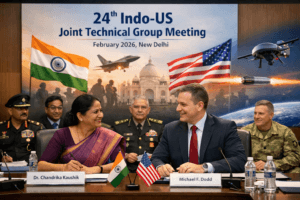
In February 2026, senior defense officials from India and the United States gathered in New Delhi for the 24th Indo-US Joint Technical Group Plenary Meeting, signaling a deepening commitment to technological collaboration at a time of shifting global power dynamics. This meeting, hosted by India’s Defence Research and Development Organisation (DRDO), focused explicitly on strengthening cooperation in critical and emerging defense technologies—a phrase that appears repeatedly in official statements with deliberate significance.
The gathering was conducted under the policy guidance established by the India-US Major Defence Partnership framework signed just months earlier in October 2025 by India’s Defence Minister Rajnath Singh and US Secretary of War Pete Hegseth. This continuity amid changing administrations and geopolitical pressures reveals a partnership that has matured beyond transactional arrangements into something more strategically resilient.
1 Strategic Context: Beyond Defense Trade
The Indo-US defense relationship has undergone a remarkable transformation over the past two decades, evolving from Cold War-era suspicion to what both nations now describe as a “major defense partnership.” The Joint Technical Group meetings represent the technical backbone of this relationship, providing a structured mechanism for scientific exchange that predates and underpins the more visible defense sales and military exercises.
India’s defense modernization goals increasingly align with technological priorities articulated by the US Department of Defense, particularly in areas like artificial intelligence, quantum computing, and space-based systems. This alignment creates natural collaboration opportunities but also raises questions about technology transfer and intellectual property rights—issues that have historically constrained deeper cooperation.
2 Meeting Details and Institutional Architecture
The two-day plenary was co-chaired by Dr. Chandrika Kaushik, Director General of Production Coordination & Services Interaction at DRDO, and Michael Francis Dodd, Assistant Secretary of War for Critical Technologies in the US Office of the Under Secretary of War for Research and Engineering. This pairing of production-focused leadership with cutting-edge technology expertise reveals the meeting’s dual purpose: advancing research while ensuring practical application.
In attendance were senior officials, scientists, and technocrats representing not only defense laboratories but also India’s Tri-Services, Ministry of External Affairs, and National Security Council Secretariat. This broad participation across military, diplomatic, and security domains indicates that technological collaboration is no longer siloed within defense establishments but recognized as having broader national security implications.
2.1 The Innovation Bridge Framework
A particularly significant outcome was the exploration of collaboration between DRDO and the US Defense Innovation Unit under what officials termed the “Innovation Bridge framework”. This framework represents an institutional innovation designed to overcome traditional bureaucratic barriers to defense innovation.
The Innovation Bridge essentially creates dedicated pathways for:
- Rapid prototyping and testing of dual-use technologies
- Shared access to specialized testing facilities
- Streamlined contracting mechanisms for joint research initiatives
- Enhanced industry participation alongside traditional defense laboratories
The culmination of the meeting in the signing of a project agreement suggests concrete progress rather than merely exploratory discussions. While specific project details remain classified, the structural implications are clear: both nations are building institutional capacity for sustained technological cooperation beyond individual transactions.
3 Technological Focus Areas and Strategic Priorities
The meeting’s agenda centered on critical and emerging defense technologies—a category that both nations have independently identified as essential for future military competitiveness. Based on public statements and prior bilateral discussions, these likely include:
Table: Key Focus Areas in Indo-US Defense Technology Collaboration
| Technology Domain | Potential Applications | Collaborative Advantages |
| Artificial Intelligence | Autonomous systems, predictive maintenance, intelligence analysis | India’s software talent combined with US hardware expertise |
| Quantum Technologies | Secure communications, advanced sensing, computational advantage | Complementary research strengths in theoretical and applied domains |
| Hypersonic Systems | Missile development, defense against hypersonic threats | Shared interest in countering regional proliferation |
| Space-based Systems | Surveillance, communication, navigation | Converging interests in space domain awareness |
| Cyber Capabilities | Network defense, offensive capabilities, resilient architectures | Mutual concerns about state and non-state threats |
| Directed Energy | Laser defense systems, anti-drone technology | Parallel development efforts with potential for shared testing |
The emphasis on university-affiliated research centers and defense laboratories indicates a deliberate strategy to move beyond government-to-government interactions toward creating an ecosystem of innovation. This approach leverages India’s substantial academic research capabilities while connecting them with the US defense innovation base—a potentially powerful combination if intellectual property and technology transfer challenges can be adequately managed.
4 Broader Implications for Defense Policy and Industry
4.1 For India’s Defense Industrial Base
This evolving collaboration directly supports India’s Atmanirbhar Bharat (self-reliant India) initiative in defense manufacturing, though in ways that may surprise observers expecting purely indigenous development. Rather than isolating India’s defense sector, the partnership provides selective access to cutting-edge technologies that can accelerate domestic capability development.
The focus on involving industries in cooperative R&D initiatives suggests recognition that traditional defense laboratories alone cannot drive the innovation pace required in contemporary technological competition. This represents a subtle but important evolution in India’s defense innovation policy, creating space for private sector participation in high-technology defense projects that were previously reserved for public sector undertakings.
4.2 For US Strategic Interests in the Indo-Pacific
From a US perspective, strengthening India’s defense technological capabilities serves multiple strategic objectives. A more technologically capable India contributes to regional balance in the Indo-Pacific, potentially reducing the direct burden on US forces. Additionally, collaboration creates interoperability foundations that would be valuable in contingency scenarios, even if formal alliances remain politically untenable for India.
Perhaps less visibly, technological collaboration builds institutional relationships between defense scientific communities that endure through political transitions. The very existence of a 24th meeting in this series demonstrates institutional resilience—the partnership has persisted through multiple administrations in both countries with varying strategic priorities.
5 Challenges and Tensions in the Partnership
Despite the positive momentum, significant challenges persist. Technology transfer restrictions embedded in US export control regimes continue to complicate collaboration on the most sensitive technologies. India’s historical reliance on Russian defense equipment creates integration challenges with predominantly Western technology standards. Furthermore, differing bureaucratic cultures and procurement processes can slow implementation even when political agreement exists.
The asymmetric nature of the technological relationship also creates inherent tensions. While collaboration is framed as mutually beneficial, the reality involves India seeking access to advanced technologies where the US maintains clear advantages. Managing expectations while building genuine partnership requires diplomatic skill on both sides—a challenge reflected in the meeting’s agenda, which included discussions of “associated challenges” alongside proposals for strengthened collaboration.
6 The Path Ahead: From Dialogue to Delivery
The signing of a project agreement at the conclusion of the meeting suggests movement from dialogue toward implementation. The true measure of progress, however, will be observable in subsequent developments: whether specific collaborative projects materialize, whether private sector participation expands as intended, and whether the Innovation Bridge framework demonstrates practical utility beyond conceptual appeal.
Looking forward, the trajectory of this technical collaboration will likely be influenced by several factors:
- The pace of technological change in priority domains, particularly artificial intelligence and quantum systems
- Geopolitical developments in the Indo-Pacific region that affect threat perceptions in both capitals
- Domestic political considerations in both countries regarding defense partnerships and technology sharing
- Competitive dynamics with other nations pursuing similar technological advancements
The institutionalization represented by these regular technical meetings provides stability mechanisms that can help the partnership weather political and strategic fluctuations. The challenge ahead lies in translating this institutional stability into tangible technological achievements that enhance security for both nations while respecting their sometimes divergent strategic autonomy concerns.
As defense technologies increasingly blur the lines between civilian and military applications, between physical and digital domains, and between national and global innovation systems, the Indo-US technical partnership represents a testing ground for how major democracies can collaborate on security technologies in an interconnected but competitive world. The next few years will reveal whether this collaboration can move beyond parallel interests to create genuinely complementary capabilities—a development that would have implications far beyond the bilateral relationship.
You must be logged in to post a comment.