
IndiGo’s Operational Meltdown: Unmasking the Systemic Cracks in Indian Aviation
The crisis that crippled IndiGo, India’s largest airline, was sparked by its catastrophic failure to prepare for revised pilot duty-time safety rules (FDTL), leading to over 1,000 flight cancellations in a single day, stranding thousands of passengers, and erasing over ₹37,000 crore in market value. While the immediate cause was corporate mismanagement and an acute pilot shortage, the meltdown exposed deeper systemic fragilities within Indian aviation, including a market distorted by chronic losses, punishingly high operating costs, and a near-total absence of enforceable passenger rights.
Shockingly, pilot unions alleged the chaos was deliberately engineered to pressure regulators into rolling back the new safety norms. The government’s reactive measures—temporary fare caps and a probe—failed to address the core issues, highlighting that the event was less a one-off failure and more a stark inflection point revealing that the industry’s pursuit of scale had dangerously outpaced its operational resilience and accountability to the public.
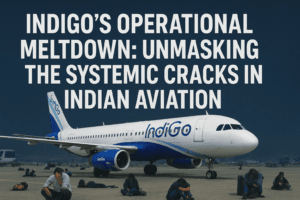
IndiGo’s Operational Meltdown: Unmasking the Systemic Cracks in Indian Aviation
The week of December 2025 witnessed a stunning reversal of fortune for India’s most reliable airline. IndiGo, which commands nearly two-thirds of the domestic market, was brought to its knees not by a competitor, but by its own catastrophic failure in planning and adaptation. What began as a scheduling hiccup snowballed into an unprecedented operational paralysis, exposing not just corporate negligence but the profound structural vulnerabilities of the Indian aviation ecosystem itself. This crisis served as a stark reminder that in a sector driven by precision, a single point of failure can trigger nationwide chaos, stranding hundreds of thousands and erasing billions in market value.
The Human and Operational Toll: Chaos on an Industrial Scale
The sheer scale of the disruption was breathtaking. At its peak, IndiGo canceled over 1,000 flights in a single day, with hundreds more delayed. Major hubs like Delhi, Mumbai, and Bengaluru descended into pandemonium. Airports became scenes of human distress, with families, the elderly, and business travelers stranded overnight, forced to sleep on terminal floors as departure boards displayed a cascade of cancellations. The airline’s communication systems collapsed, leaving passengers in a “toxic vacuum of information”. This human crisis was compounded by a logistical nightmare: images of mountains of unclaimed luggage piled up at airports, with thousands of bags separated from their owners.
The financial hemorrhage was immediate and severe. The parent company, InterGlobe Aviation, saw over ₹37,000 crore wiped from its market value in six days. The airline was forced to issue refunds exceeding ₹1,396 crore to hundreds of thousands of affected passengers. The chaos also triggered predatory market behavior, with fares on alternative carriers skyrocketing to three to five times their normal rates, and hotels near airports charging exorbitant prices, exploiting the desperation of stranded travelers.
Table: The Scale of Disruption at a Glance
| Metric | Impact | Source |
| Peak Single-Day Cancellations | Over 1,000 flights | |
| Total Refunds Issued | Over ₹1,396 crore | Based on provided data |
| Market Value Erosion | Over ₹37,000 crore | Based on provided data |
| Passenger Stranding | Over 100,000 people daily at peak | |
| Baggage Backlog | 9,000+ bags delayed | Based on provided data |
The Trigger: A Regulatory Change Meets Corporate Failure
The immediate catalyst was the rollout of revised Flight Duty Time Limitations (FDTL) by the Directorate General of Civil Aviation (DGCA). These rules, aimed at enhancing pilot safety and reducing fatigue, mandated longer rest periods and restricted night operations. While the norms had been communicated to airlines nearly two years prior, IndiGo was caught completely unprepared.
The airline’s leadership committed a “catastrophic strategic failure” by treating a fundamental safety overhaul as a routine compliance task. It disastrously underestimated the operational impact, failed to redesign its complex rostering system, and, most critically, neglected to hire enough pilots to meet the new requirements while maintaining its expansive schedule. A parliamentary standing committee had explicitly warned months earlier about the mounting risks from the mismatch between rapid fleet expansion and lagging pilot recruitment, cautioning that the system was nearing a dangerous tipping point. IndiGo ignored these warnings.
A Deeper Systemic Crisis: The Fragile Foundations of Indian Aviation
While IndiGo’s mismanagement was the proximate cause, the crisis peeled back the layers on deeper, industry-wide pathologies.
- A Distorted Market: India’s aviation sector presents a perplexing paradox. Despite record passenger numbers and consistently high fares, most airlines are drowning in losses. The sector has cumulative losses exceeding $22 billion since 2004. IndiGo is the sole consistently profitable carrier, creating a virtual monopoly on many routes. This lack of healthy competition reduces the incentive for customer-centric operations and robust contingency planning.
- The “Low-Cost” Mirage: India never developed the true low-cost carrier (LCC) ecosystem seen in Europe or Southeast Asia, which relies on secondary airports, flexible labor, and deregulation. Instead, airlines operate in a “high-friction” environment with crippling structural costs. Aviation Turbine Fuel (ATF) remains outside the GST regime, burdened by heavy state and central taxes, constituting 40-50% of operating expenses. Aircraft leasing is expensive due to past airline bankruptcies, and a weakening rupee further inflates dollar-denominated costs. As analyst Linus Benjamin Bauer notes, India has effectively “built LCC demand on full-service carrier economics”.
- The Accountability Vacuum: The crisis laid bare the near-total absence of enforceable passenger rights in India. Unlike in the European Union or the United States, where regulations mandate compensation, accommodation, and rebooking for controllable cancellations, Indian travelers were left completely unprotected. The burden of corporate failure was allowed to fall entirely on the passenger, with no regulatory intervention to cap exploitative pricing or ensure basic care.
Accusations and Scrutiny: A Crisis Engineered?
In a dramatic turn, IndiGo’s own pilots raised shocking allegations. They questioned the official narrative of a simple pilot shortage, arguing that a deficit of around 124 pilots (about 5% of the total) could not logically cause the cancellation of 30-40% of the daily schedule. Veteran pilots alleged the chaos was deliberately “engineered” to force the government to roll back the new FDTL safety norms.
They cited specific, unusual operational tweaks: standby pilots being called at the last minute instead of hours in advance, aircraft being parked in dispersed remote bays to slow down turnaround times, and unexplained delays being added even when crews reported on time. The pilot union accused the airline of putting “profits before safety” and called for a forensic investigation. These allegations, if proven, would transform the crisis from one of incompetence to one of deliberate malfeasance, aimed at sabotaging safety regulations.
Government Response and the Road Ahead
Facing a national scandal, the government was forced into a reactive stance. The Ministry of Civil Aviation relaxed some FDTL norms temporarily to help IndiGo normalize operations. It imposed temporary fare caps on other airlines to prevent price gouging and ordered a high-level probe into the causes of the failure. The DGCA issued show-cause notices to IndiGo’s CEO and COO, and the aviation minister promised “very, very strict action,” which could include hefty penalties.
However, these were reactive band-aids, not proactive solutions. As pointed out in analysis, the government failed to deploy emergency coordination, provide ground relief, or protect citizens from exploitation during the crisis’s peak. The long-term solution requires structural reform. Experts and committees have long advocated for:
- Bringing ATF under the GST regime to lower the single biggest cost component.
- Developing true low-cost airport infrastructure to create competition and reduce charges.
- Implementing a comprehensive Passenger Bill of Rights with mandatory compensation, aligning India with global standards.
- Strengthening regulatory oversight to ensure airlines build operational resilience and maintain adequate staffing buffers.
Timeline: The Unfolding of the Crisis
- Early August 2025: Parliamentary committee warns of systemic risks from pilot shortage and urges compliance with FDTL norms.
- December 2: IndiGo begins experiencing unusual rates of cancellations.
- December 5: Crisis peaks. IndiGo cancels over 1,000 flights, including all departures from Delhi at one point. Government relaxes FDTL norms and orders probe.
- December 6-8: Pilots allege chaos was engineered. DGCA issues show-cause notices to IndiGo leadership. Market value plummets.
- December 9: Operations slowly recover, but over 500 flights remain cancelled. Scrutiny intensifies on systemic causes.
Conclusion: An Inflection Point for Indian Skies
The IndiGo crisis is more than a corporate embarrassment; it is an inflection point for Indian aviation. It demonstrated that scale without resilience is a national liability. The airline’s reputation for clockwork efficiency lies in tatters, replaced by indelible images of passenger suffering. Competitors like Air India and Akasa Air are poised to aggressively poach customers, potentially ending IndiGo’s unchallenged dominance.
Ultimately, the crisis underscored a fundamental truth: in a nation aspiring to be a global aviation powerhouse, the welfare of the passenger must unequivocally trump the pursuit of cost-cutting and profit. Restoring trust will require more than fixing rosters; it demands a fundamental rewiring of the industry’s priorities, a strengthening of its institutions, and the establishment of a regulatory framework that finally treats the Indian air traveler as a citizen with rights, not merely a source of revenue. The time for that change is now.
You must be logged in to post a comment.