
IndiGo’s Crisis Exposes India’s Struggle with Market Concentration and Regulatory Challenges
The December 2025 IndiGo flight cancellation crisis, where the dominant airline’s operational failure paralyzed national travel, exposed deep systemic risks within India’s economy, highlighting how extreme market concentration in critical sectors like aviation (where two players control 91% of traffic), telecom, and digital payments creates national vulnerability.
The event underscored the inability of India’s Competition Commission (CCI) to act as a proactive guardian due to chronic understaffing, a reactive approach, and enforcement challenges, all set against a policy backdrop that often promotes “national champions”—large conglomerates favored for rapid infrastructure development. This tension between fostering scale and preserving healthy competition reveals a fundamental governance dilemma, where efficiency gains from dominant players come at the cost of reduced consumer choice, systemic fragility, and the potential stifling of innovation, demanding urgent regulatory reform and a rebalanced economic strategy.
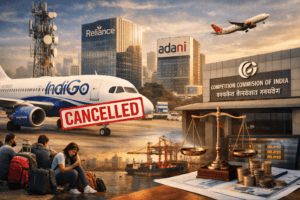
IndiGo’s Crisis Exposes India’s Struggle with Market Concentration and Regulatory Challenges
- Systemic vulnerability revealed: A single airline’s operational failure cascaded into national travel chaos.
- Market concentration trend: India’s key economic sectors are increasingly dominated by duopolies and oligopolies.
- Regulatory capacity gap: The Competition Commission of India struggles with proactive oversight amid resource constraints.
- Policy tension: The “national champions” growth model may conflict with competitive market principles.
From Operational Failure to Systemic Crisis
In early December 2025, what began as scheduling difficulties at IndiGo Airlines rapidly escalated into one of India’s worst aviation crises in years. The airline, which commands a dominant 64.2% share of India’s domestic aviation market, cancelled approximately 4,500 flights over a ten-day period, with the situation peaking at around 1,600 cancellations on December 5 alone. The disruption stranded hundreds of thousands of passengers during India’s peak wedding season, with heartbreaking accounts emerging of families missing funerals, weddings, and vital examinations.
While IndiGo attributed the crisis to difficulties implementing new Flight Duty Time Limitations (FDTL) mandated by aviation regulator DGCA, pilot associations offered a more troubling interpretation. The Airline Pilots’ Association of India characterized the situation as “an artificial crisis engineered to exert pressure on the government for commercial gain under the pretext of public inconvenience”. This interpretation gained credibility when the Ministry of Civil Aviation rolled back the new FDTL norms and delayed their implementation until February 2026.
The crisis revealed more than just operational shortcomings at a single airline. It exposed the structural vulnerabilities of an economic system where critical sectors have become increasingly concentrated in the hands of a few dominant players, with regulatory mechanisms struggling to ensure healthy competition and consumer protection.
The Aviation Duopoly: A Market in Need of Competition
India’s aviation landscape has transformed dramatically over the past decade, with multiple airline failures consolidating market power in fewer hands. The data paints a stark picture of concentration:
Table: Market Concentration in Indian Aviation (2025)
| Metric | IndiGo | Air India Group | Combined Market Share |
| Domestic Market Share | 53-64% | Approximately 16% | 69-80% |
| Revenue Passenger Kilometers | Data Not Specified | Data Not Specified | 91% |
| Total Seat Capacity (Dec 2025) | 13.7 million seats | 6.7 million seats (AI + AI Express) | Approximately 80% |
This consolidation has created what industry observers describe as a “near-duopoly“. While efficient in stable conditions, this market structure proved fragile when IndiGo—representing more than half of all domestic capacity—encountered operational difficulties. With limited alternatives available, affected passengers faced soaring airfares on remaining flights, prompting government intervention with temporary price caps.
The Federation of Indian Pilots noted that other airlines had successfully adapted to the new FDTL rules, suggesting IndiGo’s challenges stemmed from “years of lean manpower planning” and delayed hiring practices. This lean operational model, while profitable during expansion, lacked the resilience needed to accommodate regulatory changes designed to enhance flight safety.
Beyond Aviation: A Pattern of Economic Concentration
The aviation sector’s concentration reflects a broader trend across the Indian economy. Multiple sectors now exhibit worrying levels of market power concentration:
- Telecommunications: The top two players control approximately 75% of the wireless subscriber base
- Digital Payments: The leading two UPI platforms handle 84% of transaction value
- Airports: The top two operators manage 64% of passenger traffic
- Paints: Asian Paints dominates with about 52% market share
- Ports: Adani Ports leads with approximately 27% market share by cargo volume
Former RBI Deputy Governor Viral V. Acharya has documented the rising dominance of what he terms India’s “Big 5” conglomerates—Reliance Industries, Tata Group, Aditya Birla Group, Adani Group, and Bharti Telecom. Their share of total assets in non-financial sectors nearly doubled from 10% in 1991 to 18% in 2021, while the share of the next five largest business groups declined.
This concentration has tangible economic consequences. Acharya’s research suggests that India’s persistent core inflation may be partly attributable to concentrated market structures that prevent consumers from fully benefiting from input price declines.
The CCI’s Institutional Dilemma: Mandate vs. Capacity
Established under the Competition Act of 2002, the Competition Commission of India (CCI) was conceived as a “proactive guardian of the competitive process rather than a passive tribunal reacting to private disputes”. The law endowed the CCI with broad suo motu (on its own initiative) powers to conduct market studies, initiate inquiries, and intervene against emerging concentration before consumer harm occurred.
In practice, however, the CCI has operated more reactively. In recent years, it has launched just one suo motu case annually, compared to approximately three cases annually referred by government entities. The aviation sector exemplifies this reactive posture: the CCI’s last significant investigation into the industry occurred in 2015, when at least five major players existed. That investigation concluded six years later without finding evidence of collusion.
Today, with only two major domestic carriers controlling over 90% of revenue passenger kilometers, the CCI has initiated a probe into whether IndiGo abused its dominant position through potential exploitative pricing practices following the mass cancellations. The inquiry focuses specifically on whether the airline engaged in “exploitative conduct” by raising fares following its service disruptions.
Several factors constrain the CCI’s effectiveness:
- Chronic understaffing: The Commission has operated below its sanctioned strength of 195 members, reaching only 67% capacity during its peak staffing years.
- Enforcement challenges: Since 2011, the CCI has imposed penalties totaling ₹18,351 crore but collected just 2.3% (₹425 crore) of this amount.
- Jurisdictional complexity: The CCI must coordinate with multiple sector-specific regulators like the DGCA in aviation and TRAI in telecommunications, creating potential regulatory gaps.
The “National Champions” Policy: Growth vs. Competition
Beneath the CCI’s operational challenges lies a more fundamental tension between competition policy and India’s economic development strategy. Analysts have identified an emerging “national champions” model, where the government partners with select large conglomerates to implement development priorities, particularly in infrastructure.
This approach draws inspiration from South Korea’s chaebol-led development but differs in crucial aspects. Unlike Korean champions that competed globally, India’s protected champions operate primarily in non-tradable domestic sectors with limited exposure to international competition. They benefit from tariff protections, preferential project allocations, and potentially relaxed regulatory oversight.
Economists have raised significant concerns about this model. Nauriel Roubini acknowledges that concentration “has served India well in some ways” but warns that “the dark side of this system is that these conglomerates have been able to capture policymaking to benefit themselves,” potentially stifling innovation and killing early-stage startups.
Amartya Lahiri identifies four clear problems with promoting national champions: (1) creating “too big to fail” entities vulnerable to systemic shocks, (2) reducing economy-wide efficiency and productivity, (3) risking transformation into an “industrial oligarchy,” and (4) deterring foreign investment through perceptions of an uneven playing field.
Pathways to Reform: Rebalancing Scale and Competition
The IndiGo crisis presents India with an opportunity to re-evaluate its approach to market regulation and economic concentration. Several pathways could strengthen both competition and economic resilience:
- Empowering the CCI: Bolstering the Commission’s resources, expertise, and enforcement capabilities would enable more proactive market monitoring and timely intervention.
- Clarifying jurisdictional boundaries: Developing clearer frameworks for coordination between the CCI and sectoral regulators would reduce regulatory gaps and overlaps.
- Strategic use of market studies: Regular, in-depth sectoral analyses would allow the CCI to identify creeping concentration before it becomes entrenched.
- Balancing champion development with competition safeguards: If pursuing a national champions strategy, implementing conditional supports tied to performance metrics and maintaining competitive pressures in auxiliary markets could mitigate risks.
- Encouraging new entrants: Policy measures that lower barriers to entry in concentrated sectors, particularly in digital markets and infrastructure, would enhance competitive dynamism.
The Lok Sabha’s Standing Committee on Finance highlighted the urgency of addressing duopolies in August 2025, noting that “the problem has shifted from monopolies to duopolies” in critical sectors like telecom and aviation. The Committee specifically asked the CCI to outline a long-term strategy to regulate and mitigate this trend.
Conclusion: Beyond the Immediate Crisis
The disruption caused by IndiGo’s flight cancellations represents more than a corporate operational failure—it serves as a stress test of India’s economic governance. The crisis revealed how market concentration can transform a corporate problem into a national emergency, with limited alternatives leaving consumers and the state exposed.
India stands at a crossroads in its development journey. The efficiency gains from scale and the rapid infrastructure development facilitated by large conglomerates must be balanced against the risks of reduced innovation, consumer exploitation, and systemic vulnerability. The CCI‘s investigation into IndiGo represents a critical test case for whether India’s competition framework can adapt to address the challenges of concentrated markets while supporting broader economic objectives.
As the aviation sector stabilizes and investigations proceed, the lasting impact may be measured not in flight schedules restored but in whether this crisis catalyzes a more fundamental rethinking of how India nurtures both scale and competition in its quest for economic development. The pathway forward requires acknowledging that healthy markets need both champions to drive growth and vigorous competition to ensure that growth benefits the broader economy.
You must be logged in to post a comment.