
India’s Winter Is Rewriting Its Script: The Vanishing Chill of February and a Climate in Flux
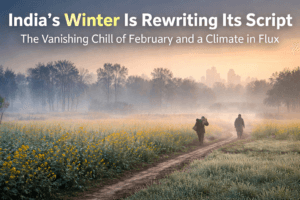
India’s Winter Is Rewriting Its Script: The Vanishing Chill of February and a Climate in Flux
For generations, the rhythm of the Indian winter was as reliable as the sunrise. In the northern plains, January mornings meant dense fog and bone-chilling cold, while February brought a gradual, comforting warmth—a prelude to the fleeting spring. The year 2026, however, has delivered a starkly different story, one that is forcing meteorologists, farmers, and urban planners to confront a new climatic reality.
As the winter season officially draws to a close on February 28, data reveals an unprecedented anomaly: for the first time in five years, the month of February has passed without a single cold wave or cold day being recorded anywhere in the country. According to a detailed analysis by Down To Earth (DTE), this February has been a “silent” month on the weather front, a dramatic departure from recent trends where February often delivered the season’s final, fierce punch of cold .
This isn’t just an isolated quirk; it is the latest, most glaring indicator that India’s winter is undergoing a fundamental transformation. The season is no longer confined to its traditional calendar box, its intensity is waning, and its geographical footprint is becoming increasingly erratic. The winter of 2026 is closing with just 24 cold wave/cold day events across 15 states—the second-lowest tally in half a decade, a stark contrast to the 38 such days recorded just two years prior in 2024 .
But beneath the raw numbers lies a more complex and concerning narrative. It’s a story of vanishing fog, sleepless farmers in Punjab, and a climate system that seems to have forgotten the script.
The Great February No-Show
To understand the shock of this February, one must look at the immediate past. In 2024, February witnessed seven cold wave days, affecting daily life and rabi crops. In 2022 and 2025, it recorded six and five such days respectively . These late-winter cold spells are often critical, providing the necessary chill for mustard crops and setting the stage for the final growth phase of wheat.
This year, the curtain fell early. The last severe cold day was confined to the hills of Himachal Pradesh on January 27. After that, the plug was pulled. By February, the India Meteorological Department (IMD) was forecasting a different reality altogether: maximum and minimum temperatures were predicted to remain 2–4°C above normal across most of the country .
The meteorological drivers behind this abrupt seasonal shift are becoming clearer. Throughout January, India experienced a significant deficit in rainfall—31 per cent below normal—with northwest India remaining particularly dry for the first three weeks . The region finally saw some precipitation in the last week of January due to a western disturbance, but it was too little, too late . Mrutyunjay Mohapatra, Director General of IMD, had signaled the change as early as late January, noting that cloudy skies—which usually trap heat—would be minimal, and that the number of cold wave days would be two to three days less than usual . What transpired was a complete washout of winter conditions in February.
“February feels like April,” is a refrain increasingly heard among meteorologists . This year, that sentiment has become a pan-India reality. The absence of cold waves is directly linked to feeble western disturbances—the weather systems originating in the Mediterranean that are the lifeblood of North India’s winter . When these disturbances are weak or absent, the flow of cold, moisture-laden air into the subcontinent is disrupted, allowing temperatures to rise.
Geography of Cold: When the South Shivers and the North Stays Dry
The analysis of the last five years reveals another layer of complexity: the geography of cold is no longer static. While the core cold zone remains northern and northwestern India, there have been intermittent and surprising forays into the south.
The winter of 2023 was a standout, affecting 17 states, with Telangana and Karnataka recording cold wave days . This year, Karnataka once again found itself on the list of affected states, a reminder that the chill can, under the right conditions, penetrate the Vindhyas. Meanwhile, Odisha, which has historically been on the fringes of intense winter, experienced cold waves on seven days in 2026, echoing patterns seen in 2022 .
This expanding and contracting footprint suggests a jet stream and pressure systems that are becoming more wavy and unstable. A high-pressure system settled over north-central India in January, which, according to analyses from the World Economic Forum, pulled cold, dry air southwards at times, allowing southern states to get a rare taste of winter . Yet, this same system contributed to a lack of widespread, sustained precipitation in the north.
The most dramatic shift, however, was witnessed not in the winter months of January and February, but in the post-monsoon season of 2025. November 2025 recorded a staggering 20 cold wave days—a nearly tenfold increase compared to the previous three Novembers combined . This early and intense arrival of winter, spread across 13 states from all four regions of India, is perhaps the loudest alarm bell. It signals that the “core” winter months are bleeding into the shoulders of the season, making the traditional November-to-February framework obsolete.
The Rabi Crop Under Stress: A Farmer’s Dilemma
For the millions of farmers across the Indo-Gangetic plains, this isn’t just a matter of temperature data; it’s a matter of survival. The rabi (winter) crop, particularly wheat, is exquisitely sensitive to temperature during its growing cycle.
A normal winter provides a prolonged period of low temperatures, which is crucial for tillering (the production of side shoots that bear grain) and the eventual grain filling. The sudden warmth in February acts as a trigger for early maturation . When temperatures spike, plants fast-track their lifecycle. They move toward flowering and grain development too quickly, resulting in smaller grains and lower yields.
“We are seeing signs of early maturity in wheat and barley,” the IMD noted in its agro-advisory for February . While a “hot” finish might sound beneficial for harvesting, it is a nightmare for productivity. The advisory warned of a potential drop in yield not just for cereals, but also for oilseeds and pulses like chickpeas and lentils. Even the humble potato and onion, staples of the Indian kitchen, are at risk. Higher temperatures can lead to “bolting” in onions and garlic—a process where the plant flowers prematurely, rendering the bulb small and unmarketable .
Imagine a farmer in Haryana who, based on generations of experience, planted his wheat in November expecting a harvest in April. He relies on the gentle warmth of March and the cool nights of February to plump up his grain. Instead, a “false spring” in February tricks the plant into thinking summer has arrived. The crop ripens on the field in late March, lighter and less profitable. This isn’t a future projection; it is the economic reality of the 2026 season.
The Vanishing Western Disturbance and the Human Cost
At the heart of this chaotic winter lies the weakening pulse of the Western Disturbance. These traveling weather systems are the primary source of winter rain and snow for the Himalayas and the adjoining plains. They are the reason why Punjab and Haryana remain green in January and why Kashmir’s ski resorts get their powder.
But climate change is scrambling their behavior. “In a warming world, Western Disturbances remain vital, but they are no longer behaving the way they once did,” reports India Today . Warmer air can hold more moisture, leading to fewer but more intense bursts of rain when a disturbance does occur, followed by long, dry spells. This variability has been on full display this year: a dry January followed by a wet spell in its final week, and then a completely dry, warm February.
The consequences extend beyond the farm. In the hills, poor snowfall—a direct result of feeble western disturbances—threatens winter tourism and raises long-term concerns about water availability for rivers fed by glacial melt . In the cities of the north, the lack of cold is intertwined with the crisis of air pollution. Usually, cold days and fog trap pollutants close to the ground, creating hazardous smog. This year, the narrative was different—the chill was present, but so was the toxic air, a combination that experts like Parsa Venkateshwar Rao Jr. point out as a growing public health emergency for vulnerable populations .
As one geography expert from Jawaharlal Nehru University noted, “Seasonality works like a traffic signal system. When the signals fail or change unexpectedly, confusion and disruption spread across both nature and society” . India’s winter traffic signal is currently flashing amber.
What Lies Beneath: La Niña, El Niño, and the Bigger Picture
While the immediate cause of this year’s warm February is the lack of western disturbances, the broader context is set by the Pacific Ocean. The world is transitioning out of La Niña conditions, which tend to favor colder winters in the subcontinent, toward a potential El Niño, which is associated with warmer temperatures .
Interestingly, the conditions in February 2026 closely mirror those of February 2023, another warm winter month that preceded the development of an El Niño . This cyclical pattern is now playing out against the backdrop of relentless global warming. The baseline temperature has shifted. So even when a “neutral” year occurs, the temperatures we experience are higher than what our grandparents would have considered normal.
The 2026 winter is a perfect case study of this “climate change amplification.” It took the natural variability of a weak La Nina-waning phase and a lack of western disturbances, and turned it into a record-breaking warm February. The seasons aren’t disappearing overnight, but they are stretching, compressing, and sliding on the calendar. The neat boxes of winter, spring, summer, and autumn no longer fit the climate reality on the ground .
As India closes the book on the winter of 2026, it leaves behind a lingering question: Was this an anomaly, or is this the new benchmark? The trend suggests the latter. The data from the last five years points toward increasing variability—early cold waves in November, warm spells in February, and a shifting geographic spread. For policymakers, this means rethinking agricultural strategies, water resource management, and even urban infrastructure. For farmers, it means adapting to a world where the old rules of the seasons no longer apply.
One thing is certain: the Indian winter is rewriting its script, and for the 1.4 billion people who live under its spell, the only predictable thing now is unpredictability itself.
You must be logged in to post a comment.