
India’s Winter Extremes: From Kashmir’s Deep Freeze to Bengaluru’s Garbage Crisis
India’s Winter Extremes: From Kashmir’s Deep Freeze to Bengaluru’s Garbage Crisis
As December tightens its grip, India presents a study in seasonal contrasts. While the Kashmir Valley grapples with temperatures plummeting to -5.5°C in Pulwama, and states like Odisha and Telangana shiver under official cold wave alerts, other regions tell a different story. In an unusual twist, Delhi-NCR residents are experiencing a warmer-than-average start to winter, and southern cities like Bengaluru are waging a different cold-weather battle—against a surge in illegal roadside garbage dumping. This complex picture reveals a nation navigating the diverse challenges of the winter season, where weather patterns and human behavior collide.
The Extent of the Chill: A Nationwide Cold Wave
A significant portion of India is currently in the throes of a pronounced cold spell, with the India Meteorological Department (IMD) issuing forecasts and alerts across multiple states.
The table below summarizes the key affected regions and their conditions:
| Region/State | Key Conditions & Alerts | Notable Minimum Temperatures | Duration/Forecast |
| Jammu & Kashmir | Severe cold wave, widespread frost. | Pulwama: -5.5°C; Srinagar: -3.6°C; Gulmarg: 0.0°C. | Cold, dry weather to continue. |
| Odisha | Yellow alert for cold wave. | Below 10°C in 15 locations across 11 districts. | Alert for Dec 13-14. |
| Telangana & North Interior Karnataka | Cold wave conditions. | Minimums substantially below normal (4.5-6.4°C). | Likely till Dec 14. |
| Central India (Maharashtra, Chhattisgarh, Madhya Pradesh) | Cold wave conditions prevailing. | N/A in search results. | Likely till Dec 13. |
Life in the Kashmir Freeze
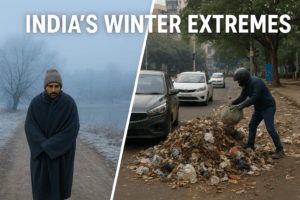
The impact is most visceral in Kashmir. Beyond the stark numbers, life has adapted to the deep freeze. Foggy mornings over Dal Lake have become a common scene, while residents bundle up and turn to traditional warming methods like the kangri (a portable earthen pot filled with hot coal). The cold has practical consequences: power demand has surged, leading to complaints of unscheduled night interruptions, and market activity slows during the chilly mornings and evenings.
Yet, a resilient spirit prevails. One Srinagar resident captured the dichotomy, calling the weather “freezing… but the good kind and enjoyable.” He advocates for embracing the cold with morning runs, a routine maintained year-round. This period is also crucial for tourism, a core economic sector. Despite the chill, tourists continue to flock to the Valley, welcomed by locals who promise they’ll “forget summer” after a visit.
The Science Behind the Shiver
The IMD attributes this extensive cold wave to a combination of large-scale climatic factors. The primary driver is a strengthened polar vortex—a large area of low pressure and cold air near the poles—which is pushing frigid winds deeper into central, northwest, and northeast India. This effect is being intensified by La Niña conditions, which are historically associated with colder-than-normal winters over the Indian subcontinent.
On a more regional level, as explained for Telangana, the persistence of cold waves requires specific local ingredients: dry air, clear night skies, and cool continental winds. Dry air lacks water vapor, which acts as a greenhouse gas, allowing heat to escape rapidly after sunset. Clear skies amplify this radiative cooling, while northerly winds continually replenish the cool, dry air mass.
The Delhi Anomaly: A Wait for Winter
In stark contrast to the national trend, the Delhi-NCR region has yet to experience its characteristic winter chill. Data shows both maximum and minimum temperatures have been above average for this time of year. The reason for this anomaly is the absence of a key meteorological trigger: active Western Disturbances.
Senior IMD scientist Dr. Naresh Kumar explains that the influx of cold, dry northwesterly winds into Delhi and northwest India depends on these weather systems. A weak disturbance was expected around December 13, but it was only likely to bring rain to parts of Jammu and Kashmir, not usher in a cold wave to the plains. Consequently, the IMD projects that minimum temperatures in Delhi might actually rise by 2-4 degrees Celsius over the next week.
This reprieve from the cold, however, does not mean the capital is enjoying clean air. The city continues to be blanketed by “very poor” quality toxic smog, a perennial winter crisis compounded by calm winds and low temperatures that trap pollutants.
Bengaluru’s Civic Cold Front: The Garbage Dumping Crackdown
While northern India contends with meteorological cold, Bengaluru is facing a civic crisis exacerbated by winter habits. Authorities have launched a stringent crackdown on motorists illegally dumping household garbage on roads and public spaces, imposing a fine of ₹5,000.
The problem is characterized by “silent dumping”—vehicles from one neighborhood disposing of waste bags in another area under cover of early morning hours, creating illegal “black spots” at junctions, footpaths, and closed shops. This not only creates visual pollution and health risks but unfairly burdens sanitation workers and communities that did not generate the waste.
The new enforcement strategy is multi-pronged:
- Technology-Aided Surveillance: Using CCTV footage and vehicle registration details to trace offenders.
- Increased Patrols: Marshals and traffic police are actively monitoring known dumping zones.
- Novel Deterrent: In addition to the fine, offenders may be forced to bear the cost of transporting the waste back to their doorstep, creating a tangible consequence and public accountability.
The issue gained national attention when a video of a KIA car occupant dumping sacks of garbage in Sarvagnanagar went viral. While the offender was fined ₹5,000, the penalty sparked debate on its effectiveness. Prominent figures like Biocon founder Kiran Mazumdar-Shaw argued for much steeper penalties of ₹50,000 and vehicle seizure to deter habitual offenders.
Looking Ahead: Health, Risks, and Resilience
The IMD has forecast that the December-February period may see more cold-wave days than usual. This increases health risks, particularly for vulnerable populations like the elderly, children, and those with pre-existing conditions. Doctors in Kashmir advise wearing layered clothing, ensuring adequate indoor heating, and avoiding prolonged exposure to the cold to ward off respiratory infections.
Dense fog, another companion of the cold wave, is expected to continue disrupting road, rail, and air transportation across several states. Travelers, particularly in northern regions, are advised to check schedules and advisories.
From the sub-zero temperatures of Kashmir to the garbage-strewn streets of Bengaluru, India’s winter narrative is multifaceted. It underscores a nation simultaneously responding to natural climatic forces and self-inflicted civic challenges. While meteorological phenomena like the polar vortex and absent western disturbances dictate the weather, the human response—from resilience and adaptation in the cold to accountability and enforcement in urban management—will ultimately define the season’s impact on the lives of millions.
You must be logged in to post a comment.