
India’s Weather Paradox: When the Himalayas Shiver and the Plains Drown Under a Volatile Western Disturbance
In summary, the current weather event driven by multiple western disturbances has created a stark meteorological divide across northern India: the Himalayan regions of J&K, Himachal, and Uttarakhand are experiencing heavy snowfall that, while essential for glaciers and apple orchards, brings avalanches, road closures, and hardship for locals; meanwhile, the plains—including Delhi, Punjab, and UP—are witnessing unseasonal rain that offers relief from toxic smog and saves irrigation costs for farmers, yet threatens the standing wheat harvest with lodging and sprouting, exposes urban infrastructure to flooding and traffic chaos, and highlights how intensifying western disturbances are becoming a new climate reality for the subcontinent.
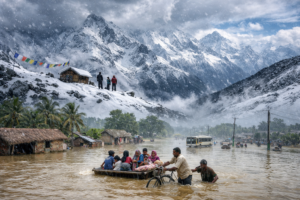
India’s Weather Paradox: When the Himalayas Shiver and the Plains Drown Under a Volatile Western Disturbance
As the last vestiges of winter cling to the calendar, India is currently experiencing a meteorological paradox that perfectly encapsulates the subcontinent’s dramatic climatic extremes. The India Meteorological Department (IMD) has pulled back the curtain on a chaotic weather event—a “wild swing” driven by multiple, successive Western Disturbances—that is painting two vastly different pictures across the northern half of the country.
In the pristine, snow-capped valleys of Jammu & Kashmir, Himachal Pradesh, and Uttarakhand, life has ground to a halt in a beautiful, white embrace. Yet, just a few hundred kilometers south, in the bustling metropolises of Delhi, the fertile plains of Punjab, and the urban corridors of Uttar Pradesh, the sky has turned a leaden grey, promising not snow, but a relentless, cleansing lash of rain.
This isn’t just a routine weather update; it is a story of geography, vulnerability, and the profound—often inconvenient—ways nature reminds us of its dominance over our daily lives.
The Anatomy of a ‘Western Disturbance’
To understand the chaos, one must first understand the culprit. A Western Disturbance is a term that meteorologists use with a mix of reverence and trepidation. Originating in the Mediterranean Sea, these are extratropical cyclones that travel eastwards, carrying vast amounts of moisture across Afghanistan, Pakistan, and finally into Northwest India.
Typically, a single Western Disturbance is a welcome guest. It brings the famous Chillai Kalan—the 40-day harshest winter period in Kashmir—and replenishes the glaciers that feed the perennial rivers of the Ganga basin. But this year, the pattern is different. The IMD’s alerts point to the impact of multiple disturbances. When one system fails to clear out before the next one barrels in, the atmospheric instability compounds.
What we are witnessing is a “phasing” event. The moisture fed by the first disturbance is being uplifted by the fresh influx of cold air from the second. The result is a meteorological perfect storm: a prolonged period of precipitation that blurs the lines between the winter and pre-monsoon seasons.
The Himalayan Whiteout: A Double-Edged Sword
For the mountain economies of J&K, Himachal, and Uttarakhand, heavy snowfall is a deal with the devil. On one hand, it is a sight to behold. Tourists who have flocked to Gulmarg and Manali find themselves in a winter wonderland, with ski resorts celebrating the deepest powder in recent memory. The visual of pine trees bending under the weight of fresh snow and the serene silence that follows a heavy snowfall is the stuff of postcards.
But the “human insight” here lies in the disruption. For the locals, heavy snowfall is not a holiday; it is a logistical nightmare.
In Srinagar, the famous Dal Lake freezes over in patches, forcing the Shikara operators—whose livelihoods depend on tourism—to stay ashore. The Mughal roads, which connect the valley to the rest of the country, become treacherous arteries prone to closure. There is the ever-present anxiety of avalanches in high-altitude areas like Sonamarg and the Rohtang Pass. For the farmers in the region, this snow is white gold—essential for the moisture that will sustain their orchards of apples, almonds, and saffron through the scorching summer. However, too much snow, too quickly, can damage infrastructure, snap power lines, and leave remote villages isolated for days.
The insight here is the resilience of the pahari (mountain) people. While city dwellers panic at the sight of a few clouds, the residents of the Himalayas have learned to read the mountains. They stockpile firewood, ration their supplies, and wait. They understand that while the snow is a disruption today, it is the promise of water for tomorrow.
The Great Plains: A Deluge of Relief and Disruption
As we descend the Shivalik hills into the Gangetic plains, the narrative shifts from snow to rain. For Delhi, Punjab, and Uttar Pradesh, this “wild swing” is bringing a different kind of intensity.
Let’s start with Delhi NCR. For the past few weeks, the national capital has been grappling with a familiar foe: rising temperatures and a thick, toxic blanket of smog. The arrival of this Western Disturbance is nothing short of a relief operation. The rain acts as nature’s scrubber. It washes away the particulate matter (PM 2.5 and PM 10) that has been choking the lungs of the city’s 20 million residents.
There is a tangible sense of relief in the air—literally. The sudden drop in temperature offers a reprieve from the unseasonal heat that had hinted at an early summer. For the urban dweller, the rain brings a psychological reset. The sound of raindrops on window panes offers a momentary escape from the relentless noise and dust of the city.
However, the “genuine value” of this weather event is felt most acutely in the agrarian heartlands of Punjab and Uttar Pradesh. We are currently in the Rabi harvest season. Wheat fields are golden and ready to be cut. For a farmer in Ludhiana or Meerut, this rain is a high-stakes gamble.
- The Positive: Rain saves them a few days of diesel costs for irrigation. It is free water for the soil.
- The Negative: If the rain is heavy and persistent—as is being predicted—it can cause “lodging,” where the wheat stalks bend over and flatten. Lodged wheat is difficult to harvest with machines, leads to reduced yield, and if the moisture persists, can cause the grains to germinate right on the stalk (sprouting), rendering the crop useless for the market.
This is the dichotomy of the Indian farmer. They pray for the rain to fill the reservoirs and aquifers, but during the harvest, they pray just as hard for the skies to stay clear. This Western Disturbance is a test of their agility—those with access to modern harvesters are racing against the clock to cut their crop before the downpour intensifies.
The Urban Mess: What the Forecast Forgets to Mention
While news headlines focus on the temperature drops and snowfall visuals, there is a third, often ignored, aspect of these weather systems: the crumbling urban infrastructure.
The IMD’s warning of rain “lashing” Delhi, Punjab, and UP should also be read as a warning about the return of the urban flood. Cities in North India, built for a dry climate, have a notoriously low capacity to handle even moderate rainfall.
A single heavy downpour in Delhi often leads to:
- Traffic Collapse: The city’s roads, already pockmarked with construction for the ongoing infrastructure projects, turn into rivers. Commutes that take 30 minutes stretch into three-hour ordeals.
- Waterlogging: Underpasses, a staple of Delhi’s landscape, become death traps if water levels rise unnoticed. Low-lying areas like Minto Bridge or the ITO intersection are perennial flood zones.
- Power Outages: The combination of wind and rain frequently leads to uprooted trees falling on power lines, plunging neighborhoods into darkness for hours.
The human insight here is the disparity in experience. For the affluent living in gated communities, the rain is a cozy event. For the daily wage earner, the auto-rickshaw driver, and the street vendor, it means loss of wages, spoiled goods, and the struggle to find a dry patch of land to survive the night.
Climate Context: Is This the New Normal?
The phrase “multiple western disturbances” is becoming increasingly common in IMD briefings. Climatologists are observing that while the total number of Western Disturbances may not be increasing drastically, their intensity and behavior are changing.
Warmer-than-usual temperatures in the Mediterranean Sea are providing more moisture to these systems. Consequently, when they interact with the cold air over the Himalayas, they dump more precipitation in a shorter amount of time. This phenomenon is often referred to as “weather whiplash”—the rapid transition from unusually warm, dry conditions to sudden, extreme precipitation.
This event serves as a microcosm of the global climate crisis. It highlights how a single weather system can simultaneously create a winter storm in the mountains and a flash flood risk in the deserts of Rajasthan and the plains of Uttar Pradesh.
How to Navigate the Swing
For the next 48 to 72 hours, as this system plays out, the value for readers lies in preparation and perspective.
- For Travelers: If you are planning a trip to the Himalayas, check highway statuses (especially the Manali-Leh highway and Jammu-Srinagar highway). Carry chains for tires if driving. If you are in the plains, avoid unnecessary travel during peak rain hours. Do not attempt to drive through waterlogged underpasses—just six inches of flowing water can sweep a car off the road.
- For Health: The sudden temperature swing is a breeding ground for viral infections. While the rain cleans the dust, it also lowers immunity. Ensure Vitamin C intake and keep vulnerable family members—children and the elderly—warm and dry.
- For Farmers: Stay updated on the hourly forecasts. If harvesting is possible in the rain-free window, prioritize it. Ensure harvested grains are covered with tarpaulin to prevent moisture damage.
Conclusion: A Nation United by Weather
In a country as vast and diverse as India, a single weather event rarely means the same thing to everyone. As the Western Disturbance tightens its grip, the nation watches two different movies simultaneously.
In the valleys of the Himalayas, it is a story of endurance—of waiting for the snowplows to clear the roads and the warmth of spring to return. In the dusty plains of Uttar Pradesh and the concrete jungles of Delhi NCR, it is a story of desperate relief and urban chaos—the joy of breathing clean air mingled with the frustration of sitting in traffic jams under a grey sky.
The “wild weather swing” predicted by the IMD is more than just a collection of data points and warning colors. It is a powerful reminder of our geographic reality. It shows us that while our economies may be digitizing and our cities modernizing, we remain, at our core, a land profoundly shaped by the caprices of the wind and the sky. As the rain lashes and the snow falls, the best we can do is adapt, prepare, and respect the formidable force of nature that governs us all.
You must be logged in to post a comment.