
India’s Weather Duality: Snow in the Hills, Smog in the Plains as Two Western Disturbances Loom
According to the IMD’s two-week forecast, India is experiencing significant weather duality as two back-to-back Western Disturbances are set to bring isolated to widespread rain and snow to the Western Himalayan region (J&K, Ladakh, Himachal) between February 13 and 17, with a secondary low-pressure area over the Bay of Bengal likely to drench Tamil Nadu, Kerala, and the Northeast. In stark contrast, while the hills prepare for winter precipitation, the national capital is grappling with a ‘Poor’ AQI of 201 due to calm winds and misty mornings, even as daytime temperatures soar to a warm 28°C. The country is further divided by temperature extremes, with early summer-like heat in Gujarat and Maharashtra, and cooler-than-average conditions persisting in Chhattisgarh and East Uttar Pradesh, creating a complex forecast that impacts everything from Himalayan tourism and wheat harvests to urban health in Delhi.
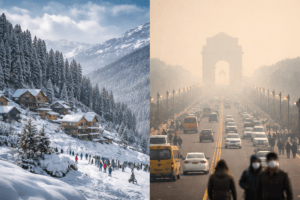
India’s Weather Duality: Snow in the Hills, Smog in the Plains as Two Western Disturbances Loom
As India navigates the middle of February 2026, the subcontinent is presenting a classic case of meteorological dichotomy. According to the latest two-week outlook from the India Meteorological Department (IMD), the northern Himalayan arc is bracing for back-to-back Western Disturbances promising rain and snow, while the national capital and its surrounding regions are grappling with a different kind of disturbance—a dip in air quality that has settled firmly in the ‘Poor’ category.
This isn’t just a weather bulletin; it is a story of two Indias colliding in the same season. In the mountains, tourists and locals alike are hoping for a fresh blanket of snow to rejuvenate the winter tourism economy. In the plains, Delhiites are waking up to misty mornings and worrying about the health implications of an AQI that refuses to budge into the ‘Moderate’ or ‘Satisfactory’ zones.
Here is a deep dive into what the next two weeks hold for India, why these patterns are emerging, and what it means for agriculture, health, and daily life.
The Western Disturbances: A Double Tap for the Himalayas
The headline feature of the IMD forecast is the arrival of two successive Western Disturbances (WDs). For the uninitiated, a Western Disturbance is an extratropical storm originating in the Mediterranean region that brings sudden winter rain and snow to the northwestern parts of the Indian subcontinent. They are a lifeline for the region, acting as the primary source of snowfall in the mountains and replenishing the water reservoirs that feed the rivers of the North.
The First Disturbance (February 13-14): The first system is already active, having begun its impact on February 13. It is currently bringing isolated to scattered light rain and snowfall to the higher reaches of Jammu & Kashmir, Ladakh, and Himachal Pradesh. While this initial spell might be moderate in intensity, it serves as the precursor, cooling the atmosphere and setting the stage for the main event.
The Second Disturbance (February 16-17): This is the system to watch. Forecast to be more potent than its predecessor, this second WD is expected to intensify the wet weather. The IMD predicts more widespread precipitation across the Western Himalayan Region (WHR). This could mean a significant accumulation of snow in popular destinations like Gulmarg, Sonamarg, and Rohtang Pass.
Beyond the Hills: This second disturbance is strong enough to have a “tail effect.” As it moves eastward, it is likely to induce cyclonic circulation that could extend its influence beyond the mountains, potentially bringing light isolated showers to the plains of Punjab and Haryana. While these states won’t see snow, a light drizzle can have a significant impact on temperature and soil moisture for the ongoing Rabi crops, particularly wheat.
The Bay of Bengal Factor
While the north is fixated on the Western Himalayas, the eastern coast has its own weather system to prepare for. The IMD has noted the likely formation of a low-pressure area over the Bay of Bengal around February 15.
This is a classic late-winter phenomenon. As the land begins to warm up, the contrast with the relatively cooler sea creates conditions favorable for cyclonic circulation. This system is expected to pull moisture from the bay and dump it over eastern and southern India.
For states like Tamil Nadu, Kerala, and Coastal Andhra Pradesh, this spells a likely continuation of the northeast monsoon’s tail end. Fishermen and coastal communities are advised to watch for updates on wind speeds, while residents can expect a few days of cloudy skies and potentially heavy spells of rain towards the end of next week.
The Temperature Tango: Early Summer in the West, Cool in the East
Perhaps the most intriguing part of the IMD’s two-week assessment is the stark temperature divide across the country. This is not a uniform February; it is a month of extremes.
The Early Warmth (Gujarat, Maharashtra, South Karnataka): For residents of Ahmedabad, Mumbai, and Bengaluru, the next week will feel more like March than February. The IMD has indicated that maximum temperatures are likely to be above normal until at least February 19. The absence of strong northern winds and the angle of the sun, which is already moving northward, is causing mercury to rise. This early warmth signals a premature transition to the spring season, which could lead to higher-than-usual power consumption due to early air conditioner use.
The Eastern Chill (Chhattisgarh, Vidarbha, East UP): In contrast, a large swath of Eastern India is experiencing a cold hangover. Temperatures in these areas are expected to remain below the seasonal average. This is likely due to moisture incursion from the Bay of Bengal activity and cool winds from the east, which keep the daytime heating in check. For cities like Nagpur and Raipur, this means pleasant days and cool nights, a temporary respite before the inevitable summer heat sets in.
Delhi’s Air Quality Crisis: The ‘Poor’ Reality
While meteorologists track the Western Disturbances hundreds of kilometers away, the effects in Delhi are purely terrestrial and chemical. On Thursday, the city’s air quality index (AQI) clocked in at 201, placing it in the ‘Poor’ category.
To put that in perspective: An AQI between 201 and 300 is considered ‘Poor,’ which means breathing discomfort for most people on prolonged exposure.
Why is the AQI still poor despite winter ending?
- Calm Winds: The arrival of a Western Disturbance often changes the wind patterns. In the buildup to the disturbance, wind speeds tend to drop. This “calm” condition prevents the dispersion of pollutants, allowing them to accumulate near the surface.
- Moisture and Mist: The IMD forecast mentions misty mornings. When mist combines with particulate matter (PM2.5 and PM10), it forms a smog-like layer that lingers until the sun burns it off. This “morning smog” is becoming increasingly common in Delhi during late winter.
- Vehicular and Construction Emissions: With temperatures slightly warmer, construction activities that may have slowed down in January are picking up pace again, adding to the dust load in the air.
For the residents of NCR, the next few days require caution. While the afternoons will be bright and sunny (with maximums touching 28°C), the mornings pose a health risk. Vulnerable individuals—those with asthma, bronchitis, or cardiac issues—should limit morning walks until the sun is well above the horizon.
Human Impact: Agriculture, Tourism, and Health
Beyond the numbers and maps, these weather patterns have real-world implications for millions of Indians.
- The Farmers’ Watch
For the wheat farmers of Punjab and Haryana, the forecast of light rain from the second Western Disturbance is a double-edged sword. A little rain is beneficial for the grain filling stage of the crop. However, if the rainfall is untimely or accompanied by strong winds, it can cause lodging (bending) of the crop, which reduces yield. In the hills, fruit growers—especially apple growers in Himachal and Kashmir—are watching the snowfall forecasts closely. Snow acts as an insulator for apple trees, protecting their roots from extreme cold. A good snowfall ensures a healthy bloom in spring. A dry winter, conversely, spells disaster for the apple yield.
- The Tourism Equation
In the hills, the mantra is “Let it snow.” Resorts in Manali, Auli, and Gulmarg have been relying on artificial snow machines in some areas due to erratic natural snowfall earlier in the season. This fresh spell of natural snow is a massive boost for the Valentine’s Day weekend crowd. It brings skiers, honeymooners, and Instagram enthusiasts, filling up hotels and local eateries.
- The Health Advisory
In Delhi, the ‘Poor’ AQI requires a behavioral shift. Here is practical advice for Delhiites:
- Ventilation Timing: Keep windows closed during early morning and late evening. Cross-ventilate homes only in the afternoon (between 1 PM and 3 PM) when the sun is at its peak and the air quality usually improves slightly due to convection.
- Face Masks: For those commuting via two-wheelers or cycling, wearing a mask is advisable.
- Diet: Incorporate natural antioxidants and Vitamin C (like amla and citrus fruits) to help the body counter the effects of particulate matter.
The Two-Week Breakdown: What to Expect Where
To simplify the complex forecast, here is a region-wise summary for the period of February 13 to February 26, 2026:
- Jammu & Kashmir, Ladakh, Himachal Pradesh:
- Feb 13-15: Isolated snow/rain (First WD).
- Feb 16-18: Increased intensity, widespread snow (Second WD). Expect travel disruptions to high-altitude passes.
- Punjab, Haryana, Delhi NCR:
- Weather: Generally clear skies. Possibility of very light drizzle around Feb 17-18.
- Temperature: Warm days (25-28°C), cool nights (10-12°C).
- AQI: Likely to oscillate between ‘Poor’ and the lower end of ‘Very Poor’ depending on wind speed.
- Tamil Nadu, Kerala, South Interior Karnataka:
- Weather: Increased cloudiness and rainfall activity, particularly around Feb 18-22 due to the Bay of Bengal low pressure.
- Northeast India (Arunachal, Assam, Nagaland, etc.):
- Weather: Wet conditions are likely. This region remains one of the wettest in the country during this phase, with rain expected throughout the two-week window.
- Gujarat & Maharashtra:
- Weather: Dry.
- Temperature: Above normal. Feeling warm and summery during the day.
Conclusion: Embracing the Uncertainty
The IMD’s forecast for the second half of February 2026 highlights India’s complex relationship with its geography. From the strategic importance of snow in the Western Himalayas to the chronic battle against pollution in the urban jungles, the weather dictates the rhythm of life.
As the two Western Disturbances march across the map, they bring hope for a bountiful apple harvest in the North, a sigh of relief for water reservoirs, and a minor disruption to the early heat in the West. Meanwhile, down in the plains, the battle against smog is a reminder that environmental health is just as critical as meteorological forecasting.
For the common citizen, the advice remains simple: if you are in the hills, enjoy the snow but drive safe. If you are in Delhi, enjoy the February sun but keep the mask handy. And for everyone else, stay tuned to the updates, because in India, the weather rarely stays the same for too long.
You must be logged in to post a comment.