
India’s Visa Thaw: A Strategic Maneuver Reshaping Asian Economic Relations
India’s decision to sharply reduce wait times for Chinese business visas marks a pragmatic thaw in bilateral relations driven less by diplomacy than by economic necessity, as prolonged restrictions since the 2020 Galwan clash had severely disrupted Indian manufacturing, particularly electronics, renewables, telecom, and EVs that depend on Chinese technology and technicians. The move reflects New Delhi’s recognition that rapid decoupling from China is economically unfeasible, even as border disputes and strategic mistrust persist.
Coming amid high-level diplomatic re-engagement and strains in India–US trade ties, the policy illustrates India’s strategy of compartmentalizing security tensions while reopening economic channels to sustain growth and global competitiveness. While the visa easing provides immediate operational relief for industry, deeper challenges—technology transfer limits, trade imbalances, and unresolved territorial disputes—mean the thaw remains fragile, tactical, and reversible rather than a fundamental reset in India–China relations.
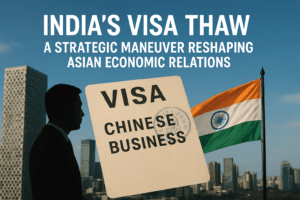
India’s Visa Thaw: A Strategic Maneuver Reshaping Asian Economic Relations
A simple policy change cutting visa wait times from months to weeks reveals how economic necessity is forcing geopolitical rivals into pragmatic cooperation
When Indian officials quietly circulated an internal directive on December 10, 2025, instructing missions to process most Chinese business visas within four weeks, they did more than streamline paperwork—they cracked open a door that had been nearly shut since the deadly 2020 Galwan Valley border clash. This administrative adjustment, removing a layer of security vetting imposed after those tensions, represents one of the most tangible signs of thaw in India-China relations in five years. For industries that had languished with idle machinery waiting for Chinese technicians, the change means production lines can finally hum again. For geopolitical observers, it signals a fascinating case study in how economic imperatives can temporarily override strategic rivalries, creating fragile but functional spaces for cooperation between competing powers.
The Economic Engine Behind the Policy Shift
India’s visa liberalization is not an act of diplomatic generosity but a calculated response to severe economic pain. Industry estimates reveal that the previous visa restrictions cost India’s electronics sector approximately $15 billion in lost output over four years. Phone manufacturers, in particular, found themselves stranded with sophisticated Chinese machinery that required specialized technicians for installation, maintenance, and calibration—technicians who could not obtain visas.
The bottleneck became so severe that it undermined India’s ambitious “Make in India” and production-linked incentive (PLI) schemes designed to position the country as a global manufacturing alternative to China. As Pankaj Mohindroo of the Indian Cellular and Electronics Association noted, the easing will directly help India “scale up production of finished goods, components and sub-assemblies”. Beyond electronics, renewable energy, telecommunications, and electric vehicle sectors—all reliant on Chinese technology and expertise—had similarly stalled.
Table: Key Economic Indicators in India-China Relations (2024-2025)
| Indicator | Figure | Implication |
| Bilateral Trade (FY 2024-25) | ~$127.71 billion | Shows resilience of economic ties despite political tensions |
| India’s Trade Deficit with China | ~$99.2 billion | Highlights extreme asymmetry and dependency |
| Production Losses in Electronics (2021-2024) | $15 billion | Quantifies cost of previous visa restrictions |
| Chinese Exports to India (2024) | >$100 billion | Makes China India’s largest trading partner |
The staggering $99.2 billion trade deficit with China presented New Delhi with a painful dilemma. On one hand, reducing dependency on Chinese imports became a strategic priority after the border clashes. On the other, Indian manufacturing needed Chinese inputs to function, much less compete globally. The visa relaxation represents a pragmatic acknowledgment that complete decoupling is economically unfeasible in the short to medium term.
The Geopolitical Dance: Compartmentalizing Conflict
This visa adjustment didn’t occur in isolation. It follows a series of diplomatic maneuvers throughout 2025 that saw Indian Prime Minister Narendra Modi visit China for the first time in seven years, attending the Shanghai Cooperation Organisation Summit in Tianjin. That high-level engagement, followed by the resumption of direct flight routes in October, created the political space for practical cooperation.
What’s remarkable is how both nations have learned to compartmentalize issues. While boundary negotiations stalled in November 2025 with multiple standoff points persisting along the Line of Actual Control, economic channels gradually reopened. This reflects what analysts term India’s “strategic autonomy” in practice—simultaneously engaging with Beijing economically while strengthening security partnerships elsewhere and maintaining firm border positions.
The timing is also geopolitically significant. The announcement came alongside the “surprise announcement of a 50 percent tariff rate on Indian exports to the US”. As relations with Washington showed strain, New Delhi demonstrated it could recalibrate relationships with other major powers. This isn’t a pivot toward Beijing so much as a diversification of options—a classic hedging strategy in an increasingly multipolar world where economic alliances are being reconfigured.
Practical Implications: From Paperwork to Production Lines
For businesses on the ground, the policy change transforms operational realities. Under the new regime, the average processing time at India’s Shanghai consulate has already dropped from approximately 90 days to 24. Chinese professionals can now obtain multiple-entry visas valid for up to 180 days per entry, placing them on par with technicians from Japan and South Korea—an important symbolic parity for Beijing.
The procedural shift is substantial: while applicants still submit biometrics and standard documentation, their files no longer require clearance from an inter-ministerial security panel that had created a bottleneck. This streamlined process means:
- Maintenance backlogs on telecommunications infrastructure and photovoltaic installations could clear within a quarter
- Multinational companies gain flexibility to rotate Chinese staff through Indian projects
- Indian manufacturers can meet contract deadlines that previously required costly remote troubleshooting
However, businesses must navigate remaining regulations. Chinese assignees staying over 180 days must still register with the Foreigners Regional Registration Office within 14 days of arrival. Payroll teams should verify whether workers qualify for India’s ‘short-stay’ tax exemption (60 days per fiscal year), and insurance policies need updating to reflect the renewed ability to dispatch personnel on short notice.
The Semiconductor Dimension: Technology Transfer Tensions
Nowhere is the complexity of this re-engagement more evident than in semiconductors—a sector where collaboration and competition dangerously intertwine. India’s Semiconductor Mission aims to establish domestic capabilities across the value chain, but this ambition collides with China’s own semiconductor strategy and restrictions on technology transfer.
Chinese actions in 2025 revealed a contradictory approach: while supporting renewed business exchanges, China reportedly restricted “manpower and specialised equipment” to deter iPhone manufacturing expansion in India and recalled over 300 Chinese engineers from Foxconn’s Indian facilities. These moves followed earlier restrictions on exports of critical minerals like gallium and germanium to countries including India.
This creates a challenging environment for genuine technology partnership. India needs Chinese expertise to build its electronics manufacturing ecosystem, but China has demonstrated reluctance to facilitate knowledge transfer that might create a competitive rival. The visa relaxation may facilitate the movement of personnel needed to operate existing Chinese-made equipment, but it doesn’t guarantee access to the proprietary knowledge needed for India to advance its own technological capabilities.
Looking Ahead: A Fragile Recalibration
As 2025 draws to a close, the India-China relationship embodies what the Atlas Institute terms “cautious re-engagement”. The visa policy represents tactical adjustment rather than strategic transformation—a recalibration driven by economic necessity rather than genuine reconciliation.
Several factors will determine whether this thaw proves durable:
- Border dynamics: With territorial disputes unresolved and standoff points persisting, any renewed confrontation could instantly reverse the progress.
- Economic rebalancing: India will likely continue pushing to reduce its massive trade deficit with China, potentially through targeted industrial policies that could create new tensions.
- Global alignments: As the U.S. enacts tariffs on Indian exports and strengthens partnerships with China, India’s strategic calculus may continue evolving.
- Domestic politics: With India’s 2026 general election approaching, the government will be sensitive to perceptions of being either too soft or too rigid with Beijing.
Businesses operating in this space would be wise to welcome the administrative relief while maintaining contingency plans. As one analysis notes, “Corporations are therefore advised to maintain contingency staffing plans and monitor bilateral developments”. The underlying structural tensions—territorial disputes, economic asymmetry, and strategic mistrust—remain fundamentally unresolved.
The true significance of India’s visa policy shift lies in what it reveals about 21st-century geopolitical-economic dynamics. In an interconnected world, even strategic rivals find their economies entangled in ways that periodically demand pragmatic cooperation. The line between competitor and collaborator becomes blurred, with nations learning to compartmentalize conflicts while pursuing selective collaboration where interests align.
This delicate dance between Asia’s two giants—what one analyst terms the “Dragon-Elephant Tango”—will continue shaping not just bilateral relations but global supply chains, technology standards, and the balance of power in the Indo-Pacific. For now, a four-week visa processing time instead of three months offers a practical fix for factories needing technicians. But it also opens a small window through which we can observe how economic necessity and geopolitical rivalry interact in our complex, interdependent world.
You must be logged in to post a comment.