
India’s Unlikely April Chill: Why Heatwaves Have Taken a Holiday in 2026
India’s Unlikely April Chill: Why Heatwaves Have Taken a Holiday in 2026
For millions of Indians who had already resigned themselves to another summer of scorching temperatures, sleepless nights, and the constant hum of air conditioners struggling to keep up, an unexpected visitor has arrived: relief.
As March 2026 draws to a close, something unusual is happening across the Indian subcontinent. The mercury isn’t rising—it’s falling. And for a country that has grown accustomed to hearing the word “heatwave” with increasing dread each year, the silence on that front is nothing short of remarkable.
The Numbers That Tell a Different Story
Let’s talk numbers, because they reveal just how extraordinary this weather pattern truly is. Across northwest and central India, temperatures are expected to hover between 2 to 5 degrees Celsius below normal—at least until April 20. In a country where a one-degree deviation can send power grids into crisis mode, a sustained five-degree drop is nothing short of transformative.
Consider what early March looked like just weeks ago. Delhi recorded its hottest first week in 15 years. Temperatures across large swathes of the country ran 4 to 12 degrees above normal. Parts of Gujarat and Rajasthan had already crossed the 40-degree mark, triggering early heatwave alerts that seemed to promise a brutal summer ahead.
Then came the turnaround.
The Mediterranean Connection
The unlikely hero of this story? A series of weather systems traveling thousands of kilometers from the Mediterranean Sea. Western disturbances—rain-bearing systems that typically brush against India’s northern frontiers—have decided to make an extended stay.
What makes this spell different isn’t the presence of these disturbances; it’s their frequency and persistence. The India Meteorological Department confirmed on March 29 that multiple such systems are active simultaneously, creating a conveyor belt of cloud cover, rainfall, and thunderstorms across Punjab, Haryana, Delhi, Uttar Pradesh, Rajasthan, and the Himalayan states.
For anyone who has experienced a north Indian summer, the significance of this cannot be overstated. Normally, by late March, the skies have already begun to take on that harsh, bleached quality—the kind that makes you squint even with sunglasses on. The dust settles in. The wind feels like a hairdryer set to medium. The nights offer little reprieve.
None of that is happening this year.
What This Means for Ordinary Lives
There’s a particular quality to the relief people are experiencing right now that weather statistics don’t quite capture.
In the sprawling suburbs of Noida and Gurgaon, residents have been noticing something unusual as March comes to a close: they haven’t switched on their air conditioners yet. Not even for a few hours in the afternoon. Not even at night when the heat typically radiates from concrete walls that have been baking all day.
For those who remember the summers of recent years—the rising nighttime temperatures that made sleep impossible, the humidity that clung to everything, the power cuts that seemed to arrive precisely when you needed electricity the most—this feels almost like borrowed time. A gift that nobody expected.
The power strain that has become a hallmark of Indian summers is, for now, absent. When days stay cooler by even 2 to 5 degrees, the cumulative effect on energy demand is enormous. In a city like Delhi, that margin can mean the difference between a stable grid and the kind of load-shedding that brings life to a halt.
The Meteorological Mechanics at Play
To understand why this is happening, we need to look at the larger atmospheric picture. Western disturbances are essentially extratropical storms that originate over the Mediterranean Sea and travel eastward, bringing moisture and instability to the western Himalayas and the northern plains.
Typically, their influence weakens as March progresses. The jet stream that guides them shifts northward, and the heating of the Indian landmass begins to create its own weather systems. But this year, the pattern has held. Multiple disturbances have lined up like trains on a track, ensuring that no sooner does one system weaken than another takes its place.
The result is a sustained period of cloud cover, rainfall, and thunderstorms that has effectively put a lid on the heating process. Cloud cover prevents daytime temperatures from rising sharply by reflecting solar radiation back into space. Rainfall cools the surface directly. And the winds associated with these systems bring in relatively cooler air from higher latitudes.
For those who follow Indian weather closely, there’s a certain irony here. The same western disturbances that often cause devastating floods in the Himalayan region during winter and early spring are now providing a cooling service that no amount of air conditioning could replicate.
The Longer View: What the Forecasts Actually Say
Before anyone gets too comfortable, it’s worth noting what this cooling spell is not. It is not a sign that global warming has reversed itself. It is not a permanent shift in India’s climate patterns. And it is certainly not a guarantee that the summer will remain mild.
The India Meteorological Department’s seasonal outlook had already warned of more heatwave days than usual between March and May 2026. That assessment was based on broader climatic factors—ocean temperatures, long-range models, and the overall warming trend that has made Indian summers progressively more punishing over the past two decades.
What we’re experiencing now is a short-term interruption of that trend. A weather pattern, not a climate shift.
The extended range outlook for the next two weeks—until April 9—explicitly states that heatwave conditions are unlikely. Maximum temperatures will stay normal to below normal across most of the country. But beyond that window, the picture becomes less certain.
South India, for its part, may still see hotter days. The cooling influence of western disturbances tends to diminish as you move south, and the peninsular region has its own weather dynamics that operate somewhat independently of what happens in the north.
The Economic Implications
There’s an economic dimension to this weather anomaly that deserves attention. When a country like India experiences a cooler-than-normal April, the ripple effects touch everything from power consumption to agricultural planning.
Peak power demand—that surge that happens when everyone turns on their air conditioners at once—is directly tied to temperature. Every degree of cooling translates to measurable relief for the power grid. For a country that has invested heavily in expanding its generation capacity but still struggles with distribution and peak management, this weather pattern is effectively doing what billions of rupees of infrastructure investment aims to achieve.
Then there’s agriculture. April is a critical month for rabi crop harvesting and for the early sowing of summer crops. Excessive heat can stress both standing crops and those just going into the ground. The current pattern of intermittent rainfall and cooler temperatures is, for many farmers, a welcome development.
The Human Experience
Beyond the statistics and the forecasts, there’s a human story here that deserves to be told.
Ask anyone who has lived through a north Indian summer about what it feels like when the heat finally arrives. There’s a particular moment—usually sometime in late March—when you realize that the pleasant days are over. The air loses its softness. The evenings stop cooling down. You start planning your day around the heat: waking up earlier to get things done before the sun rises too high, waiting until late evening to step outside again.
This year, that moment hasn’t arrived yet.
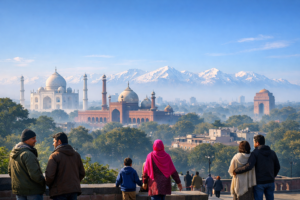
People are sitting on their balconies in the evening, something that by late March is usually impossible. Children are playing outside in the afternoon without parents worrying about heatstroke. Families are postponing the annual ritual of servicing the air conditioners, not because they’ve forgotten but because there’s no urgency.
It’s a small thing, perhaps. But in a country where summer has increasingly become something to be endured rather than enjoyed, these weeks of reprieve matter more than the temperature charts can show.
What Comes Next
The question everyone is asking, of course, is how long this will last. The honest answer is that nobody knows for certain.
Western disturbances are inherently unpredictable. They can stop coming with little warning. And when the pattern breaks, the heat tends to return with a vengeance—the accumulated solar energy that was kept at bay by cloud cover can suddenly assert itself, leading to rapid temperature spikes.
What is clear is that this cooling spell has already changed the calculus for what summer 2026 will look like. Even if the heat arrives later than usual, the delayed onset means that the cumulative heat exposure over the season may be less severe than initially feared.
For now, though, the advice from meteorologists is simple: enjoy it while it lasts. The clouds and rain that are keeping temperatures down may be inconvenient for those with outdoor plans, but they’re doing something far more valuable. They’re giving India a break from the relentless heating that has become the new normal of its summers.
A Broader Perspective
If there’s a larger lesson in this weather anomaly, it might be about how even in a warming world, short-term variability still matters. The overall trend toward hotter summers is unmistakable. The data from the past two decades shows it clearly. But within that trend, there are years like this one—and months like this April—where the weather refuses to follow the script.
For the people living through it, that variability is not just a statistical curiosity. It’s the difference between a summer that feels like a siege and one that offers room to breathe.
The relief people are feeling right now is genuine. After years of rising nighttime temperatures, increasing humidity, and the constant strain on power infrastructure, these cooler days feel like a gift. And like any unexpected gift, it comes with the awareness that it won’t last forever.
But that doesn’t make it any less valuable.
For now, across the northern plains of India, people are stepping outside in the evening without bracing themselves. Air conditioners remain off. The hum of the power grid is quieter than it normally would be. And for a few weeks at least, summer has decided to wait.
When the heat does finally arrive—and it will, eventually—these days will be remembered as the time when India caught a break. A moment when the weather systems aligned in a way that gave millions of people something they had almost forgotten was possible: an April that felt like spring.
You must be logged in to post a comment.