
India’s Trade Triumph: Historic Deals with US and EU Mask a Tougher Reality on the Ground
The article discusses India’s historic trade agreements with the European Union and the United States in early 2026, marking a significant shift from its protectionist past and positioning it as a major global player, but it highlights that these pacts alone will not guarantee export success due to India’s historically low FTA utilisation rate (around 25%), complex compliance burdens on exporters, and structural competitiveness gaps compared to rivals like Vietnam. It argues that while the deals create opportunities on paper, India must urgently address on-the-ground challenges—including streamlining Rules of Origin requirements, reducing logistics costs, improving customs predictability, and embracing deeper trade reforms—to transform these diplomatic victories into tangible export growth, attract investment, and create jobs.
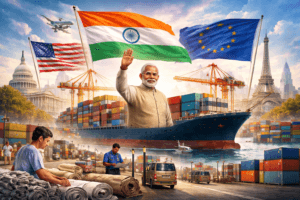
India’s Trade Triumph: Historic Deals with US and EU Mask a Tougher Reality on the Ground
In a whirlwind of diplomatic activity, India has etched its name into the global trade ledger with two landmark agreements. But for the country’s exporters, the real battle is only just beginning.
By any measure, the first quarter of 2026 will be remembered as a watershed moment for India’s economic diplomacy. In a matter of weeks, New Delhi has pulled off what feels like a geopolitical hat-trick: finalising a long-gestating trade agreement with the 27-nation European Union, securing an interim pact with the United States, and immediately pivoting to launch negotiations with the six-nation Gulf Cooperation Council (GCC).
For the government, the narrative is clear. The “mother of all trade deals” with the EU and the “father of all trade deals” with the US represent a decisive victory for Prime Minister Narendra Modi’s foreign policy, signaling India’s arrival as a confident global power ready to engage with the West on its own terms. It’s a stark departure from the protectionist instincts that for decades left Indian negotiators paralysed by the fear of foreign competition, causing talks to languish for years in bureaucratic amber.
However, as the celebratory press conferences fade and the fine print is scrutinised, a more nuanced and challenging picture is emerging. While the deals are directionally positive—opening markets for India’s skilled professionals, textiles, and gems—they are not a silver bullet. They are, in many ways, just the starting gun for a much longer and more arduous race. The true test for India lies not in signing treaties, but in the gritty, unglamorous work of fixing what happens on the factory floor, at the port, and at the customs checkpoint.
The Paper Tiger: Why Trade Deals Often Fail Indian Exporters
The most significant hurdle India faces is not the negotiation table, but its own track record of implementation. As analysts point out, India’s utilisation rate of its existing Free Trade Agreements hovers at a dismal 25%. This means that for every four dollars of exports that could be shipped under preferential terms, three dollars are still shipped under standard, costlier tariffs.
This isn’t just a statistic; it’s a story of everyday frustration for millions of small and medium-sized enterprises (SMEs) that form the backbone of Indian manufacturing. For a small textile exporter in Surat or a leather goods manufacturer in Kanpur, the promise of a 5% tariff reduction in Brussels or New York is often rendered meaningless by the mountain of paperwork required to claim it.
Consider the journey of a consignment of handicrafts destined for a buyer in Germany under the new EU deal. To prove its Indian origin, the exporter must now navigate a complex web of “Rules of Origin” (RoO). These rules are designed to prevent goods from China or Vietnam from being routed through India to exploit lower tariffs. While noble in intent, they are punishing in practice.
Under the new EU agreement, the onus of proving origin has shifted from the government to the exporter. This shift to self-certification, intended to streamline the process, places a heavy legal and financial burden on businesses. An incorrect declaration, even an honest mistake, can trigger severe penalties and demands for retrospective duty recovery years later. For a small business owner operating on thin margins, this isn’t a risk worth taking. It’s often simpler to just pay the full duty and avoid the potential legal headache.
“FTAs are like sophisticated Swiss army knives,” explains a trade compliance expert working with Indian exporters. “They have all the tools you need, but if you don’t know how to use them, they’re useless. Most Indian SMEs don’t have the bandwidth to understand the intricate rules of origin, deal with inconsistent customs interpretations across different ports, or absorb the high cost of compliance documentation. So, they stick with what they know, and the FTA becomes a dead letter.”
Beyond Tariffs: The Competitiveness Conundrum
This implementation gap points to a more fundamental issue: India’s struggle to build a truly competitive export ecosystem. The deals with the US and EU effectively level the playing field by matching the tariff advantages that competitors like Vietnam, Bangladesh, and Malaysia already enjoy. But tariff parity does not mean competitive parity.
To understand this, one only needs to look at Vietnam. In 2010, Vietnam’s merchandise exports were roughly one-third of India’s. Today, they are nearly on par, despite Vietnam’s economy being a fraction of the size. Vietnam hasn’t out-negotiated India; it has out-executed it. Its success is built on speed, predictability, and deep supply-chain integration.
For a global buyer like Nike or Apple, placing an order isn’t just about the final cost of the goods. It’s about the total landed cost and, more importantly, the cost of certainty. Can the supplier get the goods to the port on time? Will they clear customs without a bribe or a weeks-long delay? Is the power supply reliable enough to meet the production deadline? Is the logistics infrastructure efficient enough to get the container on the next ship out?
In these areas, India has historically struggled. While the government has invested heavily in infrastructure, the on-ground reality for many exporters remains one of fragmentation. Logistics costs as a percentage of GDP are significantly higher than in China or Vietnam. Customs procedures, despite digitalisation efforts, can still be unpredictable and opaque. The “ease of doing business” is often felt more acutely at a policy level in Delhi than on the factory floor in a manufacturing cluster.
This is why, as one analyst notes, “competitiveness is won in operations, not treaties.” Vietnam’s advantage is systemic. It built its export machine on a foundation of aggressive export promotion policies, welcoming foreign direct investment (FDI) with open arms, and integrating itself into global supply chains as a reliable, low-risk cog. Foreign companies didn’t just set up factories in Vietnam; they built entire ecosystems, training local workers and managers, and establishing trust with local authorities.
The Hesitant Giant: India’s Reluctance to Expose Itself to Competition
India’s path has been different. Its manufacturing push has often been characterised by a hesitancy to fully expose domestic industry to the chill winds of foreign competition. The legacy of the “Licence Raj” and a deep-seated suspicion of imports have fostered a mindset where protection is often seen as a prerequisite for growth, rather than a barrier to it.
This is reflected in India’s export basket. While the country has made remarkable strides in high-tech manufacturing—becoming a credible hub for iPhone assembly is no small feat—it lags significantly in the labour-intensive sectors where it should have a natural advantage. In textiles, footwear, furniture, and toys—industries that create millions of jobs—India has been outperformed by competitors like Bangladesh, Vietnam, and even Indonesia.
These are precisely the sectors that the new FTAs are supposed to boost. But attracting a company like Nike to shift a significant portion of its supply chain from Vietnam to India requires more than just a signed document. It requires a fundamental shift in perception. It requires Indian ports to operate with the same clockwork efficiency as Singapore’s. It requires customs officers to act as facilitators, not gatekeepers. It requires state governments to compete fiercely with each other to provide reliable power and clear land acquisition hurdles.
The Path Forward: From Treaties to Transformation
The new trade pacts with the US and EU have dramatically raised the stakes. They have put India on the global stage, but they have also exposed it to a level of scrutiny it has long avoided. The world will now be watching to see if India can transform its paper victories into tangible trade flows.
For New Delhi, the focus must now pivot from the grand strategy of geopolitics to the granular details of economic reform. The “irritants” that experts speak of—onerous logistics, high import duties on intermediate goods that make finished products uncompetitive, cumbersome customs regulations—can no longer be treated as secondary concerns. They are the primary battleground.
Streamlining the Rules of Origin process is critical. This could involve creating user-friendly digital portals that guide exporters through compliance, establishing single-window clearance mechanisms that reduce bureaucratic touchpoints, and launching massive awareness campaigns to educate SMEs on how to actually use the FTAs.
Simultaneously, the government must double down on its logistics push. The success of the India-Middle East-Europe Economic Corridor (IMEC), announced on the sidelines of a recent G20 summit, will be vital. But so will the less glamorous work of improving last-mile connectivity to ports and reducing the dwell time of containers.
Most importantly, India must embrace a culture of policy stability and predictability. Investors crave certainty. They need to know that the rules of the game won’t change overnight. This means avoiding sudden tariff hikes and ensuring that the dispute resolution mechanisms promised in the FTAs are swift and credible.
Ultimately, 2026 may well go down in history as the year India signed its most ambitious trade deals. But whether it will be remembered as the year India truly became a global export powerhouse depends on a much harder task: bridging the chasm between the promise of a treaty and the reality on the ground. The ink on the paper has dried; now the real work of turning words into widgets, jobs, and growth must begin in earnest.
You must be logged in to post a comment.