
India’s Tech Prowess Takes a Strategic Leap: IIT Kharagpur Joins the Global Digital Twin Frontier
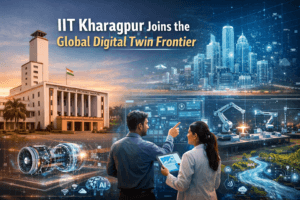
India’s Tech Prowess Takes a Strategic Leap: IIT Kharagpur Joins the Global Digital Twin Frontier
In an era where the boundary between the physical and digital worlds is not just blurring but actively merging, a new alliance signals a significant shift in how future technologies will be conceived, developed, and deployed. The recent announcement that the Indian Institute of Information Technology Kharagpur (IIT Kharagpur) has become a member of the prestigious Digital Twin Consortium (DTC) is more than a routine institutional membership. It is a strategic maneuver that positions India at the very heart of the next industrial revolution—one powered by AI-driven digital twins.
For the uninitiated, a digital twin is far more than a sophisticated 3D model. It is a dynamic, living virtual replica of a physical object, process, or system, fed by real-time data and supercharged with simulation, machine learning, and reasoning. It allows engineers, city planners, and doctors to run “what-if” scenarios in a risk-free digital sandbox—from stress-testing a jet engine before it’s built to optimizing national supply chains or simulating complex biological processes.
Why This Partnership is a Pivotal Moment for Global Tech
The DTC, headquartered in Boston, is the leading global authority setting the standards, frameworks, and best practices for digital twin technology. Its membership roster reads like a who’s who of industry and academia, including giants from manufacturing, aerospace, and software. The inclusion of IIT Kharagpur is a powerful acknowledgment of India’s burgeoning role not just as a consumer of technology, but as a primary source of innovation and intellectual capital.
As Dan Isaacs, GM & CTO of the DTC, noted, this move “strengthens our global reach and brings world-class academic expertise.” This isn’t just diplomatic praise. IIT Kharagpur, with its formidable reputation in artificial intelligence, mechanical engineering, and data science, represents a reservoir of research talent poised to tackle some of the most persistent challenges in digital twin adoption: interoperability, scalability, and intelligent automation.
Beyond Theory: The Concrete Pillars of Collaboration
The press release outlines a roadmap that moves decisively from abstract research to tangible impact. Three collaborative pillars stand out:
- The “Capabilities Periodic Table” and AI Integration: One of the most intriguing mentions is the work on “dual development Capabilities Periodic Table frameworks.” Think of this as a standardized chemistry set for digital twins—a way to categorize and compose fundamental digital twin capabilities (sensing, modeling, analytics) into complex, working systems. IIT Kharagpur’s AI prowess will be critical in making these systems self-adapting and predictive, moving from mirrors of reality to proactive advisors.
- Testbeds: Where Ideas Meet the Ground: Membership grants IIT Kharagpur active participation in the consortium’s testbed program. This is where rubber meets the road. Imagine a testbed for a “Digital Twin of a River Basin,” developed in West Bengal, using IoT sensors and AI models to predict flooding, manage irrigation, and preserve ecology. Or a testbed for smart manufacturing tailored for India’s vast MSME sector. These real-world pilots are invaluable; they generate the case studies and proven use cases that accelerate industry-wide adoption.
- Shaping the Global Rulebook: Perhaps the most understated yet powerful role IIT Kharagpur will play is in contributing to global digital twin standards. Standards are the unsung heroes of technology—they ensure that a digital twin from a factory in Pune can communicate with a supply chain platform from Stuttgart. By having a seat at this table, Indian academia and, by extension, Indian industry, help shape the protocols that will govern global trade and innovation for decades to come.
The India Context: A Fertile Ground for Digital Twin Innovation
This partnership arrives at a perfect inflection point for India. The nation’s ambitious “Digital India” and “Make in India” initiatives are creating unprecedented demand for smart infrastructure, advanced manufacturing, and sustainable urban management. Digital twins are the perfect orchestrator for these complex domains.
Professor Suman Chakraborty’s statement hits the nail on the head: the collaboration provides students and researchers “direct access to cutting-edge technologies and methodologies.” This addresses a critical gap in many academic systems: the lag between industrial practice and classroom theory. Students at IIT Kharagpur will now learn and experiment within the same frameworks used by leading global corporations, making them not just graduates, but industry-ready innovators.
The pride expressed by alumnus Arjun Malhotra, co-founder of HCL, underscores a broader narrative. It represents the closing of a loop where India’s legendary IT services prowess evolves into deep-tech product and framework innovation. It’s a move from providing solutions for global tech to helping define what that tech is.
The Road Ahead: Education, Ecosystems, and Exponential Impact
The long-term value of this membership may well lie in its stated goal of “creating educational programs and curriculum development.” IIT Kharagpur has the potential to become a nodal center for digital twin education in South Asia, training a new generation of engineers and scientists fluent in this convergent technology.
Furthermore, by fostering collaboration between global consortium members and India’s vibrant startup ecosystem, this partnership can spur homegrown entrepreneurship. Startups focusing on digital twin applications for agriculture, healthcare, and energy could find a powerful support system bridging academic research, global standards, and pilot opportunities.
A Symbiotic Relationship for a Shared Future
In essence, the Digital Twin Consortium gains a powerhouse of academic research talent and a gateway to one of the world’s most dynamic and challenging markets. IIT Kharagpur, in return, gains global relevance, industry connectivity, and a platform to translate its research into worldwide impact.
This is not a story about an Indian college joining a foreign group. It is a story about strategic convergence. It highlights how a premier Indian institution is leveraging its specific strengths in AI to claim a leadership role in a foundational technology of the future. It signals that the future of digital twins—and by extension, the future of how we design, manage, and optimize our world—will be written not in one geographic center, but through a collaborative, global effort where India is now a principal author.
The partnership announced on January 13, 2026, may well be remembered as the day India’s technological journey pivoted decisively from adoption to co-creation on the global stage. The digital twins being nurtured in this collaboration will, in time, help build smarter cities, more efficient industries, and more sustainable systems, proving that the fusion of bits and atoms holds the key to addressing some of our most pressing human challenges.
You must be logged in to post a comment.