
India’s Surveillance Crossroads: The Clash Over Mandatory Phone Tracking
India’s government is reviewing an unprecedented proposal from domestic telecom operators to mandate that all smartphones sold in the country have always-on, satellite-based location tracking (A-GPS) activated with no option for users to disable it, aiming to provide law enforcement with precise, meter-level surveillance capabilities.
This move has sparked fierce opposition from Apple, Google, and Samsung, who argue through their lobby group that the mandate is a global first and a severe regulatory overreach that would endanger the privacy and security of millions, including sensitive personnel like journalists and military officials. The clash occurs just days after the government was forced to withdraw a separate order to preload a state-run app on all devices, highlighting an ongoing tension between state surveillance ambitions and digital privacy rights in the world’s second-largest smartphone market, where no final policy decision has yet been made.
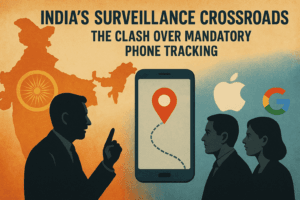
India’s Surveillance Crossroads: The Clash Over Mandatory Phone Tracking
In a week marked by a dramatic policy reversal, the Indian government finds itself at the center of a new and potentially more consequential privacy battle. Days after rescinding a controversial order to preload a state-run cybersecurity app on all smartphones, authorities are now reviewing a far more intrusive proposal: to force smartphone makers to enable always-on, satellite-based location tracking with no option for users to disable it . This move, unprecedented in its global scale, has ignited a fierce standoff between the state, domestic telecom giants, and the world’s most powerful technology companies, setting the stage for a defining conflict over privacy, security, and sovereignty in the digital age.
The Core of the Controversy: A-GPS and Unprecedented Access
The proposal originates from the Cellular Operators Association of India (COAI), the lobby group representing telecom titans Reliance Jio and Bharti Airtel. In a June internal email to the federal IT ministry, the COAI suggested that the government mandate smartphone manufacturers to activate Assisted GPS (A-GPS) technology permanently on all devices sold in India .
A-GPS, which typically only activates during specific app use or emergency calls, uses a combination of satellite signals and cellular network data to pinpoint a device’s location with startling accuracy—within about one meter. This is a stark contrast to the current system available to law enforcement, which relies on cellular tower triangulation and can be inaccurate by several meters .
The telecom industry’s request comes with two radical demands:
- That location services be permanently activated with no user-controlled off switch.
- That smartphone makers be ordered to disable pop-up notifications that alert users when their carrier is accessing their location, arguing that such alerts allow surveillance targets to know they are being watched .
The Stakes: A Market of 735 Million Phones
The scale of this proposal is monumental. India is the world’s second-largest smartphone market, with approximately 735 million devices in use as of mid-2025 . Google’s Android operating system powers over 95% of these devices, with Apple’s iOS making up the remainder . A mandate for always-on tracking would, in effect, transform the personal devices of nearly three-quarters of a billion citizens into potential real-time surveillance terminals for the state.
A Clash of Titans: Telecoms vs. Smartphone Makers
The proposal has drawn immediate and forceful opposition from the world’s leading smartphone companies and their lobby group, the India Cellular & Electronics Association (ICEA). In a confidential July letter to the government viewed by Reuters, the ICEA, representing both Apple and Google, delivered a scathing critique .
| Stakeholder Group | Primary Argument | Key Concerns Cited |
| Telecom Operators (COAI) | Law Enforcement Efficiency: Provides precise location data for investigations, overcoming inaccurate cell tower data . | Current system is imprecise; user pop-up alerts compromise surveillance . |
| Smartphone Makers (ICEA) | Privacy & Security: The proposal is a “regulatory overreach” with no global precedent . | Jeopardizes safety of military, judges, journalists; creates national security risks . |
The ICEA letter made several powerful arguments:
- No Global Precedent: It stated that a government mandate for device-level location tracking “has no precedent anywhere else in the world” .
- Regulatory Overreach: It argued that A-GPS services are “not deployed or supported for location surveillance” and that the measure “would be a regulatory overreach” .
- Endangering Sensitive Groups: It warned that the user base includes military personnel, judges, corporate executives, and journalists, whose security would be severely compromised if their precise movements were exposed .
- Defending Transparency: It insisted that pop-up alerts for location access must be preserved to “ensure transparency and user control” .
Security experts globally have echoed these alarms. Junade Ali, a digital forensics expert with Britain’s Institution of Engineering and Technology, stated plainly that “this proposal would see phones operate as a dedicated surveillance device” . Cooper Quintin, a senior staff technologist at the Electronic Frontier Foundation (EFF), called the idea “pretty horrifying,” emphasizing that it would grant phone companies and law enforcement “your exact location at any time, potentially even without legal due process” .
The Backstory: A Pattern of Surveillance Ambitions
This new tracking proposal did not emerge in a vacuum. It follows immediately on the heels of another contentious government move that was swiftly revoked following public and corporate backlash.
Just days earlier, the Department of Telecommunications had ordered all smartphone makers to pre-install the government’s Sanchar Saathi (“Communication Partner”) app on every device sold in India, and to make it unremovable . The government presented it as a tool to block stolen phones and report fraud, but it was met with widespread fear that it could act as a state-sponsored surveillance tool or even a “kill switch” for devices .
Facing fierce opposition in parliament, from privacy activists, and—crucially—from Apple and Google, who made clear they would not comply, the government rescinded the order on December 3 . Communications Minister Jyotiraditya Scindia was forced to clarify that the app was “voluntary and democratic” and could be deleted .
This rapid sequence of events reveals a persistent drive within sections of the Indian government and telecom industry to deepen access to citizen data. It also demonstrates the formidable power of coordinated resistance from tech giants, civil society, and political opposition.
Technology, Trust, and the Global Context
The technical capability for precise tracking is advancing rapidly, independent of government mandate. Notably, Airtel Business has recently partnered with Swift Navigation to launch a centimeter-level accurate positioning service in India, aimed at applications like autonomous vehicles and advanced logistics . This highlights that the infrastructure for extreme precision already exists, raising the stakes of who controls access to such data.
Globally, India’s actions are being watched closely. Privacy advocates draw parallels to Russia, which in August mandated the pre-installation of a state-backed messenger app, MAX, on all phones—a move widely criticized as a surveillance measure . The outcome in India, a vibrant democracy and massive market, could encourage or deter similar proposals elsewhere.
A critical unresolved question is the legal framework for such surveillance. The Indian government has a documented history of seeking more precise location data for investigations , but the current proposal appears to bypass the need for individual warrants by creating a permanent, ubiquitous tracking capability. This erosion of the principle of specific, cause-based authorization is at the heart of privacy advocates’ concerns.
What Comes Next: Cautious Optimism and Continued Vigilance
As of now, no policy decision has been made. A scheduled meeting between the Home Ministry and smartphone industry executives was postponed, indicating the sensitivity of the discussions .
The experience with the Sanchar Saathi app offers a playbook and a warning. The internet Freedom Foundation celebrated that reversal but termed it “cautious optimism, not closure” . The same applies here. The withdrawal of one intrusive measure does not guarantee the abandonment of the underlying ambition for greater surveillance.
The battle lines are clearly drawn. On one side stands a coalition of the state and domestic telecom operators, arguing for national security and investigative efficiency. On the other stands a coalition of global technology firms, privacy activists, and political opposition, defending individual privacy, security of sensitive persons, and global digital rights norms.
The resolution will test the balance of power in Modi’s India and signal to the world whether, in the world’s largest democracy, the phone in a citizen’s pocket is ultimately their own or an instrument of the state. The decision will resonate far beyond India’s borders, influencing global standards for privacy, corporate responsibility, and the limits of state power in the digital century.
You must be logged in to post a comment.