
India’s Summer Pause: Why April’s Heatwave Has Been Cancelled (For Now)
In a welcome respite from the early summer heat that saw record-breaking temperatures in March, India will experience no heatwaves until at least the end of April due to multiple active western disturbances—rain-bearing weather systems originating from the Mediterranean—that are bringing widespread rainfall, thunderstorms, and gusty winds across northern and central regions, keeping daytime temperatures 2°C to 5°C below normal until around April 20. The India Meteorological Department confirms that this prolonged cool spell, a sharp contrast to the earlier forecast of above-average heatwave days, is providing significant relief by reducing power strain, lowering electricity bills, and allowing residents in cities like Delhi and Gurugram to delay switching on air conditioners, though the south may still see hotter days and the long-term summer outlook still points to intense heat later in the season.
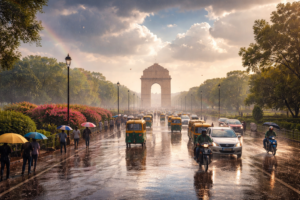
India’s Summer Pause: Why April’s Heatwave Has Been Cancelled (For Now)
Just a few weeks ago, it felt like the country was skipping straight from a mild winter into the scorching jaws of summer. In early March, Delhi recorded its hottest first week in 15 years. Parts of Gujarat and Rajasthan saw the mercury breach 40°C, triggering early heatwave alerts usually reserved for late April. The air conditioners were humming, the power grids were groaning, and millions of Indians braced themselves for another brutal summer of sleepless nights and soaring electricity bills.
But then, nature hit the pause button.
In a meteorological twist that has brought palpable relief to a nation weary of extreme weather, the heatwave that was forecast to dominate April has simply… not arrived. Instead of the usual relentless sun, large swathes of North and Central India are experiencing a spell of weather that feels more like a pleasant extension of spring—with cool breezes, cloudy skies, and the welcome pitter-patter of rain.
For the millions living in the urban heat islands of Delhi, Mumbai, Lucknow, and Jaipur, the relief is more than just a statistic on a weather app. It’s the sound of the air conditioner remaining silent. It’s the luxury of sleeping with a blanket in late March. It’s a collective sigh of relief from a population that has, in recent years, come to dread the months of April and May as a period of physical endurance.
The Unlikely Heroes: Western Disturbances
So, what is behind this unexpected respite? The answer lies not in a sudden shift in global climate patterns, but in a familiar old friend: the Western Disturbance.
These weather systems are essentially rain-bearing “packages” that originate over the Mediterranean Sea. They travel thousands of miles across the Middle East and Central Asia, carrying moisture and cool air before they slam into the Himalayas and sweep across the northern plains of India. Typically, their influence wanes as spring progresses, making way for the summer heat.
This year, however, the script has flipped. Instead of fading away, these disturbances have become more active. The India Meteorological Department (IMD) confirmed that as of late March, multiple such systems were lined up in succession—one after another—barreling towards the subcontinent.
This conveyor belt of weather systems is causing widespread light to moderate rainfall, thunderstorms, and gusty winds across Punjab, Haryana, Delhi, Uttar Pradesh, Rajasthan, and the Himalayan states. The result is a dramatic cooling effect. The IMD’s extended range outlook suggests that temperatures in Northwest and Central regions are likely to stay 2°C to 5°C below normal at least until April 20.
This is a stark contrast to the grim seasonal outlook released earlier this year. The IMD had originally warned that the March-to-May period would see more heatwave days than usual, driven by overall warming trends. The active Western Disturbances have effectively overridden that short-term forecast, creating a micro-season of cool that no computer model predicted with such certainty.
More Than Just a Weather Event: A Human Respite
To understand the significance of this cool spell, one must look beyond the meteorology and into the lived experience of India’s cities.
In recent summers, the narrative has been dominated by “nighttime heat”—a phenomenon where temperatures refuse to drop even after sunset. This, combined with rising humidity, creates conditions that are not just uncomfortable but dangerous. It strains the body, disrupts sleep, and puts immense pressure on the power grid as millions run air conditioners and coolers through the night.
In the National Capital Region (NCR), particularly in the urban sprawls of Noida and Gurugram, residents have reported a curious phenomenon in the last week of March: the ACs haven’t been switched on yet.
“Last year, by mid-March, we were already running the AC for at least six hours a day,” says Meera Sharma, a resident of Noida Sector 93. “This year, we are still sleeping with the windows open. The breeze is actually cool. My electricity bill for March is almost half of what it was last year.”
This isn’t just a matter of comfort; it’s a matter of economics and infrastructure resilience.
The Hidden Economic Dividend: Power, Health, and Agriculture
When the mercury dips by even a few degrees, the cascading effects across the economy are profound.
- Power Grid StabilityIndia’s power demand is highly sensitive to temperature. A spike in temperature leads to a spike in the use of air conditioners, which can lead to the dreaded “summer blackouts” that have plagued states like Uttar Pradesh and Bihar in the past. With temperatures remaining below normal, the peak power demand is expected to be significantly lower this month. This gives the power grids a much-needed buffer, allowing utilities to perform maintenance and build coal reserves for the inevitable heat later in the summer.
- Health and Labor ProductivityHeatwaves are classified as a natural disaster in India, responsible for hundreds of fatalities in severe years. The absence of such conditions in April is a significant public health victory. It allows outdoor workers—construction laborers, street vendors, farmers, and municipal workers—to operate without the constant threat of heatstroke or dehydration. It buys time for public health systems to prepare for the peak summer months.
- Agricultural StabilityWhile excessive unseasonal rain can damage crops, the current spell of light to moderate rain and hail is a mixed blessing. It is replenishing soil moisture for the summer crops and providing relief to livestock. For farmers in Punjab and Haryana who are preparing for the wheat harvest, the cooler temperatures are ideal for ripening without the risk of the grain shriveling under premature heat.
A Tale of Two Indias: The Southern Exception
As with most things in a country as vast as India, the relief is not uniform. While the north enjoys its “fake spring,” the southern peninsula may not be as lucky. The weather systems bringing rain to the north often draw moisture away from the south, or simply don’t have the same influence.
The article notes that while the north cools down, the south may still see hotter days. This geographic disparity highlights the complexity of the Indian monsoon system. For states like Tamil Nadu, Karnataka, and Andhra Pradesh, the search for cooling rains continues, relying on local convection or the eventual onset of the pre-monsoon showers.
The Calm Before the Storm?
The critical question on everyone’s mind is: How long will this last?
The current forecast provides a window of comfort until the third week of April. But the meteorological department maintains its warning that the overall summer trend points to above-normal heat later in the season.
In essence, this cool spell is a delay, not a cancellation, of summer. The accumulated heat energy that has been missing from April will likely have to manifest eventually. Historically, a late onset of heatwaves often results in a sharper, more intense peak in May and June.
This “weather pause” should be viewed as a strategic gift—a month-long buffer zone. It is an opportunity for urban planners to fine-tune their heat action plans, for electricity boards to bolster their infrastructure, and for citizens to prepare their homes for the intense heat that is likely to follow.
Conclusion: Embracing the Respite
In a time when climate change often feels like a relentless march towards extremes—hotter summers, fiercer floods, more erratic monsoons—a story of delayed heat feels like a quiet victory. It is a reminder that nature is still a complex, chaotic system capable of surprises, even if the long-term trend remains concerning.
For now, India can breathe a little easier. The children can play outside a little longer. The chai wallahs can serve their tea without sweating through their shirts. The relentless hum of the air conditioner can be replaced by the sound of an open window and, occasionally, the soothing rhythm of rain on the roof.
As April unfolds under a canopy of clouds and cool winds, millions are silently thanking the Western Disturbances—the far-traveling messengers from the Mediterranean—for giving India a last taste of spring before the inevitable summer returns.
You must be logged in to post a comment.