
India’s Strategic Trade Pivot: How a Web of Global Deals Redefined Its Economic Sovereignty
India’s recent trade agreement with the United States, which reduced reciprocal tariffs to 18%, was not an isolated event but the result of a deliberate, years-long strategy to insulate its economy from global uncertainty. Facing punitive U.S. tariffs, India responded not with retaliation but by accelerating a web of bilateral deals with the EU, UK, UAE, Oman, and New Zealand, thereby diversifying its export markets, securing preferential access, and reducing reliance on any single partner. This strategic repositioning transformed trade pacts into tools of geopolitical leverage, allowing India to negotiate the U.S. deal from a position of strength as a tactical compromise that avoids a trade war while preserving key interests and cementing its role as an independent node in global supply chains.
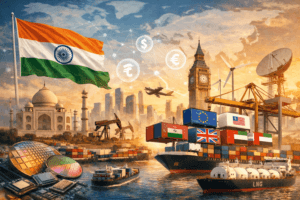
India’s Strategic Trade Pivot: How a Web of Global Deals Redefined Its Economic Sovereignty
In an era of escalating tariffs and geopolitical friction, India has executed a quiet but profound transformation in its trade policy. What began as a reactive stance to U.S. protectionism evolved into a calculated, multi-front strategy to insulate the economy and secure long-term influence. The recent “mini-deal” with the United States—which saw reciprocal tariffs reduced to 18%—was not a standalone victory but the culmination of years of strategic repositioning. This is the story of how India stopped counting tariffs and started counting leverage.
The Trigger: U.S. Tariffs and a Restrained Response
When former U.S. President Donald Trump imposed punitive tariffs on Indian goods—eventually reaching 50% in response to India’s continued purchases of discounted Russian oil—many expected a retaliatory spiral. Instead, New Delhi’s response was notably restrained. There was no public escalation, no scramble for exemptions. This calm was deliberate. India had been preparing for precisely this kind of global uncertainty long before the tariffs landed.
Trade agreements, once viewed through a purely commercial lens, had been repurposed as tools of strategic insulation. By the time Trump’s tariffs hit, India was already deep into negotiating a web of bilateral deals across Europe, the Gulf, and the Pacific. The goal was clear: diversify export markets, lock in preferential access, attract investment, and reduce vulnerability to any single economic partner.
The U.S. Deal: A Tactical Compromise, Not a Grand Bargain
On February 2, Trump abruptly announced a deal with India to ease tariffs. The 18% rate placed India ahead of peers like Indonesia, Pakistan, Bangladesh, China, Thailand, and Vietnam, who face higher duties. White House officials claimed India agreed to lower barriers to American goods and halt purchases of discounted Russian oil, with Modi pledging to “BUY AMERICAN” at a much higher level—potentially up to $500 billion in energy, agriculture, and technology.
Analysts view this as a tactical compromise rather than a transformative agreement. As JNU professor Rajan Kumar noted, the 18% tariff was “the second best deal” India could secure under Trump’s blanket tariff regime. Expecting preferential treatment was “wishful thinking.” Yet, even a modest deal unlocks deeper cooperation in critical minerals, semiconductors, data governance, and joint political engagement on China. Avoiding a prolonged trade war was itself a strategic win.
Notably, the U.S. pressure on Russian oil imports was heavily symbolic. The Wall Street Journal reported Trump’s higher tariffs aimed to punish India for “refusing to stop buying Russian oil,” linked in his administration’s narrative to financing the war in Ukraine. In practice, analysts expect India’s imports of Russian crude to decline gradually as global supply chains adjust—not stop overnight. The U.S. hopes India will pivot to American LNG and coal, though alternatives like Venezuelan heavy crude present logistical challenges.
Domestically, the pact has mixed implications. Exporters in textiles, gems, pharmaceuticals, and machinery gain from improved market access. As Harsh Pant of the Observer Research Foundation highlighted, high-tech sectors will benefit most from strategic ties and investment flows. However, the deal’s broad contours still lack specifics—start dates, exact product coverage, and safeguards—leaving room for uncertainty until a final joint statement is released.
The Cornerstone: The India-EU “Mother of All Deals”
Even before the U.S. agreement, India secured a landmark Free Trade Agreement with the European Union. This pact is staggering in scale, uniting the world’s second- and fourth-largest economies under a modern, rules-based framework. Indian exporters gain duty-free access on over 99% of export value to the EU, covering labour-intensive sectors like textiles, leather, gems, engineering goods, pharmaceuticals, and agriculture.
Commerce Minister Piyush Goyal called it “game-changing and transformational,” ending two decades of stalled talks. European Commission President Ursula von der Leyen linked the pact to strengthened security cooperation, signaling that economic and strategic alignment now go hand-in-hand. In return, India agreed to eliminate or reduce tariffs on most EU exports, including automobiles, machinery, aerospace parts, and alcoholic beverages, while protecting sensitive sectors like dairy and poultry.
This agreement reshapes trade flows, potentially boosting annual bilateral commerce from around $200 billion to new heights. Prime Minister Modi framed it as a stabilising force for the global order, reinforcing fair trade rules. The EU deal provided India crucial leverage ahead of U.S. negotiations—proof that New Delhi had credible alternatives to American markets.
Building a Web of Partnerships: UK, New Zealand, and the Gulf
India’s strategic outreach extended well beyond Brussels and Washington. The India-United Kingdom FTA, signed in July 2025, aims to treble trade by 2030, with 99% of Indian exports entering the UK tariff-free. Labour-intensive sectors again stand to gain, while the UK secured tariff cuts on cars, whisky, and gin. The pact also liberalizes services and mobility, awaiting UK parliamentary ratification by late 2026.
To the east, the New Zealand FTA concluded in December 2025 grants 100% duty-free access for Indian products, eliminating previous tariffs on textiles, leather, auto parts, and engineering goods. This cements ties with an agriculture-rich Pacific nation, diversifying India’s economic footprint.
In the Gulf, Comprehensive Economic Partnership Agreements with the UAE (2022) and Oman (2025) reflect deep strategic priorities. The UAE deal eliminated tariffs on 97% of tariff lines, making the Emirates a gateway for Indian companies into West Asia and Africa. The Oman CEPA gives Indian exporters duty-free access to over 98% of tariff lines, benefiting textiles, footwear, leather, gems, plastics, and medical devices. Gulzar Didwania of Deloitte India hailed the UAE CEPA as “the most comprehensive illustration of India’s evolving FTA framework,” promoting employment, technology collaboration, and supply-chain resilience.
The Real Challenge: Implementation and Domestic Readiness
Signing deals is only the beginning. As Agneshwar Sen, Trade Policy Leader at EY India, notes, “the real test begins” after negotiations conclude. Key challenges include implementation, compliance, and strategic follow-through. Newer FTAs with the EU and UK contain dense chapters on rules of origin, technical standards, and customs cooperation. Many Indian MSMEs face a steep learning curve, hampered by weak certification capacity, fragmented testing infrastructure, and inconsistent border interpretations.
Rules of origin, while designed to prevent trans-shipment, raise compliance costs. Without robust verification systems and state support, exporters may forgo preferential access altogether. Rising standards and sustainability pressures—especially in EU-style agreements—could also test Indian manufacturing, with commitments on labour, environment, traceability, and carbon measures posing additional hurdles.
Institutional coordination remains another fault line. Trade policy now cuts across commerce, finance, environment, labour, MSMEs, and state governments. Misalignment between ministries could slow execution and undermine credibility. Didwania underscores that converting favourable frameworks into export growth, investment inflows, and job creation depends entirely on domestic readiness.
Conclusion: A New Trade Doctrine Emerges
India’s flurry of trade agreements represents a fundamental shift in economic statecraft. By pursuing nine major pacts across six regions in just a few years, New Delhi has moved from a defensive, tariff-heavy posture to proactively shaping its integration into global supply chains. This “king of deals” strategy, as some analysts call it, is not about submitting to external pressure but about building strategic autonomy.
These agreements signal that India and its partners are pursuing agendas not subordinate to either the U.S. or China. They diversify export destinations, reduce reliance on any single market, and lock in long-term access for key sectors. The U.S. deal, rather than a surrender, becomes one piece of a larger mosaic—a tactical compromise that preserves broader strategic freedom.
As Professor Kumar observed, bilateral FTAs have become “a real option” for India. Their ultimate success will depend less on headline signings and more on execution, competitiveness, and domestic reform. But one outcome is already clear: India has moved beyond reactive trade diplomacy. In a fragmented world, it has learned to wield interdependence as a tool of influence, proving that in modern geopolitics, trade is not just about goods—it’s about leverage.
You must be logged in to post a comment.