
India’s Strategic Pivot: How Geopolitics is Forcing a Historic Shift in Oil Imports
Faced with mounting geopolitical pressure and the tightening grip of U.S. sanctions on major Russian producers, Indian state refiners led by Bharat Petroleum Corp. are strategically pivoting back to long-term supply agreements with traditional Middle Eastern suppliers, signaling a significant recalibration away from the heavy reliance on discounted Russian crude that defined the past few years. This move, exemplified by BPCL’s tenders for Abu Dhabi, Iraqi, and Omani oil through 2027, represents a prioritization of supply stability and diplomatic pragmatism over short-term cost savings, as New Delhi carefully balances its historic ties with Moscow against the contemporary economic and political imperatives of its relationship with Washington, while refiners like Mangalore Refinery and Reliance Industries publicly emphasize secure sourcing and operational predictability in an increasingly volatile landscape.
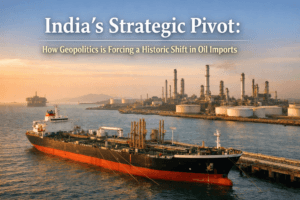
India’s Strategic Pivot: How Geopolitics is Forcing a Historic Shift in Oil Imports
In a move that signals a profound recalibration of global energy flows, Indian state-owned refiner Bharat Petroleum Corp (BPCL) is quietly locking in long-term crude oil contracts with Middle Eastern suppliers. This isn’t merely a routine procurement update; it’s a tangible symptom of a larger geopolitical realignment, where the world’s third-largest oil importer is being forced to re-evaluate its economic dependencies and strategic partnerships. After years of capitalizing on heavily discounted Russian crude, India is now gingerly stepping back toward its traditional suppliers in the Middle East, navigating a precarious tightrope between a historic ally and contemporary political pressures.
The Tender That Tells a Larger Story
BPCL’s recent tenders for Abu Dhabi’s Murban, Iraqi Basrah, and Omani crude for delivery stretching into 2027 represent more than a simple purchase order. They are a strategic hedge, a buffer against the volatility that now defines the global oil market. For traders and geopolitical analysts, the significance lies in the duration and scale of these contracts. Spot purchases are opportunistic, driven by daily price fluctuations. Year-long, and in this case multi-year, agreements signify a deliberate, long-term commitment. They reflect a calculated decision to secure supply stability, even if it comes at a potentially higher cost than the recent Russian bonanza.
This shift is not occurring in a vacuum. It is the direct result of a converging pressure front: relentless US sanctions on Russian entities like Lukoil PJSC and consistent diplomatic pressure from the Trump administration. For over two years, Indian refiners, both public and private, became adept at navigating the shadows of the sanctions regime, snapping up Russian Urals crude at steep discounts that provided a lifeline to Moscow and a boon to New Delhi’s balance of payments. At its peak, Russian imports accounted for over 40% of India’s crude intake, surpassing traditional suppliers like Iraq and Saudi Arabia.
That era of deep discount diplomacy is now facing headwinds. The US has moved from warnings to concrete action, including imposing punitive tariffs on certain Indian imports last year. The message is clear: the strategic partnership with Washington carries expectations. The Indian government’s response has been characteristically pragmatic. Instructions from the Prime Minister’s office, leading to the oil ministry mandating weekly reports on Russian and US imports, reveal a nervous system on high alert. New Delhi is meticulously monitoring its exposure, aware that every tanker tracked from Russia’s Baltic ports to India’s west coast is also being watched from Washington.
The Corporate Calculus: Stability Over Short-Term Gain
The refiner’s earnings calls have become a fascinating window into this strategic shift. The language has evolved from boasting about arbitrage gains to emphasizing “stable sourcing” and “geopolitical conditions.”
Take Mangalore Refinery and Petrochemicals Ltd. (MRPL). Its finance director, Devendra Kumar, explicitly tied the company’s commitment to Middle Eastern crude, led by Saudi Aramco, to operational stability. “Whatever may be the geopolitical conditions,” he noted, this sourcing strategy provides a reliable foundation. For a refinery, predictability is as valuable as price. Complex refineries are engineered for specific crude grades; sudden, forced shifts in feedstock can disrupt operations, affect product yields, and erode margins. The Middle East, despite its own regional tensions, offers a predictability that the current Russia trade no longer can.
Similarly, Reliance Industries, a private refining behemoth with a sophisticated trading desk, acknowledged the new reality. Srinivas Tuttagunta, COO of Reliance’s refining business, referenced the sudden imposition of sanctions, forcing a cutback. His statement about approaching national oil companies for “alternative supply” without disrupting the spot market is telling. It’s a plan B, actively being executed. Reliance’s recent spot purchases of Qatari and other Middle Eastern grades are the early movements of this contingency plan.
The Delicate Art of Balancing Act
India’s challenge is uniquely complex. Its long-standing relationship with Russia is rooted in defense, diplomacy, and a history of Cold War alignment. Abruptly severing this ties is neither politically desirable nor logistically simple. Yet, the relationship with the United States is arguably more critical for India’s future ambitions—technology sharing, countering China, and integrating into global supply chains.
This oil pivot is a masterclass in non-aligned hedging for the 21st century. India is not slamming the door on Russia—imports, while down from their peak, are still significant. Instead, it is carefully diversifying its risk portfolio. By strengthening long-term contracts with the Middle East, India achieves several objectives:
- Diplomatic Cover: It demonstrates to Washington a good-faith effort to reduce reliance on sanctioned Russian oil, potentially easing trade tensions.
- Energy Security: It mitigates the risk of sudden supply shocks should secondary sanctions or payment mechanisms become untenable for Russian transactions.
- Economic Prudence: While Middle Eastern crude may be more expensive than discounted Russian barrels, long-term contracts can offer price stability, protecting against future volatility.
The Ripple Effects and What Lies Ahead
This recalibration will reshape trade routes and market dynamics. Tanker traffic from the Middle East to India’s gargantuan refineries in Jamnagar, Kochi, and elsewhere will intensify. The premium for Middle Eastern sour crudes may find firmer support. For Russia, the loss of its largest crude customer since the Ukraine war is a stark economic blow, forcing it to seek alternative buyers, often at even deeper discounts and over longer, costlier shipping routes.
The ultimate insight for observers of global affairs is this: India’s actions reveal the limits of purely economic foreign policy. The allure of cheap crude is potent, but it is ultimately bounded by the harder constraints of diplomatic and strategic necessity. India is showcasing its agency, not as a swing voter between blocs, but as a sovereign power making calculated, pragmatic choices to ensure its energy and economic security in a fragmented world.
The tenders floated by BPCL are more than procurement documents; they are diplomatic instruments and economic safeguards. They mark the end of a chaotic, opportunistic chapter in global oil and the beginning of a more cautious, politically-aware one. As one refiner executive put it, the era of “sudden sanctions” has necessitated a return to the known, even if it is less discounted. In the high-stakes game of global energy, predictability is emerging as the new currency, and India is wisely stocking up.
You must be logged in to post a comment.