
India’s Strategic Gamble: The Unprecedented Business Delegation to Israel Amid Global Criticism
In November 2025, India sent its largest-ever business delegation, led by Commerce Minister Piyush Goyal, to Israel, formally launching negotiations for a Free Trade Agreement at a time of intense global condemnation of Israel’s military actions in Gaza. This move, involving executives from nearly 70 companies across sectors like defense, agriculture, and technology, marked a decisive shift in India’s foreign policy from its historical rhetorical support for Palestine toward a pragmatic realpolitik.
Despite facing domestic criticism and operating amidst a global diplomatic landscape where many nations were criticizing or imposing trade restrictions on Israel, the Indian government explicitly framed the mission as strengthening a “Strategic Partnership,” deliberately prioritizing concrete economic and technological interests—including access to critical innovation in water, security, and high-tech—over aligning with the widespread humanitarian critique, thereby signaling that strategic and economic imperatives now consistently outweigh diplomatic pressures in its international engagements.
India’s Strategic Gamble: The Unprecedented Business Delegation to Israel Amid Global Criticism
Introduction: A Diplomatic Tightrope in Turbulent Times
In November 2025, as international condemnation of Israel’s military actions in Gaza reached a peak within global institutions, India dispatched its largest-ever business delegation to the nation. Led by Minister of Commerce and Industry Piyush Goyal, this high-profile mission formally launched negotiations for a Free Trade Agreement (FTA) between the two countries. This move presents a striking paradox, positioning New Delhi’s clear economic ambitions against a backdrop of worldwide humanitarian outrage. The delegation’s timing and scale offer a revealing case study in how modern nations navigate the complex interplay of economic realpolitik, strategic alliances, and global diplomatic pressures, shedding light on India’s evolving foreign policy and its calculus in an increasingly polarized world.
The Delegation: Scale, Scope, and Strategic Sectors
The business mission to Israel was notable for both its size and the seniority of its leadership. Minister Piyush Goyal led the three-day visit from November 20-22, 2025. While the official parliamentary answer states he was accompanied by a 60-member delegation, other reports from trade sources indicate participation exceeded 100 senior representatives from nearly 70 leading Indian companies. This included giants like Mahindra, Amul, and Asian Paints, alongside firms specializing in high-tech, pharmaceuticals, robotics, automotive, agricultural technology, construction, and online commerce.
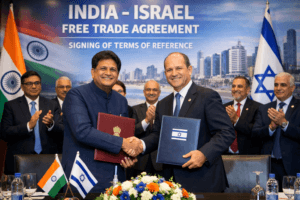
The delegation engaged deeply with Israel’s innovation ecosystem. Key events included the Israel-India Business Forum, which facilitated hundreds of B2B meetings, and a CEO Forum with both ministers. The delegation visited Israeli companies at the forefront of autonomous mobility, artificial intelligence, cybersecurity, and advanced manufacturing. The most concrete outcome was the signing of the Terms of Reference (TOR) for the India-Israel Free Trade Agreement by Ministers Goyal and Nir Barkat, formally resuming long-paused negotiations.
Table: Key Sectors Represented in the India-Israel Business Engagement
| Sector | Examples of Cooperation/Interest |
| Agriculture & Water Tech | Centers of Excellence (CoEs), Villages of Excellence (VoEs), water management plans. |
| Defense & Security | Historical arms supply, “Make-in-India” collaborations. |
| High-Tech & Innovation | AI, cybersecurity, autonomous vehicles, joint R&D through the I4F fund. |
| Pharmaceuticals & Life Sciences | Acquisitions (e.g., Sun Pharma’s merger with Taro), joint ventures. |
| Infrastructure & Trade | Haifa Port acquisition by Adani, FTA negotiations. |
The Economic Backdrop: A Deepening Partnership
This historic delegation did not emerge in a vacuum but is the latest milestone in a rapidly expanding economic relationship. Since establishing full diplomatic relations in 1992, bilateral trade (excluding defense) skyrocketed from $200 million to a peak of $10.77 billion in the 2022-23 fiscal year. Although trade declined to $6.53 billion in 2023-24 and $3.75 billion in 2024-25—attributed to the “regional security situation and trade route disruption”—the foundational ties remain strong.
Investment flows tell a similar story of deepening integration. Cumulative Indian investment in Israel reached $443 million by April 2025, marked by significant acquisitions like the Adani-led consortium’s $1.18 billion purchase of Haifa Port. Major Indian firms like TCS, Sun Pharma, Infosys, and the Tata Group have established a firm presence in Israel, often investing directly in its startup ecosystem. Conversely, over 300 Israeli investments exist in India, focusing on high-tech, agriculture, water management, and homeland security.
Historical Context: From Rhetorical Solidarity to Strategic Alignment
To understand the significance of this business push amid controversy, one must examine India’s historical foreign policy shift. For decades after independence, India positioned itself as a leader of the Global South and a vocal supporter of the Palestinian cause, with its stance “rooted in anti-imperialist solidarity”. Figures like Mahatma Gandhi and Jawaharlal Nehru expressed sympathy for Jewish suffering but were ambivalent or opposed to the Zionist political project.
A decisive turn began in 1992 with the establishment of full diplomatic relations, driven by post-Cold War realignments and India’s economic liberalization. Collaboration grew steadily, but analysts note a significant acceleration under the BJP-led governments, particularly since Prime Minister Narendra Modi’s election in 2014. Critics argue this reflects an ideological kinship between Hindutva (the governing ideology) and Zionism, viewing both as forms of nationalism that marginalize Muslim minorities within their respective contexts. This shift has moved India from a posture of symbolic support for Palestine to one of open and deepening collaboration with Israel, even during periods of intense conflict.
Domestic Criticism and the Muffling of Dissent
The Indian government’s decision to enhance economic ties during the Gaza war has not gone unchallenged domestically, though the criticism appears constrained. The parliamentary question itself reflects this concern, asking whether the government faced criticism for the timing of the delegation. The government’s official response was concise, sidestepping the criticism to reaffirm that “India and Israel are Strategic Partners” and the visit aimed to strengthen cooperation.
Beyond parliament, the space for protest has narrowed. Reports indicate that since October 2023, pro-Palestine solidarity protests across India have been routinely denied permission or dispersed. Symbolic acts like displaying the Palestinian flag or wearing a keffiyeh have been treated as subversive. A stark example of this perceived suppression occurred when the federal government denied permission to screen several films about Palestine at an international film festival in Kerala. Political analyst Achin Vanaik describes this as part of a “systematic and behind-the-scenes determination” to marginalize pro-Palestine voices, stemming from ideological alignment rather than Israeli pressure.
This domestic environment contrasts sharply with the significant public demonstrations seen in many Western nations. Of the 41 parties in India’s Lok Sabha, 31 have remained silent on the Gaza conflict since October 2023, a silence some attribute to fears of being seen as engaging in “Muslim appeasement” by a majority Hindu electorate.
The International Arena: India’s Diplomatic Balancing Act
The business delegation’s arrival coincided with a period of intense international scrutiny of Israel. Just weeks before the visit, in October 2025, the International Court of Justice (ICJ) issued an advisory opinion reaffirming Israel’s binding obligations as an occupying power to facilitate humanitarian relief in Gaza. A UN Special Rapporteur report published around the same time was titled “Gaza Genocide: a collective crime”.
In December 2025, the UN General Assembly overwhelmingly passed a resolution—139 votes in favor, 12 against—demanding Israel allow unrestricted humanitarian aid into Gaza. This global stance highlights the diplomatic context in which India chose to deepen economic ties. Furthermore, at least 12 countries from the Global South, including Bolivia, Colombia, South Africa, and Malaysia, had committed to various forms of embargoes, port bans, and trade reviews against Israel.
India’s official statements during this period have been characterized by extreme caution. After Israel broke a ceasefire in March 2025, India’s statement avoided any direct criticism, instead emphasizing the need for humanitarian assistance. Notably, while India has ratified the Genocide Convention, it has refrained from supporting or commenting on South Africa’s case against Israel at the ICJ. This careful, criticism-averse diplomacy stands in contrast to the stronger language used by traditional Israeli allies like the UK, France, and Canada, who called Israeli operations “wholly disproportionate” and threatened “concrete actions”.
Analysis: Deciphering India’s Strategic Calculus
India’s push for an FTA with Israel during the Gaza war is a multifaceted strategic decision. Economically, it seeks access to cutting-edge technology in agriculture, water, defense, and digital systems—areas where Israeli innovation can address critical Indian needs like food security and resource management. The FTA also aims to reverse recent trade declines and lock in long-term supply chains.
Geopolitically, strengthening ties with Israel reinforces India’s relationship with the United States, for which Israel is a key ally. It also fits a broader pattern of India moving away from its non-aligned past toward more explicit strategic partnerships based on mutual interest.
Perhaps most significantly, the move reflects a pragmatic, interest-driven foreign policy that deliberately decouples economic and strategic engagement from humanitarian and human rights criticisms of a partner nation. The government’s response to parliamentary criticism—“India and Israel are Strategic Partners”—is a tacit acknowledgment that the relationship’s strategic value outweighs the diplomatic cost of global condemnation.
Conclusion: The New Geometry of Global Partnerships
India’s unprecedented business delegation to Israel in late 2025 is more than a trade mission; it is a defining statement of foreign policy priorities. It demonstrates a calculated willingness to advance core national interests in technology, trade, and security, even when such advancement strains traditional diplomatic positions and invites criticism. This represents a decisive move from the rhetorical idealism of the post-colonial era toward a hardened realpolitik, where strategic and economic imperatives frequently take precedence.
The delegation underscores a global trend where economic partnerships are increasingly insulated from geopolitical disputes. For India, the strategic calculus is clear: the benefits of a deeper alliance with a technologically advanced partner like Israel are deemed essential for its own development and security, outweighing the pressures of international condemnation. As the world grapples with complex conflicts, the India-Israel model may signal a future where global relations are governed less by shared values and more by the cold arithmetic of mutual interest.
You must be logged in to post a comment.