
India’s Strategic Gamble in the US-China Tech War
The intensifying US-China tech rivalry, centered on control of semiconductors and AI, has created a strategic opening for India, transforming it from a bystander into a critical player. India is leveraging its unique advantages—a vast, skilled talent pool, geopolitical neutrality, and a massive domestic market—to attract global investment, notably in semiconductor fabrication and Global Capability Centers.
However, this opportunity carries significant risk: India must carefully navigate between competing blocs to avoid over-reliance and transition from being a backend for innovation to controlling its own technological destiny through domestic R&D, intellectual property creation, and strategic policy that ensures it evolves into a self-determining tech power rather than remaining a dependent service provider.
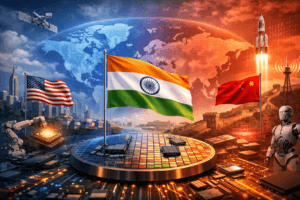
India’s Strategic Gamble in the US-China Tech War
The intensifying rivalry between the United States and China over foundational technologies like artificial intelligence (AI) and semiconductors has fractured the global tech ecosystem. In this landscape of strategic decoupling, India is no longer a bystander but is actively positioning itself as an indispensable, neutral hub. The nation is leveraging its unique advantages to transform geopolitical friction into a historic opportunity for economic and technological ascendancy.
The Geopolitical Catalyst: A World Forced to Choose
The US-China conflict has evolved beyond trade tariffs into a systemic competition over the technologies that will define the 21st century. Foundational technologies like advanced chip fabrication and AI models are now treated as national security assets, not merely commercial products. The US strategy combines massive domestic investment—such as the CHIPS Act—with stringent export controls designed to limit China’s access to the most advanced technologies.
China’s response has been a relentless push for self-sufficiency, pouring over $150 billion into its semiconductor industry and leveraging initiatives like the Digital Silk Road to build global tech dependencies. This bifurcation forces global companies to restructure supply chains, relocate R&D centers, and often choose sides. The resulting fragmentation has created gaps in the global supply chain for reliable, scalable, and geopolitically “safe” tech production—a gap India is uniquely qualified to fill.
India’s Semiconductor Play: Building from the Ground Up
India’s most ambitious bet is on creating a domestic semiconductor ecosystem. Historically strong only in chip design, the country is now making a concerted push into manufacturing—a sector of immense complexity and capital intensity.
Strategy and Key Projects
India’s approach, orchestrated by the India Semiconductor Mission (ISM), is pragmatic. It focuses initially on Assembly, Testing, Marking, and Packaging (ATMP) and the fabrication of mature or “legacy” chips (28nm to 110nm), which power the vast majority of consumer electronics, automobiles, and industrial equipment.
Table: Key Semiconductor Projects Under India’s Mission
| Company/Consortium | Project Type & Location | Key Partner/Technology | Status & Focus |
| Tata Group & PSMC | Foundry (Fabrication) in Gujarat | Taiwan’s Powerchip Semiconductor Manufacturing Corp. | $11bn project; Focus on 28nm-110nm chips; Potential customer: Intel. |
| Tata Electronics | OSAT Plant in Assam | In-house technology | $3.3bn investment; Assembly, testing, and packaging. |
| Micron Technology | ATMP Unit in Gujarat | In-house technology | $2.7bn investment; First major foreign investment, seen as a validation of India’s ecosystem. |
| Kaynes Semicon | ATMP Unit | Japanese & Malaysian partners | Shipped first batch of chip modules in Oct 2025; First such export from India. |
Unlike China’s more insular, self-reliance-driven model, India’s strategy is explicitly outward-looking and partnership-based. It aims to attract “anchor firms” like Micron, whose presence brings entire supplier ecosystems. The federal government provides the core incentives, while states like Gujarat, Tamil Nadu, and Assam compete to offer additional benefits, creating a dynamic, competitive environment for investment.
The Steep Climb Ahead
Despite the momentum, the challenges are formidable. India’s $10 billion incentive package is dwarfed by the $53 billion US CHIPS Act and China’s even larger investments. Projects face delays due to infrastructure hurdles and complex execution. Furthermore, to move beyond mature nodes to cutting-edge fabrication (e.g., 3nm chips), India will inevitably need deeper technology partnerships, likely with American or East Asian leaders. Experts warn that the window for such partnerships is narrow and requires a consistently improving business environment.
The Talent Equation: India’s Core Strength and Double-Edged Sword
India’s most potent asset in this tech war is its human capital. The country is the world’s largest exporter of high-skilled STEM and AI talent. Universities like Jawaharlal Nehru Technological University are among the top global producers of mobile AI professionals.
The Global Talent Re-Shuffle
The global movement of highly skilled talent is slowing due to geopolitical uncertainty and tighter immigration policies in traditional hubs like Canada and the UK. However, the competition for top-tier STEM and AI talent is intensifying, with the US strengthening its position as the top destination and new hubs like the UAE rising rapidly.
For India, this presents a dual dynamic:
- As a Talent Exporter: Indian engineers constitute about 20% of the global chip design workforce, and its diaspora holds influential positions worldwide. This creates a powerful global network.
- As a Talent Destination: India is itself seeing increased inflows of skilled professionals. The rapid growth of Global Capability Centres (GCCs) for multinationals and domestic R&D hubs is transforming cities like Bengaluru and Hyderabad, creating a more compelling reason for talent to stay or return.
The critical test for India is to transition from being the “world’s back office” for innovation to controlling the intellectual property and strategic outcomes. This requires moving its vast talent pool from executing foreign-designed projects to leading indigenous R&D and creating foundational IP.
The AI Frontier: A Different Kind of Battlefield
The AI rivalry adds another layer. The US and China are pursuing starkly divergent strategies, and India is carving out a distinct, value-based path.
Table: Contrasting AI Strategies & India’s Path
| Aspect | United States’ Approach | China’s Approach | India’s Emerging Path |
| Core Philosophy | Deregulation, unfettered innovation, and maintaining a full-stack technology lead. | Governance-first, using multilateral partnerships to set global standards and ensure market penetration. | Pro-innovation governance, leveraging existing laws and focusing on domestic capacity in models, data, and compute. |
| Global Posture | Inward-focused capacity building, coupled with export controls on adversaries. | Outward-focused, offering tech assistance to the Global South to build dependencies and win markets. | Sovereignty-respecting partnerships. Exporting its Digital Public Infrastructure model as “frugal innovation” for the Global South. |
| Key Example | The 2025 AI Action Plan focuses on innovation, infrastructure, and security. | Proposing a global AI cooperation organization and leveraging Belt and Road Initiative networks. | Developing tools like Kompact AI (IIT Madras), which allows LLMs to run on local computers, suited to developing nations. |
India’s AI strategy seeks to avoid the dependency-creating models of both superpowers. By offering scalable, adaptable, and sovereign solutions, it aims to position itself as a trusted leader for the Global South—a vast, untapped market where it can compete on value and relevance rather than just technological brute force.
Navigating the Tightrope: Risks and the Path Forward
India’s opportunistic stance is not without significant peril. The primary risk is over-reliance and middleman dependency. There is a danger that India becomes a “backend for innovation,” providing talent and execution but lacking control over core IP, standards, and high-value segments of the tech stack.
To avoid this, India must:
- Double Down on Strategic Autonomy: Continue building domestic capacity in semiconductor manufacturing and AI infrastructure, even if starting with mature technologies. Control over data and hardware is foundational.
- Master the Balancing Act: Maintain strategic partnerships with both blocs without becoming overly aligned with either. This includes engaging with US firms for high-tech partnerships while cautiously managing relations with China.
- Invest in Next-Generation IP: Move beyond services to create original intellectual property. This means funding ambitious R&D in areas like electronic design automation (EDA) tools or novel chip architectures for emerging markets.
- Leverage the Diaspora Strategically: Transform the brain drain into a “brain chain,” using the global Indian diaspora as bridges for knowledge, investment, and partnership.
The US-China tech war has undeniably handed India a generational opportunity. The nation has successfully moved from the periphery to a position where its scale, talent, and geopolitical neutrality are in global demand. However, the transition from a critical service provider to a self-determining tech superpower is still underway. The outcome hinges on whether Indian policymakers and corporate leaders can convert this moment of tactical advantage into sustained, long-term strategic capability. The world is not just outsourcing work to India; it is watching to see if India can build a technological future of its own design.
You must be logged in to post a comment.