
India’s Strategic Gambit: How ONGC’s Creative Deal Secures Its Russian Energy Future
India’s ONGC has secured a creative financial workaround to maintain its critical 20% stake in Russia’s Sakhalin-1 oil and gas project, leveraging approximately $800 million in frozen dividends that Indian state companies could not repatriate due to Western sanctions. By obtaining a loan from these trapped funds, ONGC Videsh will make a required contribution to the project’s abandonment fund in Russian rubles, a move specially approved by Moscow.
This maneuver, finalized around President Vladimir Putin’s December 2025 visit to New Delhi, exemplifies India’s determination to protect its strategic energy assets in Russia while navigating intense U.S. pressure to reduce economic ties. It underscores a broader strategy of geopolitical balancing, as India continues to be a major buyer of discounted Russian crude—accounting for 38% of Russia’s exports in October 2025—to fuel its economy, even as it seeks to manage relations with Western allies.
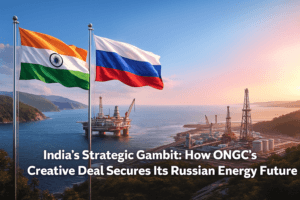
India’s Strategic Gambit: How ONGC’s Creative Deal Secures Its Russian Energy Future
A financial maneuver with frozen dividends reveals New Delhi’s determination to maintain influence in Russia’s energy sector despite Western sanctions
In a move that demonstrates both financial ingenuity and geopolitical pragmatism, India’s Oil and Natural Gas Corporation (ONGC) has devised a creative solution to maintain its critical stake in Russia’s Sakhalin-1 oil and gas project. By leveraging approximately $800 million in frozen dividends to make a required contribution to the project’s abandonment fund, ONGC has navigated the treacherous waters of Western sanctions to preserve its 20% interest in one of Russia’s most significant energy assets. This development, emerging during Russian President Vladimir Putin’s first visit to New Delhi since 2022, reveals India’s determined balancing act between its historical energy partnership with Russia and its strategic relationship with the United States.
The Sakhalin-1 Chessboard: A History of Strategic Realignment
The Sakhalin-1 project, located off Russia’s eastern coast, has undergone dramatic ownership transformations since Russia’s invasion of Ukraine in February 2022. Originally operated by American energy giant ExxonMobil, the project saw its foreign operators depart as Western companies withdrew from Russia en masse. In October 2022, President Putin issued a decree that effectively seized control of the project, placing ownership decisions in the hands of the Russian government.
The subsequent ownership reshuffle saw Russia allocate a 20% stake in the newly structured operator to ONGC Videsh (the overseas investment arm of ONGC) and 30% to Japan’s SODECO (Sakhalin Oil and Gas Development Company), which comprises Japanese firms including Itochu, Marubeni, and Japan Petroleum Exploration Co.. This restructuring was part of Moscow’s broader effort to retain foreign investment from “friendly” countries while excluding Western participation.
The Sakhalin-1 Ownership Evolution
| Time Period | Key Operators/Stakeholders | Notable Changes |
| Pre-2022 | ExxonMobil (operator, 30%), SODECO (Japanese consortium, 30%), ONGC Videsh (20%), Rosneft (20%) | Traditional international partnership |
| October 2022 | Russian government takes control | Putin decree seizes project, foreign rights determined by Russian authorities |
| Post-Restructuring | Rosneft subsidiary (operator), ONGC Videsh (20%), SODECO (30%), Russian entities (remainder) | Foreign participation limited to “friendly” nations |
A pivotal development occurred in August 2025 when Putin signed a decree allowing foreign investors to regain shares in Sakhalin-1, though with significant conditions attached. The decree stipulated that foreign shareholders must support lifting Western sanctions, conclude contracts for necessary foreign-made equipment, and transfer funds to Sakhalin-1 accounts. It was this last requirement that presented both a challenge and opportunity for ONGC’s stake retention efforts.
The Rubles-for-Dividends Solution: Creative Sanctions Navigation
The core of ONGC’s innovative approach lies in using trapped financial assets to meet Russian requirements. Due to Western sanctions imposed after Russia’s invasion of Ukraine, ONGC Videsh and other Indian state companies have been unable to repatriate approximately $800 million in dividends from their stakes in Russian energy assets. This financial limbo created a paradoxical situation where Indian companies owned valuable assets but couldn’t access the returns.
Ahead of Putin’s December 2025 visit to New Delhi, Indian state-run companies agreed to provide ONGC Videsh with a loan from these stuck dividends, creating a mechanism to fund the required contribution to Sakhalin-1’s abandonment fund. The abandonment fund, essential for decommissioning activities that ensure wells are properly sealed without environmental harm, represents a critical financial commitment for project stakeholders.
Moscow granted special permission for ONGC Videsh to make this contribution in Russian rubles using the pending dividends. This arrangement solved multiple problems simultaneously: it allowed India to utilize frozen assets, enabled Russia to secure necessary funding in its currency, and preserved a strategic energy partnership between the two nations.
The Broader Energy Context: India’s Delicate Balancing Act
ONGC’s Sakhalin-1 maneuvering occurs against the backdrop of significant shifts in India-Russia energy relations. Since the imposition of Western sanctions, India has emerged as Russia’s second-largest crude oil customer after China. In October 2025 alone, India purchased 38% of Russia’s crude exports. This relationship has been economically beneficial for both nations: India has secured discounted fuel for its rapidly growing economy, while Russia has found a reliable market for exports displaced from Europe.
However, this arrangement has faced increasing pressure from the United States. In October 2025, the Trump administration sanctioned two of Russia’s largest oil companies, Rosneft and Lukoil. This followed an August 2025 decision to impose a 25% tariff on India for buying Russian oil. The U.S. has publicly criticized New Delhi for purchases it claims are funding Russia’s war machine.
India’s Strategic Energy Imports (October 2025)
| Import Source | Approximate Volume | Strategic Significance |
| Russian crude | 38% of Russia’s exports | Discounted pricing, reliable supply |
| U.S. energy | 2.2 million tonnes LPG annually | Geopolitical balancing, diversification |
| Middle Eastern crude | Increased volumes | Traditional supply source, higher cost |
| Alternative sources (Guyana, Brazil) | Exploring options | Diversification efforts |
Putin directly addressed this pressure during his India visit, questioning why the U.S. could purchase nuclear fuel from Russia for its own power plants while criticizing India for doing the same with oil. “If the U.S. has the right to buy our fuel, why shouldn’t India have the same privilege?” Putin asked in an interview with an Indian television channel.
The Russian president emphasized Moscow’s willingness to provide “uninterrupted shipments of fuel” to India, describing Russia as a reliable supplier of “oil, gas, coal and everything that is required for the development of India’s energy”.
Adapting to Sanctions: The Emergence of New Trading Pathways
The sanctions on Rosneft and Lukoil, which together handled approximately half of Russia’s total oil exports (around 2 million barrels daily), initially prompted a reduction in Indian purchases. However, the energy trade has proven resilient, adapting through various workarounds.
Indian refiners have begun sourcing Russian crude from non-sanctioned companies, with Bharat Petroleum Corp. and Indian Oil Corp. purchasing Urals crude for January 2025 delivery from entities other than Rosneft and Lukoil. These cargoes feature discounts of $6-$7 to Brent crude, maintaining the economic incentive for Indian buyers.
Data from Goldman Sachs reveals that while oil flows from Rosneft and Lukoil dropped by approximately 1 million barrels daily after sanctions took effect in November 2025, flows from non-sanctioned Russian companies to international clients increased by half a million barrels daily during the same period. This redistribution demonstrates the adaptive nature of global energy markets in response to geopolitical constraints.
New trading intermediaries with names like Eastimplex Stream FZE, Grewale Hub FZE, and Tyndale Solutions FZE have appeared on port reports as shippers of Russian crude into India’s Vadinar port. Industry analysts predict that Indian refiners may increasingly adopt strategies like shadow carriers and ship-to-ship transfers to balance geopolitical and economic considerations.
The Summit Outcome: Formalizing Energy Cooperation
The 2025 India-Russia annual summit produced tangible outcomes for energy cooperation. A joint statement issued after the meeting between Prime Minister Narendra Modi and President Putin noted “the importance of expeditious resolution of issues related to investment projects in this area”. Both sides agreed to resolve various concerns faced by their investors in the energy sector.
This formal commitment at the highest political level provides crucial support for ONGC’s position in Sakhalin-1 and other Indian energy investments in Russia. Beyond Sakhalin-1, Indian energy companies have significant exposure in Russia, including:
- A 26% stake in CSJC Vankorneft, owner of the Vankor Field and North Vankor licence
- A 29.9% stake in LLC Taas-Yuryakh held by a consortium of Indian Oil Corp., Oil India, and Bharat PetroResources
- Imperial Energy Corp. with 10 exploration and production licence blocks in western Siberia
The energy partnership has driven bilateral trade to record levels, reaching $68.7 billion in 2024-25—nearly seven times pre-pandemic levels of $10.1 billion. Energy imports from Russia accounted for the vast majority of this trade, with India importing $63.84 billion worth of products in the last fiscal year, mainly crude oil.
Future Implications: A Test of Geopolitical and Market Forces
The ONGC-Sakhalin arrangement represents more than a clever financial workaround—it embodies the complex interplay of energy security, economic pragmatism, and geopolitical positioning that defines contemporary international relations. Several key implications emerge from this development:
- Sanctions Resilience: The deal demonstrates that targeted financial sanctions can be circumvented through creative financial engineering, particularly when both parties have mutual interests in maintaining economic relationships.
- Currency Diversification: The use of rubles for the abandonment fund contribution reinforces Russia’s efforts to de-dollarize its energy trade and promote ruble settlement for international transactions.
- Strategic Autonomy: India’s determination to preserve its Sakhalin-1 stake reflects its commitment to strategic autonomy in energy policy, despite pressure from Western allies.
- Investment Protection: The arrangement showcases how countries can collaborate to protect existing investments in politically sensitive environments, potentially establishing a model for other nations facing similar challenges.
- Environmental Responsibility: By ensuring contributions to the abandonment fund, the deal maintains environmental safeguards for decommissioning, addressing ecological concerns even amid geopolitical tensions.
As global energy markets continue to fragment along geopolitical lines, the ONGC-Sakhalin precedent may inform how other nations navigate the competing demands of energy security, alliance politics, and economic interests. The arrangement suggests that while sanctions can alter trade patterns and increase transaction costs, they rarely completely sever mutually beneficial economic relationships, especially in strategically vital sectors like energy.
India’s delicate balancing act continues as it simultaneously cultivates its “special and privileged strategic partnership” with Russia while seeking to avoid “incurring Washington’s wrath and sabotaging an imminent trade deal” with the United States. The creative solution to preserve ONGC’s Sakhalin-1 stake demonstrates that in the complex calculus of global energy politics, necessity remains the mother of invention, and national interest ultimately dictates the terms of engagement.
You must be logged in to post a comment.