
India’s Strategic Flour Export Shift: Reclaiming Global Markets After Three Years
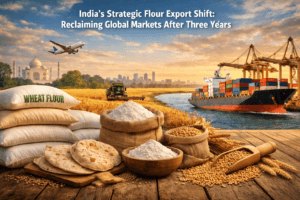
India’s Strategic Flour Export Shift: Reclaiming Global Markets After Three Years
India’s decision to allow 500,000 metric tonnes of wheat flour exports marks a pivotal, strategic re-entry into the global grain market after a nearly three-year hiatus. This measured reopening is not just a routine trade adjustment; it is a calculated move driven by record domestic stocks and robust harvests, signalling a potential transformation of India’s agricultural sector from a domestically focused endeavor into a strategic global power player. The move promises to stabilize domestic prices, rejuvenate the milling industry, and allow India to reclaim its position in traditional markets across Africa, the Gulf, and South Asia.
From Ban to Bumper Crop: The Context Behind the Policy Shift
To understand the significance of this export allowance, one must revisit the circumstances that led to the original ban. In May 2022, the Indian government imposed a sudden and comprehensive ban on wheat exports. This decision was a direct response to a severe heatwave that crimped domestic production, leading to soaring local prices and acute concerns over national food security. At the time, global supply chains were already reeling from the Russia-Ukraine war, which disrupted nearly a quarter of the world’s wheat exports. India’s ban, following Prime Minister Narendra Modi’s earlier statements about “feeding the world,” drew international criticism and was seen as a blow to its credibility as a reliable supplier.
However, the agricultural landscape has dramatically improved since then. Key indicators now paint a picture of abundance:
- Record-Breaking Stocks: Government wheat stocks have swelled to approximately 30.46 million tonnes, significantly above the buffer norm of 20.52 million tonnes required for January 2026.
- Strong Production Outlook: The agriculture ministry projects wheat output at a record 117.5 million tonnes for the 2024-25 crop year, a 3.7% increase over the previous year.
- Favourable Sowing Data: Planting for the current season is progressing rapidly, with sown area already up significantly year-on-year, supported by surplus monsoon rains.
- Controlled Inflation: Wheat inflation has eased substantially, falling to 2.04% year-on-year in October 2025 from 3.67% in September, alleviating domestic price pressures.
This comfortable supply position created a compelling argument for industry bodies like the Roller Flour Millers’ Federation of India, which lobbied the government to ease restrictions, arguing that controlled exports would help reclaim lost markets without jeopardizing domestic needs.
More Than a Commodity: The Strategic and Economic Rationale
The export of 500,000 tonnes of wheat flour, as opposed to raw wheat, is a nuanced policy choice with layered benefits.
- A Strategic Re-engagement with Global MarketsFor nearly three years, traditional importers of Indian wheat products like flour (atta), refined flour (maida), and semolina (sooji) have turned to alternative suppliers such as Pakistan, Nepal, and Bangladesh. Some Indian companies were even forced to set up milling units in the Middle East and Canada to serve the diaspora. This export allowance is a first step towin back these markets. As noted by industry president Navneet Chitlangia, it enables the Indian milling industry to resume its presence where Indian atta is “valued for its authentic flavour and high quality”.
- Stabilizing the Domestic EcosystemAllowing exports acts as a pressure valve for the domestic market. With a new harvest expected from mid-March 2026, releasing surplus stock into the international market helpsprevent a domestic price crash that would hurt farmers. Simultaneously, it improves capacity utilization in the milling sector, which has been operating below potential due to the ban. The recent lukewarm response to the Food Corporation of India’s (FCI) open market sales scheme, where only 69,000 tonnes of an offered 0.2 million tonnes were sold, indicates limited domestic bulk demand, further justifying an export channel.
- The “Power-Lifter” Potential of Agri-ExportsThis move aligns with a broader vision, as discussed in analyses of India’s economic strategy, of transforming agriculture into astrategic growth engine. In an era of geopolitical fragmentation and reconfiguring supply chains, reliable food suppliers gain strategic influence. By exporting processed flour instead of raw wheat, India captures more value within its own economy, supporting jobs in milling, packaging, and logistics. This echoes lessons from other Indian export sectors, like seafood, which thrived after diversifying markets and focusing on value addition.
Table: India’s Key Wheat Flour Varieties and Their Global Appeal
| Flour Type (Common Name) | Technical Classification | Ideal Culinary Uses | Key Characteristic for Export |
| Atta | Whole wheat flour | Traditional flatbreads (Rotis, Chapatis) | High protein/fiber content; staple for diaspora |
| Maida | Refined wheat flour | Cakes, biscuits, pastries, noodles | Low protein; creates soft textures |
| Sooji/Rawa | Semolina | Pasta, couscous, upma, desserts | Coarse texture, high gluten strength |
| Sharbati Atta | Specific variety of whole wheat | Premium breads and rotis | High-protein wheat from central India |
Navigating the Export Process: A Guide for International Buyers
For global buyers looking to source from India, understanding the regulatory and quality landscape is crucial. The process is designed to ensure reliability and safety.
Essential Certifications and Compliance: Any reputable export deal must begin with verification. Buyers should ensure their Indian exporter is registered with the Agricultural and Processed Food Products Export Development Authority (APEDA) and possesses a valid FSSAI (Food Safety and Standards Authority of India) license. The most critical document is the Export Inspection Council (EIC) certificate, a government-mandated quality guarantee that ensures the shipped consignment matches the approved samples in parameters like moisture, gluten, and pesticide residues.
Logistics and Packaging: Wheat flour is highly susceptible to moisture. Reputable exporters use multi-layer, moisture-proof polypropylene (PP) or jute bags (typically 25kg or 50kg) to prevent spoilage during long sea voyages. India’s major west coast ports, such as Mundra and Kandla, are primary gateways for such shipments. Under normal conditions, shipment can be arranged within 10-20 days of order confirmation.
Cost Considerations: The total landed cost involves more than just the per-tonne price. Buyers must account for:
- FOB (Free On Board) Price: The cost of the flour loaded onto the ship, influenced by domestic Minimum Support Price (MSP) trends.
- Freight Charges: Variable costs depending on the destination.
- Inspection Fees: A small mandatory fee for EIC testing, which is essential to prevent costly rejections at the destination port.
The Global Landscape and Future Trajectory
India’s re-entry occurs in a complex global wheat market. While Russia, Australia, and Canada dominate global wheat exports, the market for processed flour has its own dynamics. Turkey and Ukraine are among the top global wheat flour exporters. India’s return adds a significant, quality-competitive player to this mix.
The initial allowance of 500,000 tonnes is likely a testing of the waters. It is half of the 1 million tonne quantity initially proposed by the Food Ministry. The government’s cautious approach underscores its primary commitment to domestic food security, a point repeatedly emphasized by Food Minister Pralhad Joshi. The performance of these initial exports—their impact on domestic prices, their reception in international markets, and the smoothness of logistical chains—will heavily influence future policy.
Looking ahead to Budget 2026-27, there are calls for the government to treat agriculture as an “investment-led growth engine” rather than just a welfare sector. Strategic investments in agri-logistics (cold chains, modern warehouses), support for food processing clusters, and, most importantly, a commitment to predictable and stable export policies are seen as essential to fully unlock the sector’s potential. Unpredictable policy swings, as seen in 2022, erode the trust of both international buyers and domestic investors.
Conclusion: A Calculated Step in a Long-Term Strategy
India’s decision to permit limited wheat flour exports is a multifaceted development. It is a direct response to improved domestic supply, a tactical move to regain lost global market share, and a potential precursor to a more robust, export-oriented agricultural strategy. For the world, it means the return of a reliable supplier of high-quality wheat products. For India, it represents an opportunity to enhance farmer incomes, stabilize domestic markets, and leverage its agricultural prowess for greater strategic and economic influence. The success of this calibrated opening will depend on sustained high production, efficient logistics, and, above all, a policy framework that balances global ambition with unwavering domestic food security.
You must be logged in to post a comment.