
India’s Strategic Crossroads: The Geopolitical Message of Pax Silica and the Quest for Tech Self-Reliance
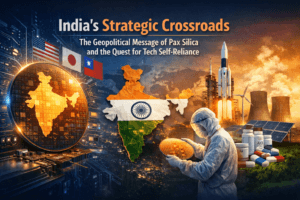
India’s Strategic Crossroads: The Geopolitical Message of Pax Silica and the Quest for Tech Self-Reliance
The recent formation of Pax Silica, a U.S.-led alliance to secure semiconductor supply chains for the AI era, marks a definitive redrawing of the global techno-geopolitical map. The alliance’s deliberate exclusion of India, a key Quad partner, is more than a diplomatic snub; it is a stark revelation of how the world’s leading democracies perceive India’s place in the high-stakes technology hierarchy. This moment forces a critical examination of India’s profound dependencies across foundational sectors and the urgent, monumental task of building genuine technological sovereignty.
The Geopolitical Snub: Why India Was Left Out
The Pax Silica alliance is engineered as a pact of trust and capability, uniting nations with existing technological leadership and sovereign control over critical supply chains. India’s absence stems from a clear-eyed U.S. assessment that India currently represents strategic potential, not actionable capability. This calculus is rooted in several hard realities:
- Persistent Dependencies: A core goal of Pax Silica is to eliminate “forced dependence,” particularly on China. India, however, remains deeply enmeshed in the dependencies the alliance seeks to circumvent. For instance, it relies on China for 50-100% of most minerals on its own critical list and imports nearly 40% of its electronic components from China.
- The “Goldilocks” Dilemma: U.S. strategy appears to seek a “Goldilocks India”—a nation strong enough to act as a counterweight to China in the Indo-Pacific, but not so technologically empowered that it could evolve into a future rival in foundational technologies like semiconductors and AI. Granting India access to a core tech alliance risks accelerating its ascent to an undesired extreme.
- Strategic Multi-Alignment: India’s cherished policy of “strategic autonomy,” manifested in its strong defense ties with Russia and active participation in China-influenced forums like BRICS+, creates wariness in Washington. Pax Silica requires tight, predictable coordination on export controls and technology security, a level of alignment that contrasts with India’s independent foreign policy stance.
A Sector-by-Sector Analysis of Strategic Vulnerability
India’s exclusion from Pax Silica is a symptom of a broader condition of dependence. The following table summarizes critical vulnerabilities and ongoing national responses across key strategic sectors:
| Sector | Core Vulnerability & Scale | Key National Initiative & Investment | Stated Goal / Timeline |
| Semiconductors | Near-total import dependence; market projected at $45-50B in 2025. | India Semiconductor Mission (ISM); $9.2B corpus. Major fab investments (e.g., Tata-PSMC: $11B). | Establish end-to-end ecosystem; claim share of $1T global market by 2030. |
| Pharmaceuticals | ~70-80% dependence on China for Active Pharmaceutical Ingredients (APIs). For some antibiotics, exceeds 97%. | Production-Linked Incentive (PLI) schemes for bulk drugs. 32 API projects completed as of 2024. | Reduce import dependence and build API self-sufficiency. |
| Quantum Computing | Nascent stage; significant gap in qubit scale (India: 7-64 qubits vs. IBM: 1,121; China: 504). | National Quantum Mission (NQM); $730M (₹6,003 Cr) from 2023-31. | Develop 50-1000 physical qubit computers in 8 years. |
| Green Energy (EVs/Hydrogen) | >85% of lithium-ion batteries imported. Immature hydrogen ecosystem. | National Green Hydrogen Mission; $2.4B (₹19,744 Cr) initial outlay. Incentives for electrolyser & hydrogen production. | Produce 5M tons/year green hydrogen; become global export hub. |
| Nuclear Energy | Low capacity (7,938 MWe) meets just ~3% of electricity demand. Historical isolation and liability law hindered growth. | SHANTI Bill 2025 (enables private sector participation). Nuclear Energy Mission. | Achieve 100 GWe capacity by 2047. |
The Semiconductor Gambit: Building from Scratch
India’s semiconductor push is a colossal undertaking. While the Tata Group’s joint venture for a 50,000-wafer-per-month fab is a landmark, it must be contextualized against China’s 44 operational fabs. The strategy wisely spans the value chain—from design (where India has talent strength) to ATMP/OSAT facilities (like Micron’s plant in Gujarat) and upstream materials. However, moving from impressive investment announcements to stable, high-yield commercial production of leading-edge nodes remains an untested challenge.
The Pharmaceutical Paradox: “Pharmacy of the World” on a Fragile Foundation
India’s title as the world’s pharmacy masks a critical fragility. Its generic drug manufacturing empire is built on a vulnerable foundation of Chinese APIs and Key Starting Materials. During the COVID-19 pandemic, this dependence triggered export restrictions on essential drugs like paracetamol. The PLI scheme is a start, but building capital-intensive, environmentally compliant API capacity to compete with China’s entrenched scale and cost advantages is a decadal project.
The Quantum Leap: Playing Catch-Up in a New Frontier
In quantum technologies, the gap is not just in current capability but in the momentum of investment. China’s reported $15.3 billion public investment in quantum (2022) dwarfs India’s $1 billion National Quantum Mission outlay. India’s mission to develop intermediate-scale quantum computers (50-1000 qubits) by 2031 is a credible goal, but global leaders are already planning for the 100,000-qubit era by 2033. The mission’s focus on thematic hubs and startups is sound, but the resource gap is substantial.
Energy Security: Beyond Fossil Fuels
India’s energy vulnerabilities are multidimensional. Its electric vehicle ambitions are tethered to imported batteries. The National Green Hydrogen Mission is a visionary framework, but its success hinges on reducing the cost of electrolysis and building a massive renewable energy base for production. In nuclear power, the recent SHANTI Bill is a potential game-changer. By repealing restrictive older laws, it opens the door for private sector participation in building reactors and the fuel cycle, which is essential for meeting the audacious 100 GWe by 2047 target.
Forging a Path to Strategic Autonomy
The message from Pax Silica is unequivocal: in the 21st century, partnerships are contingent on capacity. For India to transition from a “country of potential” to a strategic technology power, several imperatives are clear:
- From Market to Maker: India must relentlessly focus on moving up the value chain from a premier consumption market to a co-creator of foundational technologies. This requires a cultural and policy shift that celebrates deep-tech manufacturing and R&D as much as software services.
- Decade-Long Financial Commitment: The scale of investment in China and the U.S. shows that winning in sectors like semiconductors and quantum requires sustained, massive capital. India’s mission-mode outlays are a beginning, but they must be the first tranche of a consistent, non-partisan financial commitment over multiple political cycles.
- Strategic Deregulation and Private Sector Mobilization: The SHANTI Bill for nuclear energy is a template for other sectors. Reducing red tape, clarifying liability, and incentivizing private capital—both domestic giants and global players—are essential to accelerate development.
- Smart and Focused International Collaboration: While Pax Silica’s door may be closed for now, India must pursue targeted bilateral collaborations (like the iCET with the U.S.) and attract technology transfer through its market power. Simultaneously, it can lead partnerships in the Global South for pharmaceutical and green energy supply chain resilience.
Ultimately, the exclusion from Pax Silica is not a permanent verdict but a pivotal opportunity for introspection and acceleration. The vision of an Atmanirbhar Bharat (Self-Reliant India) must evolve from a political slogan into an integrated, well-funded, and executed national mission. India’s journey to technological self-reliance is not merely an economic project; it is the fundamental prerequisite for securing its strategic autonomy in a fracturing world. The decade ahead will determine whether it can transform its profound vulnerabilities into pillars of enduring strength.
You must be logged in to post a comment.