
India’s Strategic Autonomy: Navigating a Fractured World Order Through Multi-Alignment
India’s foreign policy of multi-alignment represents a confident and deliberate strategy of strategic autonomy, where it maintains deep, historical defense and energy ties with Russia while simultaneously pursuing ambitious technology and security partnerships with the United States. This approach, rooted in economic resilience and a pragmatic rather than ideological view of partnerships, allows India to navigate a fractured global order without being constrained by any single bloc. By engaging with all major powers yet being beholden to none, India acts as an independent balancer, seeking to stabilize international relations through dialogue and complex interdependence, thereby asserting its role as a major global player defined by its own choices and national interest.
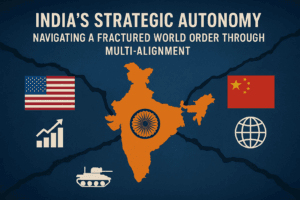
India’s Strategic Autonomy: Navigating a Fractured World Order Through Multi-Alignment
In an era of deepening geopolitical fractures, India is crafting a foreign policy doctrine that defies conventional alignment. Termed “multi-alignment” by its practitioners and analysts, this approach allows India to simultaneously deepen defense ties with Russia, expand technology partnerships with the United States, manage a complex rivalry with China, and build bridges across the Global North-South divide. Far from a sign of indecision, this strategy is a confident assertion of national interest and strategic autonomy, rooted in a unique blend of historical memory, economic resilience, and civilizational instinct for balance.
For India, this is not the Cold War’s non-alignment revisited but a pragmatic and agile framework for a multipolar world. It is the quiet architecture of a confident republic determined to stabilize a world that others have fractured, proving that in the 21st century, power is confirmed not by the camps one joins but by the choices one retains.
The Foundations of a Confident Strategy
India’s multi-alignment is built on a tripod of formidable strengths: a robust and growing economy, a vast demographic dividend, and a clear-eyed evolution of foreign policy doctrine.
- Economic Resilience and Domestic Growth: With a GDP of $4 trillion, India is the world’s fastest-growing major emerging economy. This growth is increasingly driven by resilient domestic demand and a dynamic base of micro, small, and medium enterprises (MSMEs), which account for nearly 30% of GDP and 45% of exports. This internal economic engine provides the foundational autonomy that allows India to engage with external partners from a position of strength, resisting pressure that would compromise its core interests.
- Demographic and Human Capital Power: India’s greatest global asset may be its people. With a median age of 29 and a labor force of 600 million, the country represents both a massive market and an unparalleled talent pool. This “reverse brain drain” is now attracting global businesses and talent back to India’s own “valleys,” fueling innovation and strengthening its hand in technology partnerships.
- From Non-Alignment to Strategic Autonomy: The contemporary policy has its roots in the Cold War doctrine of non-alignment but has undergone a significant evolution. Modern “strategic autonomy” is less an ideological stance and more a mutation of realism. It prioritizes self-sufficiency and independent decision-making, moving beyond non-alignment’s historical aversion to partnerships. The goal is to engage with all, but be beholden to none, ensuring that no single relationship can constrain India’s freedom of action.
Navigating the Core Strategic Triangles
The true test of India’s multi-alignment lies in managing its most critical and contradictory relationships.
| Relationship | Strategic Rationale & Benefits | Key Challenges & Tensions |
| India-Russia | Historical trust; reliable arms/energy supplier; UNSC veto power; continental counterbalance to China. | Russia’s growing dependency on China; Western sanctions complicating trade/defense; pressure to choose sides. |
| India-USA | Technology transfer & investment; cornerstone of Indo-Pacific strategy (via Quad); shared democratic values. | Transactional U.S. trade policy (tariffs); expectation of ideological conformity; risk of being “re-hyphenated” with Pakistan. |
| India-China | Major trading partner; engagement in BRICS/SCO; managed border disputes. | Massive trade deficit (~$100B); direct territorial disputes & rivalry; China’s “String of Pearls” encirclement in Indian Ocean. |
The Russia Equation: An Enduring, Yet Evolving, Partnership The trust with Russia was forged in decades of reliable support, including the sharing of critical defense technologies when few others would. Today, even as India diversifies its arms imports—with France now a leading supplier—Russia remains a crucial energy partner and a valued geopolitical counterweight, especially as China’s influence grows. However, this pillar is under strain. A Russia weakened by war and increasingly dependent on Beijing is losing its utility as an independent continental balancer, forcing India to recalculate.
The American Partnership: Ambition Tempered by Transactionalism The India-U.S. relationship has transformed into one of the most consequential of the century, centered on technology, defense manufacturing, and the Indo-Pacific Quad. Yet, it is increasingly tested by a transactional U.S. foreign policy. The Trump administration’s imposition of tariffs, its public comments on mediating India-Pakistan disputes, and a national security strategy framed around “Fortress America” have introduced profound uncertainty. For India, which fiercely guards its autonomy, any U.S. move that appears to equate it with Pakistan or treat it as a subordinate is deeply problematic.
The China Conundrum: Rivalry, Dependence, and Diplomacy China represents India’s most complex challenge: it is a long-term strategic rival, a major economic partner, and a competing leader of the Global South. The border remains contested, and China’s Belt and Road Initiative actively challenges India’s influence in its own neighborhood. India’s multi-alignment is, in many ways, a direct response to this threat, seeking to build a network of partnerships to avoid over-dependence on any single power, including China, for trade, technology, or security.
The Inherent Dilemmas and Future Tests
Multi-alignment is a high-wire act, and its success is not guaranteed. The strategy produces its own set of dilemmas:
- The Perception of Unreliability: By engaging deeply with competing blocs, India risks being viewed as an unreliable partner by all sides. Washington may question India’s commitment when it refuses to condemn Russia; Moscow may worry about its tilt toward the West.
- Strategic Overstretch: Juggling multiple high-stakes relationships requires immense diplomatic capital and can lead to conflicting obligations. For instance, U.S. sanctions on Russia create direct complications for India’s military maintenance and energy imports.
- The Domestic Foundation: The policy’s success is predicated on continued strong economic growth and social stability. Persistent challenges like the productivity gap of MSMEs and the need for deeper domestic reforms remain critical vulnerabilities.
The road ahead will be shaped by external shocks and internal resolve. A further deterioration in U.S.-China relations, a dramatic shift in the Ukraine war, or a severe economic downturn could force difficult choices. However, India’s current trajectory suggests it will double down on strategic autonomy, not abandon it. It will likely continue to diversify its partnerships—strengthening ties with middle powers in Europe, the Middle East, and Asia—while investing fiercely in domestic capabilities, from defense manufacturing to semiconductor production.
Conclusion: The Architect of a New Balance
India’s multi-alignment is more than a diplomatic tactic; it is a statement of civilizational identity in the modern world. It reflects a nation that is secure enough in its own trajectory to engage with the world on its own terms. In a global landscape where older powers are retreating into blocs or nationalism, India is attempting to craft a different model: one where dialogue prevails over coercion, and complex interdependence tempers outright rivalry.
This approach positions India not as a swing state waiting to be recruited, but as a unique bridge and balancer. It can speak to the developmental aspirations of the Global South while collaborating on advanced technology with the North. It can advocate for a more representative multipolar world order while engaging with existing institutions.
The ultimate insight is that India’s foreign policy is a mirror to its own domestic journey: a diverse, complex, and sometimes contradictory democracy seeking unity and progress on its own terms. In defending its right to this complex path, India is challenging a central tenet of 20th-century statecraft—that stability requires clearly defined alliances. Instead, it proposes that in an interconnected, fractured century, stability may indeed require the confident, agile, and principled autonomy of nations like itself. The quiet architecture is being built, and the world is watching.
You must be logged in to post a comment.