
India’s Startup Revolution 2.0: Why a New Definition is Fueling the Next Wave of Innovation
India has fundamentally revised its national startup definition to strategically fuel its next wave of innovation, doubling the general turnover limit to ₹200 crore, creating a special 20-year eligibility window for capital-intensive deep-tech ventures, and—in a transformative move for grassroots entrepreneurship—extending recognition to cooperative societies. This policy reset directly addresses the maturation of its decade-old startup ecosystem by accommodating the longer development cycles of science-based firms and democratizing access to benefits for community-driven enterprises. The changes are designed to retain scaling companies within the support framework, unlock patient capital for strategic deep-tech sectors, and harness the cooperative model to solve local problems, collectively strengthening India’s position as a global hub for high-technology and inclusive innovation.
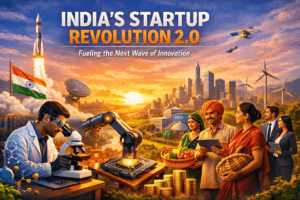
India’s Startup Revolution 2.0: Why a New Definition is Fueling the Next Wave of Innovation
India’s startup ecosystem, now a decade old and boasting over 200,000 recognized ventures, has just received its most significant policy reset . In a move that signals a strategic shift from quantity to quality and from rapid scaling to deep innovation, the Department for Promotion of Industry and Internal Trade (DPIIT) has fundamentally rewritten the rulebook for what constitutes a “startup” .
This overhaul isn’t just bureaucratic tweaking. By doubling the turnover limit, creating a special 20-year category for deep tech firms, and welcoming cooperative societies into the fold, the government is deliberately shaping the next decade of Indian entrepreneurship . It’s a recognition that the one-size-fits-all policy of 2016 is inadequate for the mature, diverse, and ambitious ecosystem of 2026.
The table below summarizes the key changes from the previous framework:
| Policy Parameter | Previous Framework (2019) | New Framework (2026) | Key Implication |
| General Turnover Limit | ₹100 Crore | ₹200 Crore | Retains benefits for larger, scaling startups. |
| General Age Limit | 10 years | 10 years (Unchanged) | Keeps core definition stable for most ventures. |
| Deep Tech Turnover Limit | N/A (No separate category) | ₹300 Crore | Acknowledges higher revenue potential of tech/IP commercialization. |
| Deep Tech Age Limit | N/A (No separate category) | 20 years | Accommodates long R&D and gestation periods. |
| Eligible Entities | Companies, LLPs, Partnership Firms | Now includes Cooperative Societies | Fosters grassroots, community-based innovation. |
Decoding the “Why”: A Response to a Maturing Ecosystem
The policy revision is a direct response to the evolution witnessed over Startup India’s first decade. The government explicitly noted that the ecosystem is shifting toward longer innovation cycles, higher capital intensity, and delayed commercialisation, particularly in sectors like deep technology, manufacturing, and R&D . Startups in these fields were consistently “aging out” of benefits or breaching turnover caps while still being in critical, capital-hungry development phases, prematurely losing access to vital support .
As Vishesh Rajaram of Speciale Invest points out, this change “signals that the government recognises deep-tech investments require patience,” which helps reduce regulatory risks for investors with long-term horizons . It aligns policy with the reality that building a semiconductor, biotech, or space-tech company is fundamentally different from scaling a software-as-a-service (SaaS) platform.
The Deep Tech Differentiation: A Twenty-Year Marathon
The creation of a dedicated “Deep Tech Startup” category is the cornerstone of this reform. For the first time, the government has provided a clear definition: entities developing solutions based on new scientific or engineering knowledge, with a high proportion of expenditure on R&D, and those owning or creating significant novel intellectual property .
The extended 20-year timeline and higher ₹300 crore turnover ceiling are game-changers. Anirudh A Damani of Artha Venture Fund stated this “unlocks a meaningful pool of domestic capital and removes a structural bottleneck that many high-quality companies were facing” . It allows patient capital to flow into sectors vital for national strategic interests and global competitiveness.
However, with expanded benefits come stricter safeguards. Deep-tech startups face explicit restrictions against investing in non-core assets like speculative real estate or unrelated financial instruments, ensuring government incentives fuel genuine innovation, not financial engineering .
Grassroots Innovation: The Cooperative Society Entry
Perhaps the most socially transformative aspect is the inclusion of cooperative societies. By making Multi-State and state-registered cooperatives eligible for startup recognition, the policy aims to democratise entrepreneurship and spur innovation at the grassroots level .
This move has the potential to revolutionize sectors like agriculture, dairy, handicrafts, and rural manufacturing. It enables farmer-producer organizations (FPOs) or artisan clusters to access the same tax benefits, funding schemes, and regulatory easing as tech startups in Bengaluru. This bridges the urban-rural innovation divide and leverages the cooperative model’s strength in community trust and collective action to solve local problems with scalable solutions.
The Bigger Picture: Integration with a Broader Support Framework
This definition change does not exist in a vacuum. It dovetails with the incentives outlined in the Union Budget 2026-27, creating a layered support system . The budget announced massive fund infusions—including a ₹10,000 crore expansion for the Fund of Funds, a ₹10,000 crore Biopharma SHAKTI fund, and a ₹10,000 crore SME Growth Fund .
The revised startup definition ensures that mature, high-potential deep-tech companies and innovative cooperatives can qualify for these new capital pools. Furthermore, the extension of the Section 80-IAC tax holiday eligibility window until 2030 provides a stable fiscal benefit for these long-gestation ventures .
Implications and the Road Ahead
The immediate impact is clear: thousands of growing companies that had lost their “startup” status will requalify for benefits, and hundreds of deep-tech ventures can now plan with a 20-year horizon of support . For investors, it provides regulatory clarity to back long-term science projects.
The success of this policy, however, will hinge on implementation. Streamlining the application process for the new deep-tech category and ensuring cooperative societies are aware of and can navigate the recognition process will be critical. The goal, as Commerce Minister Piyush Goyal stated, is to strengthen India’s position as a global hub for high-technology and knowledge-intensive entrepreneurship .
A decade ago, Startup India ignited an entrepreneurial explosion. Today, by redefining the startup itself, India is strategically fueling the second wave—one that is deeper, more resilient, and built to solve tomorrow’s grand challenges. This policy reset is less about celebrating past success and more about laying the foundation for the next decade of transformative, homegrown innovation.
You must be logged in to post a comment.