
India’s Skies Are Electrifying: The Complex Dance Between Air Pollution and Lightning
A groundbreaking study reveals that India’s severe air pollution is actively and complexly altering lightning patterns, capable of both intensifying and suppressing electrical storms depending on local conditions. The process hinges on aerosols, which act as cloud seeds; moderate pollution boosts lightning by creating more cloud droplets that rise to form ice and graupel, fueling storm electrification, but excessive pollution (beyond ~7,500 particles/cm³) chokes storm updrafts and shuts this process down.
This explains regional paradoxes, such as why highly polluted northern winters see few storms, while arid western regions, influenced by desert dust, have experienced a 141% increase in powerful positive lightning strikes. These shifts have dire consequences in a country where lightning causes 40% of natural disaster deaths, complicating forecasts and increasing risks, making the integration of aerosol data into early warning systems and pollution mitigation critical for future climate resilience.
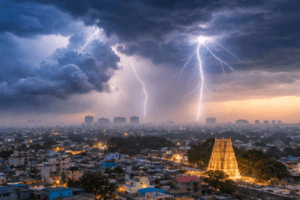
India’s Skies Are Electrifying: The Complex Dance Between Air Pollution and Lightning
The Unseen Catalyst in Our Atmosphere
Imagine a typical hot, humid day in India during the pre-monsoon season. The air feels thick and heavy, not just with moisture but with millions of microscopic particles from vehicle exhaust, industrial emissions, and agricultural burning. These aerosols, invisible to the naked eye, are doing more than just clouding the air and dimming the sun. Scientists have discovered they are actively rewriting the rules of one of nature’s most dramatic displays: the thunderstorm. Recent research reveals that India’s severe air pollution is not a passive backdrop but a dynamic player, capable of both intensifying and suppressing lightning in complex, localized ways.
This discovery fundamentally alters our understanding of weather hazards in a country where lightning already accounts for an estimated 40% of all natural disaster-related deaths. As climate change fuels more intense convective storms, the interplay with pollution creates a new layer of uncertainty for forecasting and disaster management. The implications stretch from protecting vulnerable farmers in rural fields to safeguarding India’s ambitious solar energy future.
The Science of Seeding Storms: How Aerosols Charge the Clouds
At the heart of this phenomenon is a complex series of interactions between aerosols—tiny solid or liquid particles suspended in the air—and the life cycle of a thundercloud. These particles act as cloud condensation nuclei (CCN), the essential “seeds” around which water vapor condenses to form cloud droplets.
The process follows a delicate, non-linear path, often described in three phases:
- The Boost Phase: Moderate increases in aerosol pollution provide abundant nuclei. This leads to a higher number of smaller cloud droplets. Because these droplets are tiny and light, they are carried higher into the atmosphere by storm updrafts instead of falling as warm rain. This suppression of early rainfall allows more water to be transported into the mixed-phase region of the cloud, where temperatures are below freezing.
- The Electrification Engine: In this frigid zone, the supercooled liquid water droplets collide with ice crystals and graupel (soft hail). Through a process known as non-inductive charging, these collisions separate electrical charge. Lighter ice crystals become positively charged and are carried to the top of the cloud, while heavier graupel gains a negative charge and sinks. This separation creates the massive electrical potential that culminates in a lightning strike.
- The Crash Phase: Research indicates there is a tipping point. When aerosol concentrations exceed a critical threshold—studies suggest around 7,500 particles per cubic centimeter—the effect reverses. Extremely high pollution can “choke” the atmosphere, absorbing sunlight and stabilizing the air layer. This weakens the buoyant updrafts that are the engine of the storm, ultimately shutting down the cloud’s electrification process.
This explains a key paradox: why northern India, with its catastrophic winter pollution, does not see corresponding winter lightning. The season’s shallow planetary boundary layer and stable atmospheric conditions simply suppress the deep convection necessary for thunderstorms to form.
A Natural Experiment: The COVID-19 Lockdown Proof
The unprecedented COVID-19 lockdowns in 2020 provided scientists with a real-world laboratory to test these theories. As industry halted and traffic disappeared, air quality saw dramatic improvements. Concentrations of key pollutants like sulfur dioxide (SO₂), nitrogen dioxide (NO₂), and particulate matter (PM₁₀) plummeted by 40% to 68% in some areas.
The atmospheric response was swift and measurable. A detailed study of Northeastern and Eastern India, comparing seven years of data, found that during the lockdown period, cloud-to-ground (CG) lightning flashes decreased by 67% and 51% at two observation sites. Furthermore, the intensity of thunderstorms weakened, with reductions in their duration, peak flash rates, and lightning currents. This “natural experiment” provided compelling evidence that reduced aerosol loading directly leads to less frequent and less powerful lightning activity.
Regional Patterns: From Humid Plains to Arid Dust
The impact of pollution on lightning is not uniform across India; it is profoundly shaped by local climate and geography. Studies contrasting different regions reveal this starkly:
- The Humid Northeast: Regions like West Bengal and Assam, with high background moisture, are natural lightning hotspots. Here, aerosols have a pronounced amplifying effect. The abundant moisture allows pollution particles to efficiently form cloud droplets, enhancing the “boost phase” and leading to more frequent and intense lightning activity.
- The Arid West: In contrast, arid regions like Gujarat and Rajasthan see a different interaction. The primary aerosol here is often desert dust, transported from the Thar Desert and the Arabian Peninsula. Research in Maharashtra has uncovered a startling trend linked to this dust: a 141% increase in positive cloud-to-ground (+CG) lightning over the past decade during the summer monsoon. Positive lightning, though less common, is typically more powerful and destructive. The mechanism is microphysical. Dust particles are efficient ice nuclei. During the monsoon, high humidity lowers cloud bases, allowing more dust to be ingested into storms. This enhances ice crystal formation in the lower cloud layers, potentially fostering an “inverted polarity” charge structure where the main positive charge sits lower in the cloud, favoring +CG strikes.
Regional Lightning and Pollution Dynamics in India
| Region | Primary Aerosol Type | Key Impact on Lightning | Notable Trend |
| Northeast (e.g., W. Bengal) | Urban/Anthropogenic (SO₂, NO₂, PM) | Amplifies frequency & intensity of total lightning | ~67% reduction during low-pollution lockdown |
| Indo-Gangetic Plain (Winter) | Extreme Urban/Agricultural Smog | Suppresses formation (lacks convective conditions) | High pollution does not equal more lightning |
| Arid West (e.g., Maharashtra) | Desert Dust (long-range transport) | Alters electrical structure, increases positive CG strikes | +CG lightning increased 141% (2014-2023) |
Beyond the Bolt: Cascading Consequences for a Nation
The shifting patterns of lightning carry severe and wide-ranging consequences for India.
- Human Toll and Vulnerable Communities: Lightning is a silent killer, claiming thousands of lives annually, with most victims being agricultural workers and rural populations exposed in open fields. Changing patterns and potentially more powerful positive strikes complicate traditional risk awareness.
- The Forecasting Challenge: Current weather prediction models often fail to account for these complex aerosol interactions, leading to inaccurate severe storm forecasts. Lightning is a highly localized phenomenon, difficult to predict even under normal circumstances. Incorporating real-time aerosol data into models is now a critical frontier for accurate impact-based early warnings.
- Broader Climatic and Economic Impacts: The aerosol-lightning story is one thread in a larger tapestry of atmospheric change. These same particles are also scattering and absorbing sunlight, reducing the solar energy reaching the ground by an estimated 13%. This “dimming” effect has direct costs, reducing the output of solar photovoltaic panels by 12-41% and potentially undermining India’s ambitious renewable energy goals.
Building Resilience: India’s Path Forward
Confronted by this dual challenge of climate change and pollution-altered weather, India is not standing still. The response is evolving into a multi-pronged strategy focused on resilience.
- Advancing Early Warning Systems: The India Meteorological Department (IMD) has developed sophisticated tools like the ‘Damini’ app for lightning alerts and a GIS-based Decision Support System to provide timely, location-specific warnings. The key is moving from general weather forecasts to impact-based warnings that tell people not just that a storm is coming, but what it will do and how to respond.
- Community-Led Mitigation: Recognizing that warnings alone are not enough, national and local initiatives are promoting the construction of lightning safe shelters in high-risk rural areas and installing lightning protection devices on vulnerable buildings. Grassroots awareness campaigns educate communities on the simple, life-saving mantra: “When thunder roars, go indoors“.
- The Imperative for Clean Air: Ultimately, while adapting to the changes is crucial, mitigating the root cause remains essential. Efforts to reduce anthropogenic air pollution—through cleaner energy, transportation, and industry—could have a dual benefit: improving public health and stabilizing a key driver of violent weather. The lockdown study showed it is possible; the challenge is to achieve it sustainably.
As science peels back the layers of the atmosphere, the connection between the air we pollute and the skies that frighten us becomes undeniable. India’s experience is a stark lesson for the world: in the Anthropocene, even the raw power of nature is no longer entirely natural. The path forward requires not only listening to the forecasts but also cleaning the air that helps write them.
You must be logged in to post a comment.